By now we all know that if Michael Moore makes a film called Capitalism: A Love Story, he's going to play the third wheel. The documentary filmmaker revealed his liberal leanings in his feature film debut, Roger & Me (1989), which stood up for the blue-collar workers abandoned by General Motors in Moore's hometown of Flint, Michigan. Since then Moore has established himself as a spokesman of the Left, fighting for gun control (Bowling for Columbine) and against the Bush administration (Fahrenheit 9/11), and, in his last film, attempting to expose the woes of the American healthcare system (Sicko).
In Capitalism, Moore circles back to Roger & Me's theme of corporate greed. Only this time he sets his sights on not just a company, but—in the context of the recent financial crisis—our entire economic system. It's an ambitious target and, as it turns out, rather elusive for Moore.
"If you wish to converse with me," said the French philosopher Voltaire, "define your terms." I imagine that Moore might feel some kinship with Voltaire—think of the satirical bent and progressive stance—but in Capitalism his standard for conversation is lower. The film's most frustrating aspect is Moore's sloppy use of terms—namely, "capitalism" and "democracy."
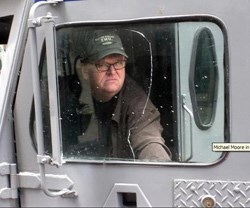
Michael Moore directs and stars in the film
He assumes we know what capitalism is. Indeed, heargues that our country's history is "a love story" with capitalism, as Americans have let themselves be force-fed an affection for its fundamental principles. To illustrate this, he shows clips fromcheesy 1950s education films that fawn overfree markets and private ownership. But Moore's definition of capitalism (narrated over images of abandoned homes and businesses across the country) is a little different: "a system of giving and taking … mostly taking."
So the ostensible purpose of Moore's film is to discredit capitalism. But many of his representative targets—Reagan's tax cuts, or the deregulation of our banks—are not so much capitalism as they are fiscally conservative ways of operating within the system. Moore spends a lot of time skewering last year's Bush-led bailout bill, claiming that it was a robbery of the American people facilitated by some of Wall Street's close connections with Washington D.C. But even if he's right, that isn't capitalism per se, but rather political corruption. So what is Moore actually after: capitalism, Republican policies, backdoor politics, or something else?
At points in the film, Moore actually does touch on some dangers at the core of capitalism. In one troubling example, he shows how a number of companies take out life insurance policies on their employees. Whether or not it makes economic sense for the employer, Moore highlights how morally perverse it feels for a company to profit from someone's death—especially when a widow is suddenly strapped for cash while the giant corporation lands a cool million. Even more, Moore points out how companies talk about this policy in internal memos. One report shows certain companies failing to achieve their "expected mortality rates" for the year, and another refers to the deceased employees as "Dead Peasants."
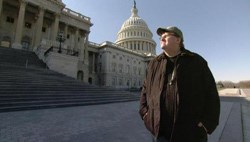
Moore figures out the difference between 'capitol' and 'capital'
Here Moore is getting at something: the way in which capitalism's profit motive can too easily slap a dollar sign on just about anything. Our ingenuity can be a frightening thing. But just when you think the film is as radical as it purports—going after the very heart of capitalism—Moore shows us something he likes: Capitalism.
Okay, it's admittedly an unconventional variety. Moore spotlights a couple of co-op firms in which every employee is part-owner, profits are equally or more equally shared, and the decision-making hierarchy is flattened. Everybody's happy. It's an intriguing model that looks very different from most American businesses. But aren't these still privately owned, profit-driven companies? That sounds like capitalism, but Moore tries to make a distinction by calling it "democracy" instead. Yes, he's using a metaphor, but it's not a helpful one. Moore's decision to be rhetorically cute rather than clear makes it hard to nail down exactly what he's proposing in lieu of our current system.
Another thing about Moore is that it's hard to trust him. He's drawn a lot of criticism for distorting the truth in previous films (here and here, for instance), and he blurs the facts in at least one part of Capitalism. As part of his effort to demonstrate unethical ties between Washington and Wall Street, Moore interviews a mortgage officer who handled VIP loans for Countrywide Financial. This officer alleges that Senator Chris Dodd, chairman of the Senate Banking Committee, got more than $1 million in loan discounts that he shouldn't have. That would be a big conflict of interest. But in the film, Moore doesn't mention that the Senate Ethics Committee investigated this very issue and dismissed it.
But there's no denying that Moore is an entertaining and often clever filmmaker. In one segment, he reminds us of the hero status given to "Sully," the pilot who saved 155 lives on the Hudson River in January, and Moore mixes in some appropriately patriotic music. But as we watch Sully testify before Congress about the problem of low salaries for pilots (a union issue), Moore turns up the volume on his brass band to drown Sully out. The effect is funny, and underscores well the irony in Congress's alleged disregard of Sully.
Article continues below
Not the first time 'get that camera outta my face' has been said during the making of a Moore doc
Moore also looks at how Christianity has fed our country's affection for capitalism. He finds more 1950s clips, this time of people correlating capitalism with "God's laws and the teaching of the Bible." Moore is reaching for the most extreme examples once again, but unfortunately this kind of Christian-political syncretism is not that rare even today, or necessarily any more subtle. Nonetheless, Moore finds a couple of priests from his hometown who condemn capitalism, so (thank goodness!) it appears that we Christians are also able to get with the program. (And as a matter of fact, Moore calls himself a Catholic.)
"Capitalism is an evil, and you can't regulate something that's evil," says Moore at the end. "You have to replace it with something that's good. And that thing is democracy."
It's really too much to expect a two-hour film to thoroughly dismantle a model of economics. And in fact, Moore raises some tough issues for our country, like how wide the gap between the rich and poor is, or how some companies will do crazy things for a profit. But it fails on too many counts. Moore's historical analysis is too selective; he doesn't acknowledge the evidence for other positions or counter their arguments; and, most fundamentally, he doesn't draw a clear distinction between our capitalist system and his vision of an economic "democracy." And all of it would be easier to forgive if Moore didn't seem so sure how of much he accomplishes in Capitalism.
Talk About It
Discussion starters
Can one economic system be more "Christian" than another?
How has your church talked about politics in the past? Are you comfortable with that?
In your opinion, why does or doesn't capitalism work?
How should Scripture's teachings on money shape our understanding of capitalism?
The Family Corner
For parents to consider
Capitalism: A Love Story is rated R for language. There's not a lot of bad language in the film, but it is choice enough to earn the rating.
Beyoncé’s right. Whether listening to Cowboy Carter or reading theology, diversity is a good thing.
Khristi Adams
Capitalism: A Love Story
1 of 3
Michael Moore directs and stars in the filmMoore figures out the difference between 'capitol' and 'capital'Not the first time 'get that camera outta my face' has been said during the making of a Moore doc














 While we pray for peace, we need moral clarity about this war.
 A Christian reconciliation group in Israel and Palestine warned that war would come. Now the war threatens their relevance.españolالعربيةFrançaisрусскийУкраїнська
 Beyoncé’s right. Whether listening to Cowboy Carter or reading theology, diversity is a good thing.