This biopic of Charles Darwin gives a nice portrait of his personal life, but doesn’t adequately explore the origin of his ideas—and pits science and religion against one another.
"You'd be the first naturalist to set foot on the islands, I'll wager," the ship's captain promises. The islands are the Galápagos, and the naturalist, played by Paul Bettany, encounters there a bewildering array of biological diversity leading him to a momentous conclusion: The species on these islands are changing.
"Did God make them change?" asks a curious sailor.
"Did God make them change?" Bettany repeats thoughtfully. "Yes, certainly. But do they also change themselves? Now that is a question, isn't it?"
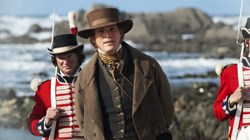
Bettany plays Charles Darwin in Creation, directed by Jon Amiel (Entrapment, Sommersby) and written by John Collee—but the dialogue above isn't from that film. It's from another Collee-scripted film with Bettany as a 19th-century naturalist dazzled by the diversity of the Galápagos: Peter Weir's Master and Commander: The Far Side of the World, with Bettany playing Stephen Maturin, physician of the H.M.S. Surprise in Patrick O'Brian's swashbuckling novels.
Paul Bettany as Charles Darwin
Despite these resonances, cinema does not repeat itself. Darwin's real-life journey to the far side of the world on the H.M.S. Beagle isn't depicted in Creation. Nor does the film ever consider the question that Master and Commander raises in those brief lines: whether divine causality and natural processes might be compatible and complementary rather than contradictory explanations.
Instead, every character in Creation falls into one of two neatly opposed camps: those who devoutly believe that God created the world and therefore reject evolution, and those who enthusiastically accept the evidence for evolution and therefore reject faith in God. The first camp includes Darwin's Unitarian wife Emma (Bettany's real-life wife Jennifer Connelly) and her pastor, Reverend John Innes (Jeremy Northam); the second, biologist Thomas Huxley (Toby Jones) and botanist Joseph Hooker (Benedict Cumberbatch). Only Darwin himself struggles with the tension between the two, and even he has no thought of a possible reconciliation.
Doting on the devout Emma, Darwin has no wish to undermine the faith of Christendom. "Suppose the whole world stopped believing that God had any sort of plan for us?" Darwin muses darkly in a remarkable speech. "That nothing mattered—not love, not trust, not faith, not honor—only brute survival."
Like Bill Condon's Kinsey, which allowed its protagonist to be disparaged as "churchy" and "square" to exonerate him from any charge of subverting science out of revolutionary intent, Creation distances Darwin from the aggressively atheistic Huxley's anti-religious passion. When Huxley cheers, "You've killed God, sir … And I say good riddance!" Darwin winces.
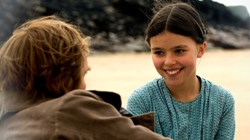
Darwin with his beloved daughter Annie (Martha West)
"We live in a society," Darwin counters, "bound together by the church—an improbable sort of barque, I grant you, but at least it floats … You would have us all rebuild, plank by plank, the very vessel in which we sail?"
Huxley, though, isn't buying it. "Our behavior, like our physical forms, evolves according to our needs. Your very own words, sir! And thus, in time, we lose those parts that are no longer required. Like the appendix, the male nipple, and finally, thank Christ, our belief in an utterly redundant Almighty!"
Huxley's views of the incompatibility of science and faith are stated with admirable clarity and forthrightness. Where is the other side of the debate? Where is the Darwin who declared it "absurd to doubt that a man might be an ardent theist and an evolutionist"? Where are the likes of Charles Kingsley and Asa Gray—representatives of, respectively, religion and science, who saw no quarrel between their two worlds, and both of whom Darwin cited in this connection? Where, indeed, is the Reverend Innes who vouched that his friend Darwin "follows his own course as a Naturalist and leaves Moses to take care of himself"?
It can't be argued that Creation is only interested in the science, not the religion. From the biblical resonance of the title to an early image of a fetal hand in utero assuming the pose of the divine hand in Michelangelo's Sistine Chapel Creation of Adam, the film seems less interested in Darwin's scientific discoveries per se than in pondering a world in which science has supplanted religion.
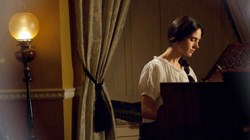
Jennifer Connelly as Emma Darwin
At the same time, the film suggests that it was not his discoveries about the interconnectedness of life on earth that cost Darwin his faith in God, but something far more personal and mundane: In 1851, God failed to save his beloved ten-year-old daughter Annie (Martha West) from tuberculosis. Like innumerable desperate fathers before and since, Darwin begs and bargains with the Almighty to save his dying daughter: pledging lifelong fidelity if God delivers, offering his own life in Annie's stead.
The film's interpretation of Darwin's life draws on the biography Annie's Box by the naturalist Randal Keynes, who is Darwin's great-great-grandson as well as the great-nephew of economist John Maynard Keynes, father of Keynesian economics. (Randal Keynes's son, Skandar Keynes, plays Edmund in the Narnia films.)
Article continues below
In the end, Creation is less a spectacle of discovery or a drama of ideas than a psychological portrait of a hero in crisis. Curiously, Darwin's inner struggles are externalized with a narrative device straight out of another Bettany biopic, A Beautiful Mind, which also created a chimeral drama of relationships exemplifying its brilliant protagonist's psychological meltdown—and which made the protagonist's marriage his saving grace.
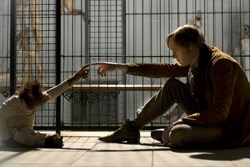
A scene with an orangutan is especially powerful
Unfortunately, neither of Darwin's central relationships—with Emma or Annie—is enough to bring the film to life emotionally. This is not the fault of the actresses; Connelly makes Emma more complex and human than the character has a right to be, and young West projects the needed intelligence and spirit as Annie. But Emma is short-changed by the screenplay, which keeps her and Darwin at arm's length emotionally until the last act, while Annie is sublimated into Darwin's character for much of the film.
The film does have some effective moments and intriguing images. Time-lapse photography of a dead bird decomposing and becoming food for maggots resonates intriguingly with Reverend Innes's citation of the gospel saying about the Father's eye on the sparrow that falls. The scenes of Darwin and Annie enduring grueling hydrotherapy treatments are like secular baptisms. A couple of scenes between Darwin and an orangutan are among the most potent in the film.
I appreciate, too, the complexity of Innes, who on the one hand subjects Annie to painful chastisement but on the other responds to an irate outburst from Darwin with grave respect and regret. Emma, too, is eventually deepened and humanized, though it's too little too late. In the end, the film comes down, in a sense, to what Emma thinks after reading her husband's great work, The Origin of Species. Of her verdict she can only say, "May God forgive us both." Is that anything like justice to either Mr. or Mrs. Darwin, or to their respective world views?
Talk About It
Discussion starters
The film depicts Darwin worrying about the social effects if people stopped believing in a divine plan or in the meaningfulness of moral categories. Can atheists be honorable, loving, trustworthy, kind-hearted people? If so, does that mean Darwin's concerns were mistaken? Why or why not?
Suppose there really were no divine plan and that words like "love" and "honor" merely describe how we feel about certain acts rather than anything "real" about those acts themselves. Why would it matter if we stopped believing in the "realness" of love and honor? Would it make sense to want people to believe in a divine plan and in moral categories if they were illusory? On the other hand, would it make sense to want people to disbelieve in God if God weren't real? If there is no God and no real moral categories, does it ultimately matter what people believe or what they do one way or the other?
Article continues below
There is a story that a lady of Darwin's day, learning of his theory, commented, "Let us hope that what Mr. Darwin says is not true; but, if it is true, let us hope that it will not become generally known." Is it ever better for the truth not to be known—for people to believe a convenient falsehood or disbelieve an inconvenient truth? Or is it better to know the truth even if it seems in some way damaging? Why or why not?
The Family Corner
For parents to consider
Creation is rated PG for intense thematic material including parents mourning the death of a child and skeptical debate about the existence of God and the afterlife.
Paul Bettany as Charles DarwinDarwin with his beloved daughter Annie (Martha West)Jennifer Connelly as Emma DarwinA scene with an orangutan is especially powerful













 While we pray for peace, we need moral clarity about this war.
 A Christian reconciliation group in Israel and Palestine warned that war would come. Now the war threatens their relevance.españolالعربيةFrançaisрусскийУкраїнська
 How groups like Hillsong learned to let go of the literal in favor of creative collaboration.españolPortuguês