Short of a heroic rescue by Superman, what will it take to fix America's broken education system? The question seems to motivate documentarian Davis Guggenheim in Waiting for Superman, which tackles one of our most complicated problems: public education. Though he has made films on more controversial subjects (the Oscar-winning An Inconvenient Truth addressed global warming), and on less (the guitar rock documentary It Might Get Loud), writer/director Guggenheim here tackles an indisputably important, bipartisan issue—one that we all have a stake in.
It might seem a tall order to make a succinct, engaging documentary on something like "the problems of education in America today," and indeed it is. But Waiting for Superman manages the task, in part because Guggenheim (who narrates the film) frames the issue in personal terms, by focusing on five individual students and their families. Anthony, Biana, Daisy, Emily and Francisco are the film's protagonists—American public school students ranging in age from kindergarten to eighth grade. What unites these five is that each is trying to win a spot in a public charter school, in hopes of receiving a high quality education instead of (in some cases) an abysmal, small-chance-of-success education at notoriously failing schools. For these students, the lottery that will determine whether they can go to charter school truly will decide their fate. It's the difference between being set on a track where college is expected and one where even a high school diploma is improbable.
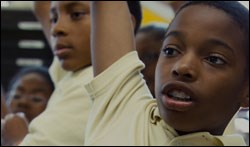
Anthony has a question
Whether or not the disparity and "opportunity gap" between charter and "regular" schools is actually this extreme is an open question, but Guggenheim convincingly, wrenchingly shows us that for these five families, the drama is very real. We root for these students, feel the pain in their parents' eyes, and understand that yes, we'd do the same thing. Every parent wants the best for their child—schools that will help them excel rather than let them down. The tragedy underscored in this film is that for most Americans who can't afford private education, it's all about the luck of the draw. You go to the school in the neighborhood in which you live. Or you go to a charter school—but only if you win the lottery (literally).
Though these five personal stories provide the film's main emotional arc, Waiting for Superman is also full of facts, graphs, history, and speculation about the factors that have led to this situation. Why have our students' test scores flatlined in recent decades, even as education spending continues to increase ($9,000 per student today, versus $4,300 in 1971)? What is truly behind the "achievement gap" between rich and poor students? Do bad neighborhoods cause bad schools, or is it the other way around?
As with any compelling movie, Waiting for Superman has both heroes and villains. Among its heroes is Geoffrey Canada, innovative education reformer who created charter schools in one of Harlem's most disadvantaged neighborhoods and has overseen a dramatic increase in high school graduation rates. Then there is Michelle Rhee, a tough-as-nails outsider who became Chancellor of Washington D. C.'s embattled public school system in 1997 and radically changed the system by firing bad teachers and compensating good ones with much higher salaries.
Rhee, and the film at large, is pit against the chief villain: Teachers' unions. Represented in the film by staunch labor leader Randi Weingarten (current head of the American Federation of Teachers), the unions are portrayed as a "menace" and obstacle No. 1 in the way of positive education reform. It's easy to see them as such. The film points out that because of the teacher unions (which, Guggenheim makes clear, have been among the Democratic party's most important coalitions of support), bad teachers are almost impossible to fire and good teachers are almost impossible to reward with financial incentives. But good teachers are what make education work. If principals and superintendents are unable to incentivize good teaching and purge bad teaching, how can the system be changed? Guggenheim, Canada, and Rhee remind us that education should not, in the end, be about protecting the interests of adults. It's about doing what's best for our children.
Francisco and his mom
In many ways, Waiting for Superman is a film about injustice. Is it fair that one child gets in to a charter school and has a great education, and his neighbor doesn't? Is it fair that one's neighborhood, economic welfare, and family situation so often determine the quality of education we receive? No, it isn't fair. But it's a wrong we can work to right, suggests Guggenheim, and it starts by putting the interests of kids (not just our kids, but other peoples' kids too) ahead of our own.
At one point in the film, Rhee makes a comment about how teachers often feel like they are entitled to their job, when they should actually feel like they are privileged to occupy such an esteemed role in shaping young minds. But the same could be said for students. Is education a right? Something we are all entitled to? Or should we look at it more as a privilege? When we see something as a privilege, we usually value it more. And when we value something, we usually work harder at it. Perhaps we shouldn't "wait for Superman" as much as we should seize upon whatever education we do have and make the most of it, cherishing it for the wonderful gift that it is.
Article continues below
Geoffrey Canada interacts with students
Waiting for Superman isn't a perfect film. At times, feels a bit too wide-reaching and broad, and it's confusingly structured in places. I also think the case could have been strengthened had Weingarten and the union voices been given more direct opportunities to answer tough questions. In addition, the film occasionally feels a tad too agenda-driven and simplistic in its suggested solutions (more charter schools!). For such a grand, difficult, chronically problematic issue such as this, can there be any easy answers?
Having said that, Waiting for Superman is indeed an "important" film (and I don't use that word lightly). It's important because this is an issue that has for too long been relegated to partisan political lip service and mired in the stalemate of government bureaucracy and personal ignorance. It's important because people need to know about what's going on in our schools and what's holding them back. Waiting for Superman is a thoughtfully crafted first volley in a debate/discussion we simply cannot avoid.
Talk About It
Discussion starters
How can Christians positively effect change in the education system? How can churches help with reform? (For some ideas, click here.)
How important is the role of a family and a broader community in the education of children? Is it really all about teachers in schools?
What are some actions steps you can take to help further the cause of education reform in America?
The Family Corner
For parents to consider
Waiting for Superman is rated PG for a few brief instances of language, but aside from that it is an appropriate film for audiences of all ages. It deals with complicated ideas and might confuse younger viewers, but it could also provide a helpful platform for families to discuss the importance and privilege of education.
















 While we pray for peace, we need moral clarity about this war.
 A Christian reconciliation group in Israel and Palestine warned that war would come. Now the war threatens their relevance.españolالعربيةFrançaisрусскийУкраїнська
 Do activists often invest their work with religious significance? All the more reason for Christians to be discerning co-laborers.