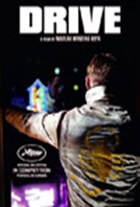
The opening scene of Drive is, appropriately, a car chase. But it's clear early on that this is not a car chase film in the Fast and the Furious style. With nary a word spoken in its first ten minutes, save a police radio commentary and a sportscast of a Clippers basketball game, Drive sets itself apart as an art film from the get go: quietly intense, curious, ironic, oddly paced, retro (pulsating '80s techno soundtrack and pink font opening titles straight out of 1987), and very self consciously cinematic.
As it unfolds, the structure of Drive mimics the stop-and-go, twist-and-turn nature of driving in Los Angeles. Trance-like, almost meditative stretches are regularly interrupted by brief, jarring explosions of intense violence. Frequent gear-shifts in tone—between wide-eyed earnestness and campy ridiculousness—match the temperament of the alternately sweet and psychotic protagonist (Ryan Gosling). But does this journey ever get anywhere, or is it just a joyride through the landscapes of pulpy, freeform cinematic indulgence?
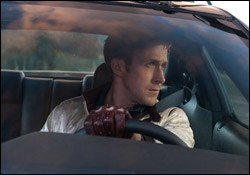
Ryan Gosling as Driver
The plot of Drive—directed by Danish up-and-comer Nicolas Winding Refn—is standard fare for a L.A. noir film. Based on the 2005 novel of the same name by James Sallis, Drive tells the story of a brooding, morally complex man-of-few-words (Gosling, aka "Driver") who falls in love with the wrong girl (Carey Mulligan) and becomes something of a father figure to her little boy (Kaden Leos). Turns out the girl has a shady husband (Oscar Isaac) who comes home from prison and instantly gets in trouble with mobsters, enlisting Driver to help with a heist. (Driver works as a stunt car driver for the movies by day and a getaway driver for criminals by night.) Predictably, the heist goes terribly wrong, launching a bloody sequence of events for the remainder of the film, as Driver is thrust into a kill-or-be-killed death match with mobsters, set against the backdrop of seedy nightclubs, a pizza place, rundown apartment complexes, and the eerie, surrealist glow of afterhours L.A.
That's more or less the plot. But Drive is not primarily about the plot; it's about archetypes, genre, and style. It's about Gosling riffing on iconic antiheroes like Steve McQueen or Clint Eastwood, with dashes of vigilante superheroes; it's about graphic novel-influenced shot-framing and Los Angeles mood lighting informed by the cinema of Michael Mann (Heat, Collateral) and David Lynch (Mulholland Drive); it's about '70s exploitation films and road movies, '80s "neon noir" films with touches of John Hughes; it's about the '90s hyperviolent pastiche genre introduced by Quentin Tarantino and his groundbreaking "lowbrow camp as high art" masterpiece Pulp Fiction. In other words, Drive is very much about the movies, and its choreographed car chases and slow-mo shots of heads exploding do not let you forget it.
Let's talk about that violence. Do not be deceived by the soft pink fonts you see on the Drive posters. This is a brutal film. Some will maintain that the over-the-top violence—throats slashed, heads exploded by gun shots, heads bashed in by boots, various other body parts impaled by household objects—is appropriate to the stylized, self-consciously artificial nature of the film. It's a film about the violent tradition of gangster films and hardboiled noir, after all. Yes, we get it. But one wonders why Refn—who displays such class and technical prowess elsewhere in the film—resorts to not only incorporating outrageous violence, but to focusing the camera on it longer and more relentlessly close than anyone needs to see. Perhaps he's trying to make a statement about Hollywood's glorification of gore or America's obsession with violence. If so, ho-hum. Tarantino, Scorsese, Haneke and others have made that statement enough times already.
It would be one thing if the characters in the film were developed in such a way that the intense rage and outbursts of violence seemed warranted. But they aren't. The mobster villains, though quite amusingly acted (especially Albert Brooks as the mob boss), are run-of-the-mill lowlifes. Gosling's Driver is stoic and mostly emotionless, driven (seemingly) by affection for an innocent girl and her son, but apparently nothing more. We never know his backstory, where his rage comes from, or why he's so tainted with bloodlust and brokenness. Meanwhile, Mulligan is cute but bland as the love interese, rather unconvincing as the damsel in distress so many people are getting killed over. Even so, the Driver's willingness to sacrifice himself to protect the woman and child he so admires is honorable. Beneath the façade of blood, guts, and synth is a somewhat redeeming message about trying to right past wrongs and escape the cycle of crime and violence. Not to mention the classic noir message: "crime doesn't pay."
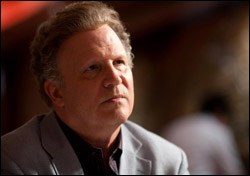
Albert Brooks as Bernie Rose
But what's best about Drive is surely its artistic merit and technical achievement. This is one of the most stylish, singular, fascinating films of the year. Refn's vision—however scattered and flawed—is at least creative and pretty to look at (except for the heads being crushed). The '80s-inspired soundtrack (featuring electronic artists Kavinksy, Desire, and the Chromatics) and the score by Cliff Martinez give the film much of its hazy, slightly sinister Miami Vice-meets-David Lynch vibe. The layered sound editing, expressionistic lighting, coloring (vivid and slightly blurred hues, nighttime neon), and memorable cinematography by Newton Thomas Sigel (The Usual Suspects, Superman Returns) all contribute to a look and feel that can certainly be called "cool" and more often than not, "beautiful."
Article continues below
Oscar Isaac as Standard
Against this backdrop, Gosling delivers a suitably oblique, understated performance in which he dons a soon-to-be-iconic satin bomber jacket with a scorpion on the back. Gosling's Driver is the sort of morally ambiguous, lost-in-the-world lone wolf character for whom the cinema—especially film noir and westerns—was made. Speeding through the urban jungle, eyes glossy with an unknown pain, the Driver embodies the themes and threads of postwar American noir storytelling: moral ambiguity, existential dread, the insecurities of maleness and fatherhood, anxieties about the messiness of the modern world. Armed with his cars, his stuntman masks, his bomber jacket, and a hammer, Gosling manages to channel a lot of authentic neurosis into his character with very little animation. It's all the more impressive given the uneven, sometimes absurd meanderings of the film at large.
Drive isn't a perfect film, and certainly not for the squeamish or for Gosling fans expecting The Notebook. But it is an artful, impressively made film—and one sure to excite cinephiles, everyday adrenaline junkies, and fans of stylized car chases set to an indie synthpop soundtrack.
Talk About It
Discussion starters
What can we learn about bravery, honor, and chivalry from The Driver, if anything?
Does the Driver do the right thing in helping Standard with the heist? What else might he have done in that situation?
What does Drive have to say about the cyclical nature and domino effect tendencies of immoral behavior?
The Family Corner
For parents to consider
Drive is rated R for strong brutal bloody violence, language and some nudity. It contains extremely graphic violence, including close-ups of a woman's head being blown up by a shotgun, a man's head being savagely stomped upon repeatedly until completely mashed, and people getting stabbed in the neck and face. It's not for the faint of heart, unless you look away during those scenes. In addition to the violence there is quite a bit of language and one scene in a strip club where several women are topless. It's a movie parents should not recommend to their children and one they should themselves approach with caution.














 While we pray for peace, we need moral clarity about this war.
 A Christian reconciliation group in Israel and Palestine warned that war would come. Now the war threatens their relevance.españolالعربيةFrançaisрусскийУкраїнська
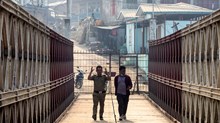 The government plans to close its porous border with Myanmar to boost security, separating ethnic groups that straddle the boundary.