For 20 years, We haven't heard any new music from Steve Taylor in a decade, but the guy has been plenty busy—running a studio, writing, producing, and now working on a feature film.
In 1983, the fledgling Contemporary Christian Music scene was dominated largely by inspirational pop and behind-the-times rock bands. Amy Grant was still a rising star and virtually no one had heard of Michael W. Smith. Suddenly, a young twenty-something emerged with his debut EP, I Want to Be a Clone, armed with a relevant new wave rock sound and lyrical wit that challenged Christians to consider their faith and actions.
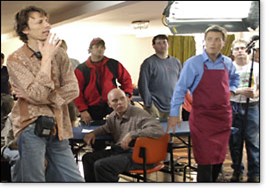
Steve Taylor (left) gives direction to actors in the new movie,The Second Chance
That artist was Steve Taylor, who went on to become one of the most important Christian artists in the next two decades—half that time in a solo career, including an all-too-brief stint with the mainstream band Chagall Guevara. Since then, Taylor has made an impact as a producer, record label executive, and music video director. But it's been ten years since his last album, and his Squint record label—once home for Sixpence None the Richer, Burlap to Cashmere, and Chevelle—folded. We wanted to know what he's been up to, so we caught up with Taylor in Nashville, where we looked back on his contributions to Christian music and ahead to his first feature film, starring another Christian music legend.
What Christian music trends have impressed you most in the last 20 years?
Steve Taylor I read an article about a year ago that interviewed some A&R people at major [secular] labels. They were talking about how they were seeking out Christian rock bands to sign because they tended to be the better bands. Apparently it's due to the circuit we've developed through churches, coffeehouses, and things like that, where rock bands have grown up in a performance environment and are better for it.
The idea that major labels are specifically seeking out Christian bands because of superior talent is really a mindbender, though it kind of makes sense because it is such a fertile ground for breeding talent. With under-funded public education and artist programs, I suppose it's one of the few common outlets for people to gain consistent musical experience. So it really impresses me that Christian music continues to expand, and that there's less of a stigma attached to it.
What do you consider your best work in your years as a solo artist?
Taylor I feel like I was a pretty slow learner. As I've dabbled in different aspects of the entertainment business, hopefully I didn't jump into something where I was completely incompetent, but I never felt that I jumped into something thinking I'd ever make a masterpiece either.
It's hard for me to listen to I Want to Be a Clone and Meltdown—there are songs in there that I think are fun and good, but others where I wonder today what I was thinking. I think the albums got better with time. Probably the Chagall Guevara album and Squint are the two pinnacles for me that I can still listen to today without squirming.
Most remember your solo work for your honest, witty, and satirical writing. How naturally did that come to you?
Taylor (Smiling) Yeah, the satire probably came a little too naturally for me. I think there was an aspect of that which probably garnered attention because it was Christian music—when you're working in a small enough pool, it's easier to make a big splash.
That's part of the reason for starting Chagall Guevara or taking a chance signing a band like Sixpence None the Richer [at Squint]. You just want to find out if what you're doing is competitive on a broader level. That's part of the reason I got into production—to learn more and more about making records through experience.
So you grew as a producer at the same time. When did you start favoring your production career?
Taylor I probably learned most about production when I worked with the rest of the band and [producer Matt Wallace] on the Chagall Guevara record. And eventually, I found it difficult as both a Christian and an artist to continually do stuff that's centered on your persona. It becomes hard to reconcile it with your ego. I knew a teacher who encouraged his students to find a childlike vulnerability within them, and he said, "Don't think you don't have it, because if you were a totally well-rounded mature individual, you wouldn't need to get up on stage in the first place." That's very true.
As you go on, it becomes hard to balance all that self-promotion with being a follower of Jesus. I appreciate those who are able to do it well, but it's just something that can wear you down.
Is that one of the reasons you've drifted away from a solo career?
Taylor Well, it's probably part of it. Certainly producing and looking out for a band's best interests are good too. They take you out of your own headspace as you work for the good of another. Even starting a record label was primarily to see a Sixpence album released by someone who cared. As [Squint Entertainment] quickly grew and flourished over those years, it was more and more about investing my life in the lives of other artists and my staff.
Part of it was just out of boredom too. If you keep following the same routine of writing, recording, and touring over and over, it gets tedious.
Article continues below
Your fans are wondering: Will you ever make music again?
Taylor I don't know! The other guys in Chagall Guevara came across these old live tapes of a concert we did in town. We transferred them to preserve them, and my friend [engineer Russ Long] did a mix. It sounded really good, reminding all of us of enjoyable times.
But on the other hand, when I decided to pursue filmmaking, it's really not a good career for dilettantes. I still enjoy making music, and plan on making music in the future sometime. But I'm also mindful of the people that have invested in this movie and hopefully other ones—I don't want them to think this is just a little hobby I've got.
So someday, when the time is right …
You're also still active with newsboys—producing and writing—even now when they've steered away from the witty songs in favor of a worshipful focus. I was surprised you were so involved in that.
Taylor Well, a chunk of it. That was an easy shift for newsboys, but difficult for me. Adoration ... I haven't talked about this much, but I actually tried to bail out of it. I really enjoy Peter Furler a lot and working with him, but we'd been working on it for a long time, and things were going really slow. We barely had ten songs—mostly live cuts from the Thrive album.
I grew up singing hymns at my church—more traditional instead of the modern worship thing. I just didn't understand it, to my discredit. And my home churches have done more of that stuff over the years, but it always felt like warmed over Kenny Loggins or James Taylor to me. Again, to my discredit, it just seemed like really boring music that I wouldn't mind missing out on. It was as much a spiritual malaise as anything.
So what kept you on the newsboys project then?
Taylor It was partly out of regard for Peter that I felt we needed to finish it. I had a lot of other stuff going on, and I was exhausted from that. But we stayed on it, did three more songs and some covers. The one I really enjoyed was "In Christ Alone," because it feels like more of an old school hymn.
Was Devotion a better experience since it had more originality to it—less covers and more new songs?
Taylor Yeah, I think it's a better record. For that album, I was more concerned about the obvious U2 influence, though as Peter rightfully pointed out, that's like being influenced by The Beatles these days.
The real challenge was writing real worship lyrics, and I think I have a better handle on it now—understanding what needs to go into it without sounding too clichéd. It's just very hard for me to write lyrics for something where craft sort of takes a backseat. You can't write worship lyrics based on craft. It's a much more mystical process, and there are songs on both Adoration and Devotion that I think touch on something beyond what either Peter or myself are able to write.
Article continues below
Moving on to your record label, Squint Entertainment, do you have any regrets? Anything you would you have done differently?
Taylor (Jokingly) I'd have probably quit earlier.
No, I'm not sorry I did it. It was a good thing to do at the time. I've gone into great detail at a Cornerstone press conference. The first four years were great, and done with an agreement and a handshake through Roland Lundy, the head of Word Records at the time. It was as good as it could have been, but it never occurred to me that he wouldn't always be there. When he was forced out [when Gaylord Entertainment bought Word in 2000], things changed immediately, and as I've said before, "The Pharaoh who knew not Joseph" came in. So the last year was not enjoyable.
Probably my biggest regret is that L.A. Symphony got messed over in the nonsense that ensued. Ironic, because the reason I wanted to release their album was put out a great hip-hop album that didn't get caught in corporate machinery, but sadly that's exactly what happened.
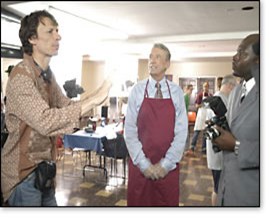
Taylor (left) on the set with Michael W. Smith (in the maroon apron)
Now you're focused on making movies. What's your current project?
TaylorThe Second Chance. It's probably best described as a "black and white buddy movie"—a white and a black get together and don't like each other, but by the end of the movie they do. It's centered on two churches in the Nashville area—one predominantly white in the suburbs, the other predominantly black in the inner city. The associate pastor from the big suburban church, played by Michael W. Smith, gets "sent down" to the inner city church to rediscover what it's all about, and hijinks ensue.
How did you choose Smith for the role?
Taylor It was one of the film's writers, my longtime friend Ben Pearson, who thought Smith should try for the lead. We got with him early on, and gave him what amounted to a screen test to see if he could act. When we decided he could pull it off, it's fair to say we wrote the part with him in mind to play it.
And the other lead is played by?
Taylor Jeff Obafemi Carr, who's a pretty well known actor in town. We were originally hoping for a B+ actor like Don Cheadle or Jeffrey Wright, but both of them were booked. Jeff auditioned and read through a table reading of the script cold, and I'm not exaggerating, every line was exactly how I heard it when we were writing it. I talked to him afterwards, and honestly told him that I'd like to use him as a backup if we couldn't get a better-known star for the film. He was very gracious, and as it turned out, he seemed the best actor for the job.
Article continues below
You're planning to release this in theaters to the mainstream?
Taylor Right. One of the reasons we've avoided the tag "Christian film" is because it's the kiss of death—it's not an apocalyptic thriller or a conversion story. It's a redemption story, set in the world of these two churches, and we wanted to tell an authentic story deep in those settings.
You ever see Alec Baldwin play Jimmy Swaggart in Great Balls of Fire? It was so awful—a total caricature and an embarrassment. I'm sure he would agree, because he's an awesome actor. It was a great example of why Hollywood doesn't seem to understand the Christian culture. Then Robert Duvall came around, saying for years that nobody ever gets it right, that he was going to do it right. He made The Apostle, and he nailed the Southern Pentecostal scene, using local people and a small budget to do a great job. I wouldn't want to be directly compared with that movie, but that was the gold standard. Our aspirations were to try and approach that kind of realism and authenticity.
The Second Chance is currently slated for theatrical release on September 9. Click here to read a story about the making of the film at ChristianityTodayMovies.com












 While we pray for peace, we need moral clarity about this war.
 A Christian reconciliation group in Israel and Palestine warned that war would come. Now the war threatens their relevance.españolالعربيةFrançaisрусскийУкраїнська
 Beyoncé’s right. Whether listening to Cowboy Carter or reading theology, diversity is a good thing.