Henry Poole Is Here is a film that Christian moviegoers will yearn to embrace, if only from sheer gratitude; here, at last, is a depiction of Christian faith that portrays it as something other than the domain of cranks and loonies. And it's not just theological theory that wins the film's blessing, but something more substantive, verging on shocking: it proposes that miracles can happen—and supplies an audacious one for our consideration.
That daring premise is set in a simple story. Henry Poole, a thoroughly dejected young man, has bought an empty house in a California suburb, and it's still mostly empty after he moves in, apart from the accumulating vodka bottles. On one side, he has a cheery neighbor, Esperanza, who keeps interfering with his goal of continual glumness. On the other, there's a mysterious, elfin 6-year-old girl, Millie, who doesn't speak but does tote a tape recorder, and her mom, Dawn, who bakes cookies and owns a variety of V-necked outfits.
Luke Wilson as Henry Poole
So there are a number of neighborly distractions for Henry, some more appealing than others, but the most disruptive thing is happening in his own back yard. The slapdash stucco job done before Henry moved in has a discolored patch that shows through the paint. But maybe it's not just a random stain; maybe it's a face—the face of Christ. (We viewers never see the thing clearly enough to judge for ourselves.)
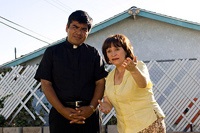
Esperanza certainly thinks so, and brings in her priest to look it over, who gives it cautious approval. If you've only seen George Lopez in comic roles, you'll be pleasantly surprised at his portrayal of Father Salazar; the pastor is intelligent, sincere, and hasn't a shred of burlesque (we should thank the filmmakers for that, too). Esperanza then begins encouraging her friends to come and pray in front of the stain (or image, as it may be). As apparent miracles begin to occur, Henry faces an increasingly pointed challenge: he must either surrender and believe, or allow his pent-up rage to put an end to the "miracles" once and for all.
George Lopez as Father Salazar, Adriana Barraza as Esperanza
Christians are so used to being portrayed as creeps and buffoons in entertainment that they may spend much of the movie braced for the slapdown. But there isn't one; the miracle, and the faith that wells up surrounding it, are treated with respect. It is the gloomy atheist at the center of the story who will have to learn a lesson. Henry can insist, "There are no miracles!", but it turns out that he's wrong, and there will come a time for him to express repentance.
I expect that for many Christian moviegoers, this is more than enough to sell them on the film. But I don't think the movie is as good as it could have been. As I watched these characters go through their predictable motions, I kept thinking that this must be the outtakes, and somewhere there was an alternative movie where they were doing and saying things that are interesting. Surely they don't spend all their time trading wistful comments ("Things happen for a reason," "I got a pretty long journey ahead," "It's the last time I remember being happy"), walking at sunset, brooding in darkness, jolting through too many montages, doing all manner of things in slow motion—and all of it set to a mix-tape of emo favorites.
Radha Mitchell as Dawn
I wonder if this is one of those cases where the biggest truths are simple truths, and they impact most those who are ready to receive them. Director Mark Pellington has endured a blinding tragedy: the sudden loss of his wife, leaving him to care for their toddler daughter. When you've been in a "black hole" (as he terms that period of his life), things get whittled down to the essentials. Clarity becomes an urgent need. A simple saying, like "Things happen for a reason," is packed with repercussions. A movie that seems a bit vacant or hypothetical to a reviewer may express the director's most profound beliefs, and express them most accurately precisely because they are simply put.
As Pellington writes in the film's production notes, "I believe in these characters and this story and its themes. The things I want to say to the world are in this film." I feel bad that I was not able to take from the film everything he meant it to convey. For every resistor like me, though, there will be dozens of moviegoers who embrace it with gratitude, and who look with increasing hope for future movies on related themes. Those are plenty of good reasons to wish Henry Poole all the success it can gain.
Talk About It
Discussion starters
The film is shot in such a way that the audience can't get a clear view of the supposed image, and can't decide for themselves whether or not it's real. Do you think this was a wise choice on the part of the director? How might the film have felt different, if we were shown an undeniable face of Christ on the wall?
What about the element of blood appearing to come through the wall? Was this distracting or disturbing to you, or did it enhance your appreciation of the film's daring approach to miracles?
Is there an Esperanza at your church, or in your neighborhood? Is she (or he) sometimes difficult to deal with? What would you tell her in a situation such as in the film, when she has broken a promise not to bring people into Henry's yard, but defends her action by saying, "God is bigger than a promise"?
Article continues below
Do you think the people in the film experienced real miracles? Who did? Who didn't? Did Henry experience a miracle? Discuss.
What's the significance to the names of the characters around Henry? (Patience at the grocery store, Esperanza—Spanish for "hope"—and Dawn as neighbors.)
The Family Corner
For parents to consider
Henry Poole Is Here is rated PG for thematic elements and some language. There are some mild obscenities, and Henry drinks a great deal. Apart from that the film contains little that would be inappropriate for children, though they might find it uninteresting or hard to follow.
















 While we pray for peace, we need moral clarity about this war.
 A Christian reconciliation group in Israel and Palestine warned that war would come. Now the war threatens their relevance.españolالعربيةFrançaisрусскийУкраїнська
 How groups like Hillsong learned to let go of the literal in favor of creative collaboration.españolPortuguês