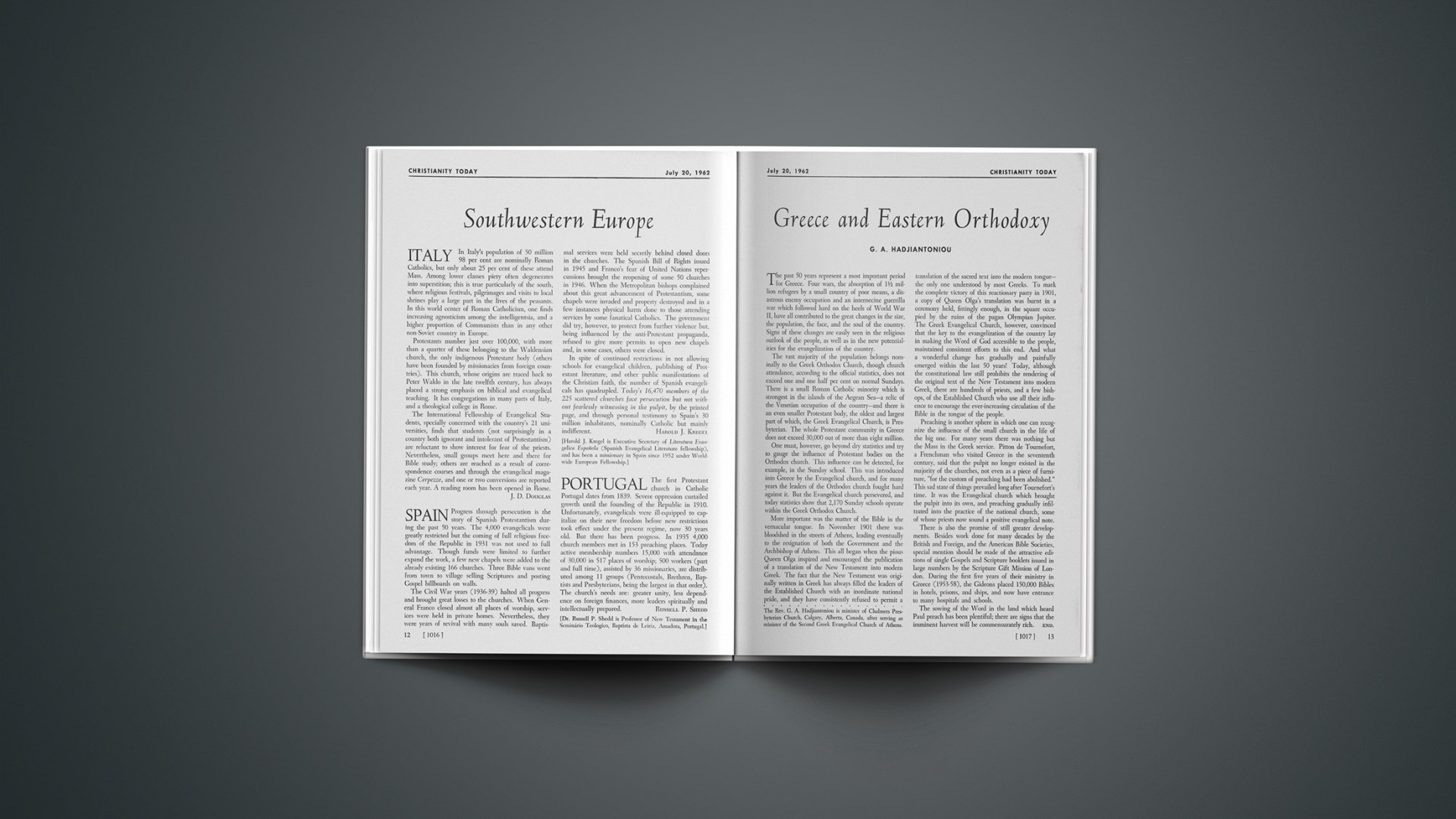

The past 50 years represent a most important period for Greece. Four wars, the absorption of 1½ million refugees by a small country of poor means, a disastrous enemy occupation and an internecine guerrilla war which followed hard on the heels of World War II, have all contributed to the great changes in the size, the population, the face, and the soul of the country. Signs of these changes are easily seen in the religious outlook of the people, as well as in the new potentialities for the evangelization of the country.
The vast majority of the population belongs nominally to the Greek Orthodox Church, though church attendance, according to the official statistics, does not exceed one and one half per cent on normal Sundays. There is a small Roman Catholic minority which is strongest in the islands of the Aegean Sea—a relic of the Venetian occupation of the country—and there is an even smaller Protestant body, the oldest and largest part of which, the Greek Evangelical Church, is Presbyterian. The whole Protestant community in Greece does not exceed 30,000 out of more than eight million.
One must, however, go beyond dry statistics and try to gauge the influence of Protestant bodies on the Orthodox church. This influence can be detected, for example, in the Sunday school. This was introduced into Greece by the Evangelical church, and for many years the leaders of the Orthodox church fought hard against it. But the Evangelical church persevered, and today statistics show that 2,170 Sunday schools operate within the Greek Orthodox Church.
More important was the matter of the Bible in the vernacular tongue. In November 1901 there was bloodshed in the streets of Athens, leading eventually to the resignation of both the Government and the Archbishop of Athens. This all began when the pious Queen Olga inspired and encouraged the publication of a translation of the New Testament into modern Greek. The fact that the New Testament was originally written in Greek has always filled the leaders of the Established Church with an inordinate national pride, and they have consistently refused to permit a translation of the sacred text into the modern tongue—the only one understood by most Greeks. To mark the complete victory of this reactionary party in 1901, a copy of Queen Olga’s translation was burnt in a ceremony held, fittingly enough, in the square occupied by the ruins of the pagan Olympian Jupiter. The Greek Evangelical Church, however, convinced that the key to the evangelization of the country lay in making the Word of God accessible to the people, maintained consistent efforts to this end. And what a wonderful change has gradually and painfully emerged within the last 50 years! Today, although the constitutional law still prohibits the rendering of the original text of the New Testament into modern Greek, there are hundreds of priests, and a few bishops, of the Established Church who use all their influence to encourage the ever-increasing circulation of the Bible in the tongue of the people.
Preaching is another sphere in which one can recognize the influence of the small church in the life of the big one. For many years there was nothing but the Mass in the Greek service. Pitton de Tournefort, a Frenchman who visited Greece in the sevententh century, said that the pulpit no longer existed in the majority of the churches, not even as a piece of furniture, “for the custom of preaching had been abolished.” This sad state of things prevailed long after Tournefort’s time. It was the Evangelical church which brought the pulpit into its own, and preaching gradually infiltrated into the practice of the national church, some of whose priests now sound a positive evangelical note.
There is also the promise of still greater developments. Besides work done for many decades by the British and Foreign, and the American Bible Societies, special mention should be made of the attractive editions of single Gospels and Scripture booklets issued in large numbers by the Scripture Gift Mission of London. During the first five years of their ministry in Greece (1953–58), the Gideons placed 150,000 Bibles in hotels, prisons, and ships, and now have entrance to many hospitals and schools.
The sowing of the Word in the land which heard Paul preach has been plentiful; there are signs that the imminent harvest will be commensurately rich.