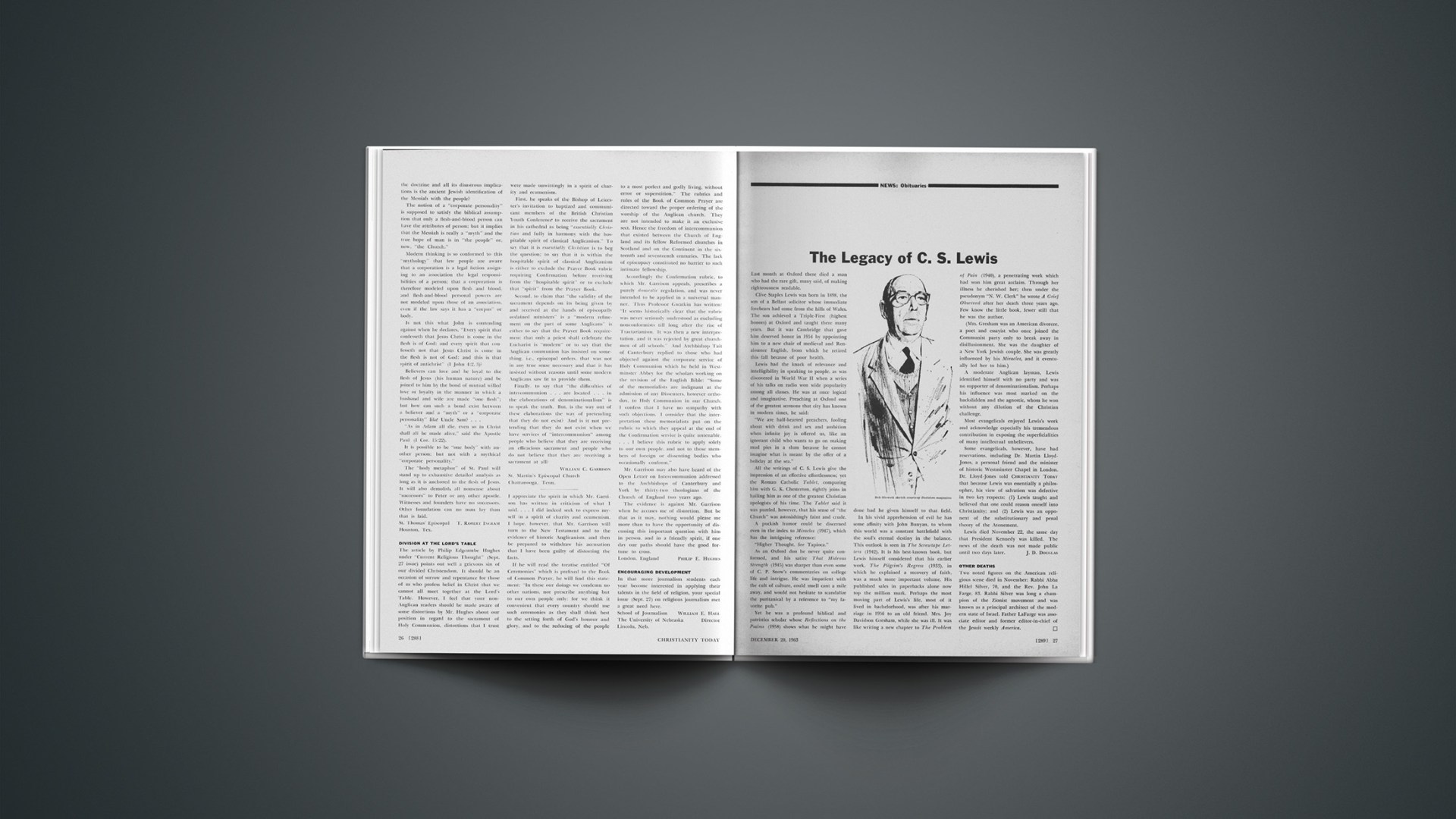

Last month at Oxford there died a man who had the rare gift, many said, of making righteousness readable.
Clive Staples Lewis was born in 1898, the son of a Belfast solicitor whose immediate forebears had come from the hills of Wales. The son achieved a Triple-First (highest honors) at Oxford and taught there many years. But it was Cambridge that gave him deserved honor in 1954 by appointing him to a new chair of medieval and Renaissance English, from which he retired this fall because of poor health.
Lewis had the knack of relevance and intelligibility in speaking to people, as was discovered in World War II when a series of his talks on radio won wide popularity among all classes. He was at once logical and imaginative. Preaching at Oxford one of the greatest sermons that city has known in modern times, he said:
“We are half-hearted preachers, fooling about with drink and sex and ambition when infinite joy is offered us, like an ignorant child who wants to go on making mud pies in a slum because he cannot imagine what is meant by the offer of a holiday at the sea.”
All the writings of C. S. Lewis give the impression of an effective effortlessness; yet the Roman Catholic Tablet, comparing him with G. K. Chesterton, rightly joins in hailing him as one of the greatest Christian apologists of his time. The Tablet said it was puzzled, however, that his sense of “the Church” was astonishingly faint and crude.
A puckish humor could be discerned even in the index to Miracles (1947), which has the intriguing reference:
“Higher Thought. See Tapioca.”
As an Oxford don he never quite conformed, and his satire That Hideous Strength (1945) was sharper than even some of C. P. Snow’s commentaries on college life and intrigue. He was impatient with the cult of culture, could smell cant a mile away, and would not hesitate to scandalize the puritanical by a reference to “my favorite pub.”
Yet he was a profound biblical and patristics scholar whose Reflections on the Psalms (1958) shows what he might have done had he given himself to that field.
In his vivid apprehension of evil he has some affinity with John Bunyan, to whom this world was a constant battlefield with the soul’s eternal destiny in the balance. This outlook is seen in The Screwtape Letters (1942). It is his best-known book, but Lewis himself considered that his earlier work, The Pilgrim’s Regress (1933), in which he explained a recovery of faith, was a much more important volume. His published sales in paperbacks alone now top the million mark. Perhaps the most moving part of Lewis’s life, most of it lived in bachelorhood, was after his marriage in 1956 to an old friend, Mrs. Joy Davidson Gresham, while she was ill. It was like writing a new chapter to The Problem of Pain (1940), a penetrating work which had won him great acclaim. Through her illness he cherished her; then under the pseudonym “N. W. Clerk” he wrote A Grief Observed after her death three years ago. Few know the little book, fewer still that he was the author.
(Mrs. Gresham was an American divorcee, a poet and essayist who once joined the Communist party only to break away in disillusionment. She was the daughter of a New York Jewish couple. She was greatly influenced by his Miracles, and it eventually led her to him.)
A moderate Anglican layman, Lewis identified himself with no party and was no supporter of denominationalism. Perhaps his influence was most marked on the backslidden and the agnostic, whom he won without any dilution of the Christian challenge.
Most evangelicals enjoyed Lewis’s work and acknowledge especially his tremendous contribution in exposing the superficialities of many intellectual unbelievers.
Some evangelicals, however, have had reservations, including Dr. Martin Lloyd-Jones, a personal friend and the minister of historic Westminster Chapel in London. Dr. Lloyd-Jones told CHRISTIANITY TODAY that because Lewis was essentially a philosopher, his view of salvation was defective in two key respects: (1) Lewis taught and believed that one could reason oneself into Christianity; and (2) Lewis was an opponent of the substitutionary and penal theory of the Atonement.
Lewis died November 22, the same day that President Kennedy was killed. The news of the death was not made public until two days later.
Other Deaths
Two noted figures on the American religious scene died in November: Rabbi Abba Hillel Silver, 70, and the Rev. John La Farge, 83. Rabbi Silver was long a champion of the Zionist movement and was known as a principal architect of the modern state of Israel. Father LaFarge was associate editor and former editor-in-chief of the Jesuit weekly America.