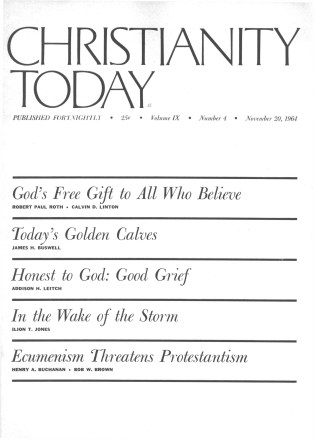
Many think that Christianity and happiness live on opposite sides of the street, but in truth both live in the same house. Contentment is found only where life is gratefully accepted as a gift from Another. And only where the Giver is thanked does happiness dwell.
Despite considerable evidence, the relation of gratitude to human happiness is commonly overlooked. Experience shows and the Bible teaches that life does not consist in abundance of possessions. People are happy who cherish the good things of life. But abundance without gratitude is joyless. That a thankful person is a happy person is a rule with no exceptions.
It is often said that Americans enjoy a greater prosperity than any other people have ever enjoyed. But is this true? That ours is the most affluent society in all history is not in doubt. But do we really enjoy our abundance? In our very busy factories and offices and on our hurried and crowded streets, few faces reflect quiet satisfaction or radiant happiness. Unparalleled affluence has not brought us happy contentment.
When harvest comes, the happiest celebrants will be, not those whose tables are most weighted with the fruits of the field, but those who, sitting down to little or much, pause to give thanks and exclaim from their hearts, “Surely, God is good.”
What is the Christian religion but the summons to accept all of God’s good gifts with thanks? In Christianity, gratitude motivates all human life and action. In this deepest thankfulness lies our greatest happiness.
Failure to accept the blessings of life with thanksgiving leads to joyless depreciation of all things: of God, of neighbor, and of cultural and material possessions. When the good gifts of the heavenly Father are accepted without gratitude, they are soon treated without respect. And then they may be abused. The man who respects his neighbor does not assault him on the streets. He who regards others as a gift of God to be accepted with thanksgiving does not by loveless invasion violate the sexual mystery of another. Nor does he wantonly destroy property in purposeless vandalism. People and things, and life itself, are respected only when accepted with thanks. Where this occurs, happiness dwells.
The relation between thanklessness and abuse is written large in our national life. The motive of crime, immorality, vandalism is never joy. This the Apostle Paul taught us long ago. In Romans he describes pagans by saying, “neither were [they] thankful,” and goes on to show that they respected nothing—neither God, whose glory they changed into that of bird, beast, or corruptible man, nor human beings. For the pagan is, says Paul, “without natural affection,” both men and women changing “the natural use [of sex] into that which is against nature.” The pagan’s attitude of thanklessness and his abuse of all God’s gifts are not unrelated.
Elsewhere in this epistle, the Apostle points to God’s gift of justification through faith, a gift that should create our greatest joy and elicit our deepest thanks. That “the just shall live by faith” (or as Anders Nygren translates it, “by faith the just shall live”), means that the person who is justified has received from God the right to live.
“The wages of sin is death” is a solemn declaration that the sinner has no right to live and therefore no future. But God’s gift of justification through faith in Jesus Christ means that we who are sinners have nonetheless received from God the right to live. This is freedom: to have the right to live, to have an authentic future, one that in all its ever-receding horizons will always be without sin, death, condemnation, and hell.
It is a symptom of deep spiritual malaise when men refuse to accept joyfully and thankfully from God the right to live a life that moves into an ever-opening future. Such refusal is literally a “sickness unto death.” Those who are unwilling to respond to God’s incomparable gift of life with thanks and joy are also unable to understand the meaning of happiness and gratitude for the lesser things of life—roast turkey, pumpkin pie, and all that goes with them.