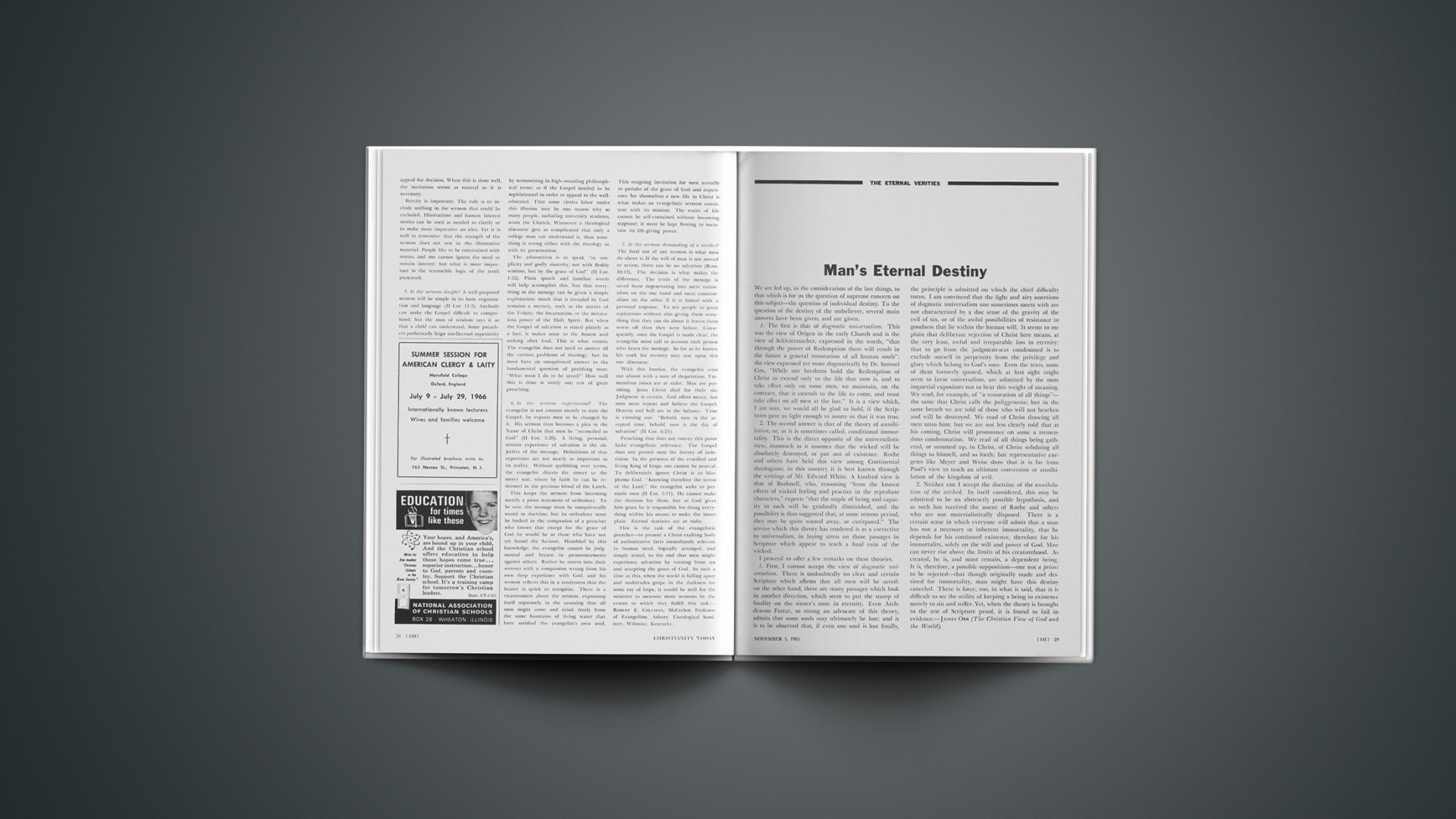

We are led up, in the consideration of the last things, to that which is for us the question of supreme concern on this subject—the question of individual destiny. To the question of the destiny of the unbeliever, several main answers have been given, and are given.
1. The first is that of dogmatic universalism. This was the view of Origen in the early Church and is the view of Schleiermacher, expressed in the words, “that through the power of Redemption there will result in the future a general restoration of all human souls”; the view expressed yet more dogmatically by Dr. Samuel Cox, “While our brethren hold the Redemption of Christ to extend only to the life that now is, and to take effect only on some men, we maintain, on the contrary, that it extends to the life to come, and must take effect on all men at the last.” It is a view which, I am sure, we would all be glad to hold, if the Scriptures gave us light enough to assure us that it was true.
2. The second answer is that of the theory of annihilation, or, as it is sometimes called, conditional immortality. This is the direct opposite of the universalistic view, inasmuch as it assumes that the wicked will be absolutely destroyed, or put out of existence. Rothe and others have held this view among Continental theologians; in this country it is best known through the writings of Mr. Edward White. A kindred view is that of Bushnell, who, reasoning “from the known effects of wicked feeling and practice in the reprobate characters,” expects “that the staple of being and capacity in such will be gradually diminished, and the possibility is thus suggested that, at some remote period, they may be quite wasted away, or extirpated.” The service which this theory has rendered is as a corrective to universalism, in laying stress on those passages in Scripture which appear to teach a final ruin of the wicked.
I proceed to offer a few remarks on these theories.
1. First, I cannot accept the view of dogmatic universalism. There is undoubtedly no clear and certain Scripture which affirms that all men will be saved; on the other hand, there are many passages which look in another direction, which seem to put the stamp of finality on the sinner’s state in eternity. Even Archdeacon Farrar, so strong an advocate of this theory, admits that some souls may ultimately be lost; and it is to be observed that, if even one sold is lost finally, the principle is admitted on which the chief difficulty turns. I am convinced that the light and airy assertions of dogmatic universalism one sometimes meets with are not characterized by a due sense of the gravity of the evil of sin, or of the awful possibilities of resistance to goodness that lie within the human will. It seems to me plain that deliberate rejection of Christ here means, at the very least, awful and irreparable loss in eternity; that to go from the judgment-seat condemned is to exclude oneself in perpetuity from the privilege and glory which belong to God’s sons. Even the texts, some of them formerly quoted, which at first sight might seem to favor universalism, are admitted by the most impartial expositors not to bear this weight of meaning. We read, for example, of “a restoration of all things”—the same that Christ calls the paliggenesia; but in the same breath we are told of those who will not hearken and will be destroyed. We read of Christ drawing all men unto him; but we are not less clearly told that at his coming, Christ will pronounce on some a tremendous condemnation. We read of all things being gathered, or summed up, in Christ, of Christ subduing all things to himself, and so forth; but representative exegetes like Meyer and Weiss show that it is far from Paul’s view to teach an ultimate conversion or annihilation of the kingdom of evil.
2. Neither can I accept the doctrine of the annihilation of the wicked. In itself considered, this may be admitted to be an abstractly possible hypothesis, and as such has received the assent of Rothe and others who are not materialistically disposed. There is a certain sense in which everyone will admit that a man has not a necessary or inherent immortality, that he depends for his continued existence, therefore for his immortality, solely on the will and power of God. Man can never rise above the limits of his creaturehood. As created, he is, and must remain, a dependent being. It is, therefore, a possible supposition—one not a priori to be rejected—that though originally made and destined for immortality, man might have this destiny canceled. There is force, too, in what is said, that it is difficult to see the utility of keeping a being in existence merely to sin and suffer. Yet, when the theory is brought to the test of Scripture proof, it is found to fail in evidence.—