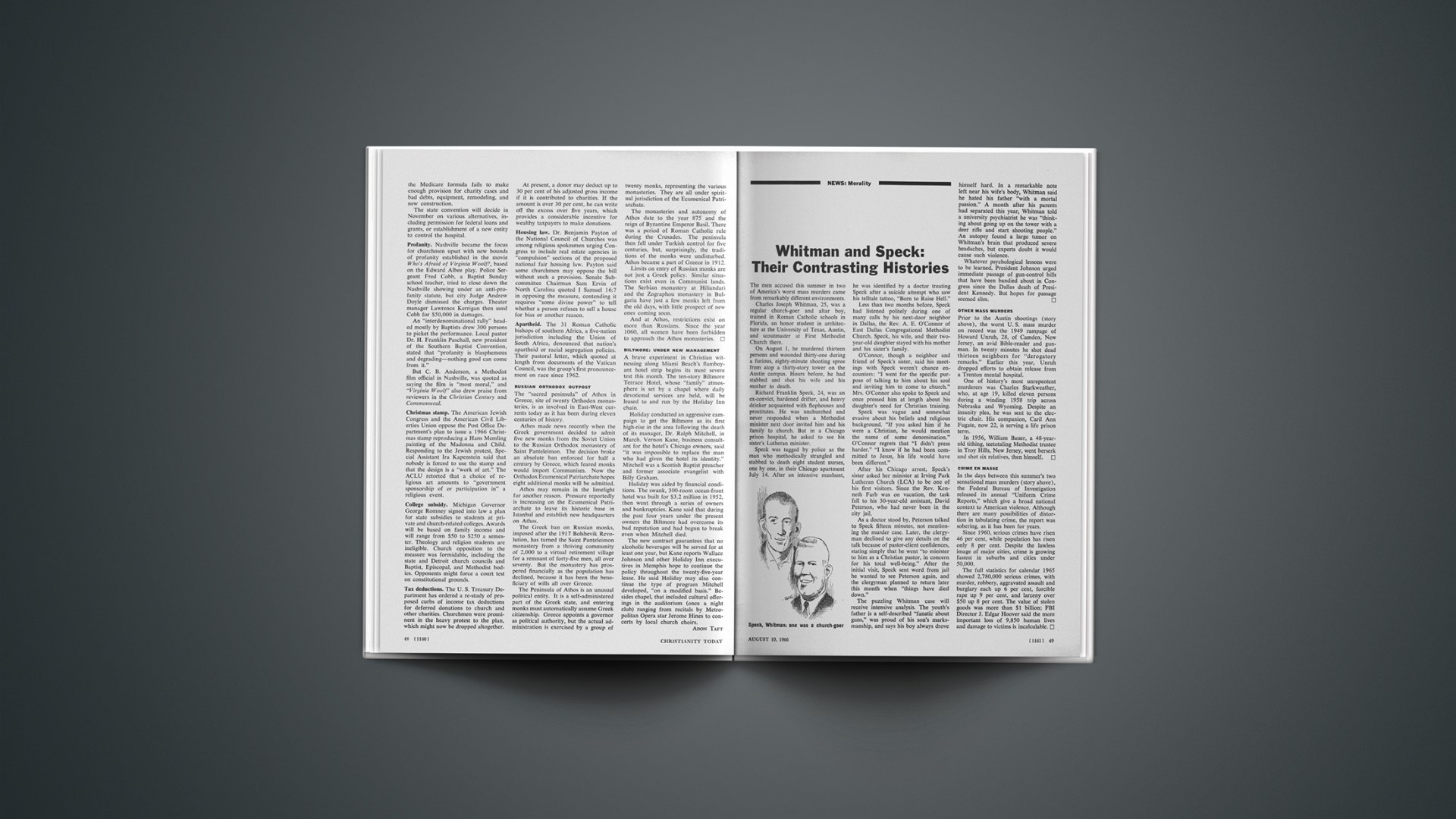
The men accused this summer in two of America’s worst mass murders came from remarkably different environments.
Charles Joseph Whitman, 25, was a regular church-goer and altar boy, trained in Roman Catholic schools in Florida, an honor student in architecture at the University of Texas, Austin, and scoutmaster at First Methodist Church there.
On August 1, he murdered thirteen persons and wounded thirty-one during a furious, eighty-minute shooting spree from atop a thirty-story tower on the Austin campus. Hours before, he had stabbed and shot his wife and his mother to death.
Richard Franklin Speck, 24, was an ex-convict, hardened drifter, and heavy drinker acquainted with flophouses and prostitutes. He was unchurched and never responded when a Methodist minister next door invited him and his family to church. But in a Chicago prison hospital, he asked to see his sister’s Lutheran minister.
Speck was tagged by police as the man who methodically strangled and stabbed to death eight student nurses, one by one, in their Chicago apartment July 14. After an intensive manhunt, he was identified by a doctor treating Speck after a suicide attempt who saw his telltale tattoo, “Born to Raise Hell.”
Less than two months before, Speck had listened politely during one of many calls by his next-door neighbor in Dallas, the Rev. A. E. O’Connor of East Dallas Congregational Methodist Church. Speck, his wife, and their two-year-old daughter stayed with his mother and his sister’s family.
O’Connor, though a neighbor and friend of Speck’s sister, said his meetings with Speck weren’t chance encounters: “I went for the specific purpose of talking to him about his soul and inviting him to come to church.” Mrs. O’Connor also spoke to Speck and once pressed him at length about his daughter’s need for Christian training.
Speck was vague and somewhat evasive about his beliefs and religious background. “If you asked him if he were a Christian, he would mention the name of some denomination.” O’Connor regrets that “I didn’t press harder.” “I know if he had been committed to Jesus, his life would have been different.”
After his Chicago arrest, Speck’s sister asked her minister at Irving Park Lutheran Church (LCA) to be one of his first visitors. Since the Rev. Kenneth Farb was on vacation, the task fell to his 30-year-old assistant, David Peterson, who had never been in the city jail.
As a doctor stood by, Peterson talked to Speck fifteen minutes, not mentioning the murder case. Later, the clergyman declined to give any details on the talk because of pastor-client confidences, stating simply that he went “to minister to him as a Christian pastor, in concern for his total well-being.” After the initial visit, Speck sent word from jail he wanted to see Peterson again, and the clergyman planned to return later this month when “things have died down.”
The puzzling Whitman case will receive intensive analysis. The youth’s father is a self-described “fanatic about guns,” was proud of his son’s marksmanship, and says his boy always drove himself hard. In a remarkable note left near his wife’s body, Whitman said he hated his father “with a mortal passion.” A month after his parents had separated this year, Whitman told a university psychiatrist he was “thinking about going up on the tower with a deer rifle and start shooting people.” An autopsy found a large tumor on Whitman’s brain that produced severe headaches, but experts doubt it would cause such violence.
Whatever psychological lessons were to be learned, President Johnson urged immediate passage of gun-control bills that have been bandied about in Congress since the Dallas death of President Kennedy. But hopes for passage seemed slim.
Other Mass Murders
Prior to the Austin shootings (story above), the worst U. S. mass murder on record was the 1949 rampage of Howard Unruh, 28, of Camden, New Jersey, an avid Bible-reader and gunman. In twenty minutes he shot dead thirteen neighbors for “derogatory remarks.” Earlier this year, Unruh dropped efforts to obtain release from a Trenton mental hospital.
One of history’s most unrepentent murderers was Charles Starkweather, who, at age 19, killed eleven persons during a winding 1958 trip across Nebraska and Wyoming. Despite an insanity plea, he was sent to the electric chair. His companion, Caril Ann Fugate, now 22, is serving a life prison term.
In 1956, William Bauer, a 48-year-old tithing, teetotaling Methodist trustee in Troy Hills, New Jersey, went berserk and shot six relatives, then himself.
Crime En Masse
In the days between this summer’s two sensational mass murders (story above), the Federal Bureau of Investigation released its annual “Uniform Crime Reports,” which give a broad national context to American violence. Although there are many possibilities of distortion in tabulating crime, the report was sobering, as it has been for years.
Since 1960, serious crimes have risen 46 per cent, while population has risen only 8 per cent. Despite the lawless image of major cities, crime is growing fastest in suburbs and cities under 50,000.
The full statistics for calendar 1965 showed 2,780,000 serious crimes, with murder, robbery, aggravated assault and burglary each up 6 per cent, forcible rape up 9 per cent, and larceny over $50 up 8 per cent. The value of stolen goods was more than $1 billion; FBI Director J. Edgar Hoover said the more important loss of 9,850 human lives and damage to victims is incalculable.