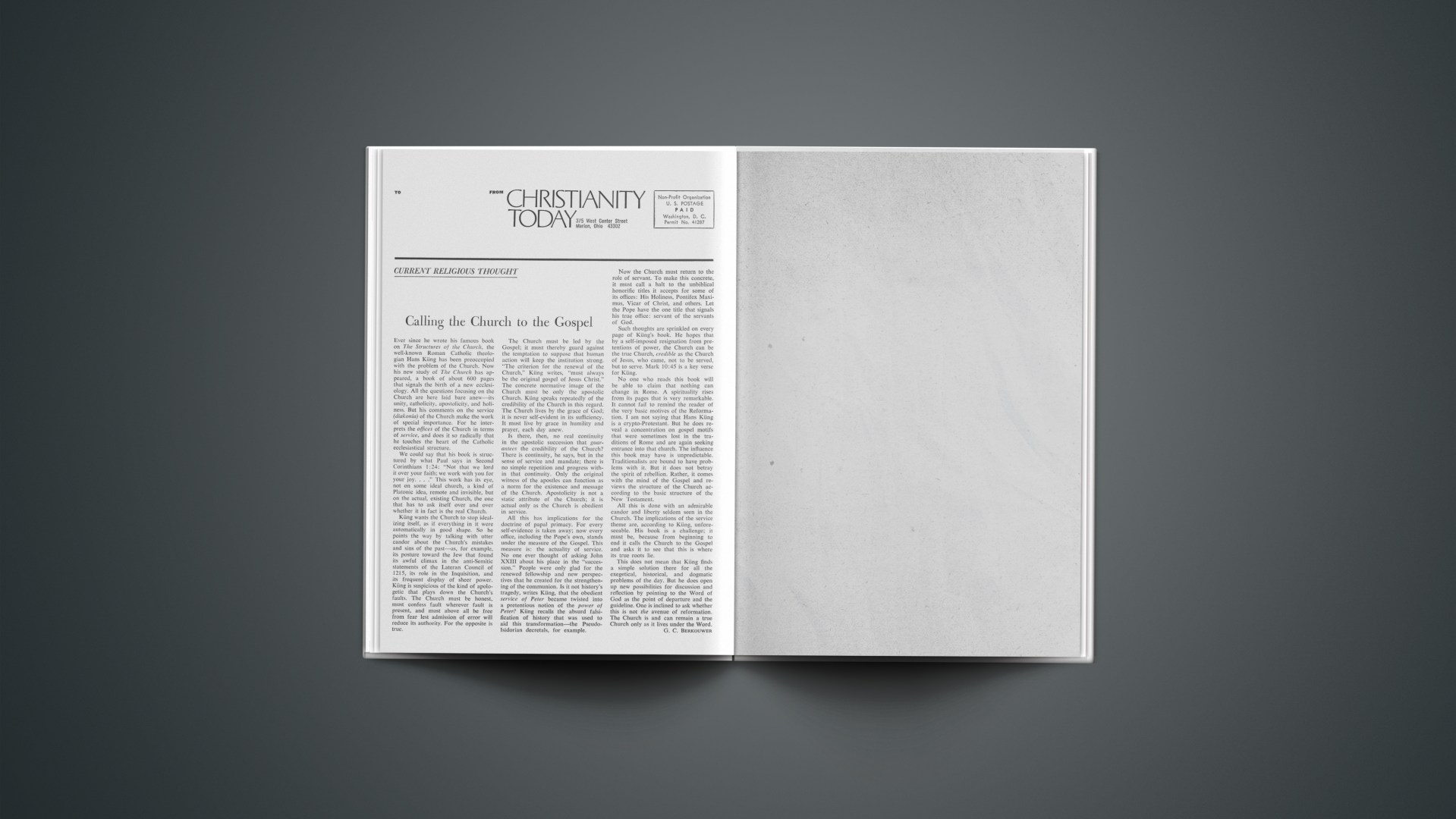
Ever since he wrote his famous book on The Structures of the Church, the well-known Roman Catholic theologian Hans Küng has been preoccupied with the problem of the Church. Now his new study of The Church has appeared, a book of about 600 pages that signals the birth of a new ecclesiology. All the questions focusing on the Church are here laid bare anew—its unity, catholicity, apostolicity, and holiness. But his comments on the service (diakonia) of the Church make the work of special importance. For he interprets the offices of the Church in terms of service, and does it so radically that he touches the heart of the Catholic ecclesiastical structure.
We could say that his book is structured by what Paul says in Second Corinthians 1:24: “Not that we lord it over your faith; we work with you for your joy.…” This work has its eye, not on some ideal church, a kind of Platonic idea, remote and invisible, but on the actual, existing Church, the one that has to ask itself over and over whether it in fact is the real Church.
Küng wants the Church to stop idealizing itself, as if everything in it were automatically in good shape. So he points the way by talking with utter candor about the Church’s mistakes and sins of the past—as, for example, its posture toward the Jew that found its awful climax in the anti-Semitic statements of the Lateran Council of 1215, its role in the Inquisition, and its frequent display of sheer power. Küng is suspicious of the kind of apologetic that plays down the Church’s faults. The Church must be honest, must confess fault wherever fault is present, and must above all be free from fear lest admission of error will reduce its authority. For the opposite is true.
The Church must be led by the Gospel; it must thereby guard against the temptation to suppose that human action will keep the institution strong. “The criterion for the renewal of the Church,” Küng writes, “must always be the original gospel of Jesus Christ.” The concrete normative image of the Church must be only the apostolic Church. Küng speaks repeatedly of the credibility of the Church in this regard. The Church lives by the grace of God; it is never self-evident in its sufficiency. It must live by grace in humility and prayer, each day anew.
Is there, then, no real continuity in the apostolic succession that guarantees the credibility of the Church? There is continuity, he says, but in the sense of service and mandate; there is no simple repetition and progress within that continuity. Only the original witness of the apostles can function as a norm for the existence and message of the Church. Apostolicity is not a static attribute of the Church; it is actual only as the Church is obedient in service.
All this has implications for the doctrine of papal primacy. For every self-evidence is taken away; now every office, including the Pope’s own, stands under the measure of the Gospel. This measure is: the actuality of service. No one ever thought of asking John XXIII about his place in the “succession.” People were only glad for the renewed fellowship and new perspectives that he created for the strengthening of the communion. Is it not history’s tragedy, writes Küng, that the obedient service of Peter became twisted into a pretentious notion of the power of Peter? Küng recalls the absurd falsification of history that was used to aid this transformation—the Pseudo-Isidorian decretals, for example.
Now the Church must return to the role of servant. To make this concrete, it must call a halt to the unbiblical honorific titles it accepts for some of its offices: His Holiness, Pontifex Maximus, Vicar of Christ, and others. Let the Pope have the one title that signals his true office: servant of the servants of God.
Such thoughts are sprinkled on every page of Küng’s book. He hopes that by a self-imposed resignation from pretentions of power, the Church can be the true Church, credible as the Church of Jesus, who came, not to be served, but to serve. Mark 10:45 is a key verse for Küng.
No one who reads this book will be able to claim that nothing can change in Rome. A spirituality rises from its pages that is very remarkable. It cannot fail to remind the reader of the very basic motives of the Reformation. I am not saying that Hans Küng is a crypto-Protestant. But he does reveal a concentration on gospel motifs that were sometimes lost in the traditions of Rome and are again seeking entrance into that church. The influence this book may have is unpredictable. Traditionalists are bound to have problems with it. But it does not betray the spirit of rebellion. Rather, it comes with the mind of the Gospel and reviews the structure of the Church according to the basic structure of the New Testament.
All this is done with an admirable candor and liberty seldom seen in the Church. The implications of the service theme are, according to Küng, unforeseeable. His book is a challenge; it must be, because from beginning to end it calls the Church to the Gospel and asks it to see that this is where its true roots lie.
This does not mean that Küng finds a simple solution there for all the exegetical, historical, and dogmatic problems of the day. But he does open up new possibilities for discussion and reflection by pointing to the Word of God as the point of departure and the guideline. One is inclined to ask whether this is not the avenue of reformation. The Church is and can remain a true Church only as it lives under the Word.