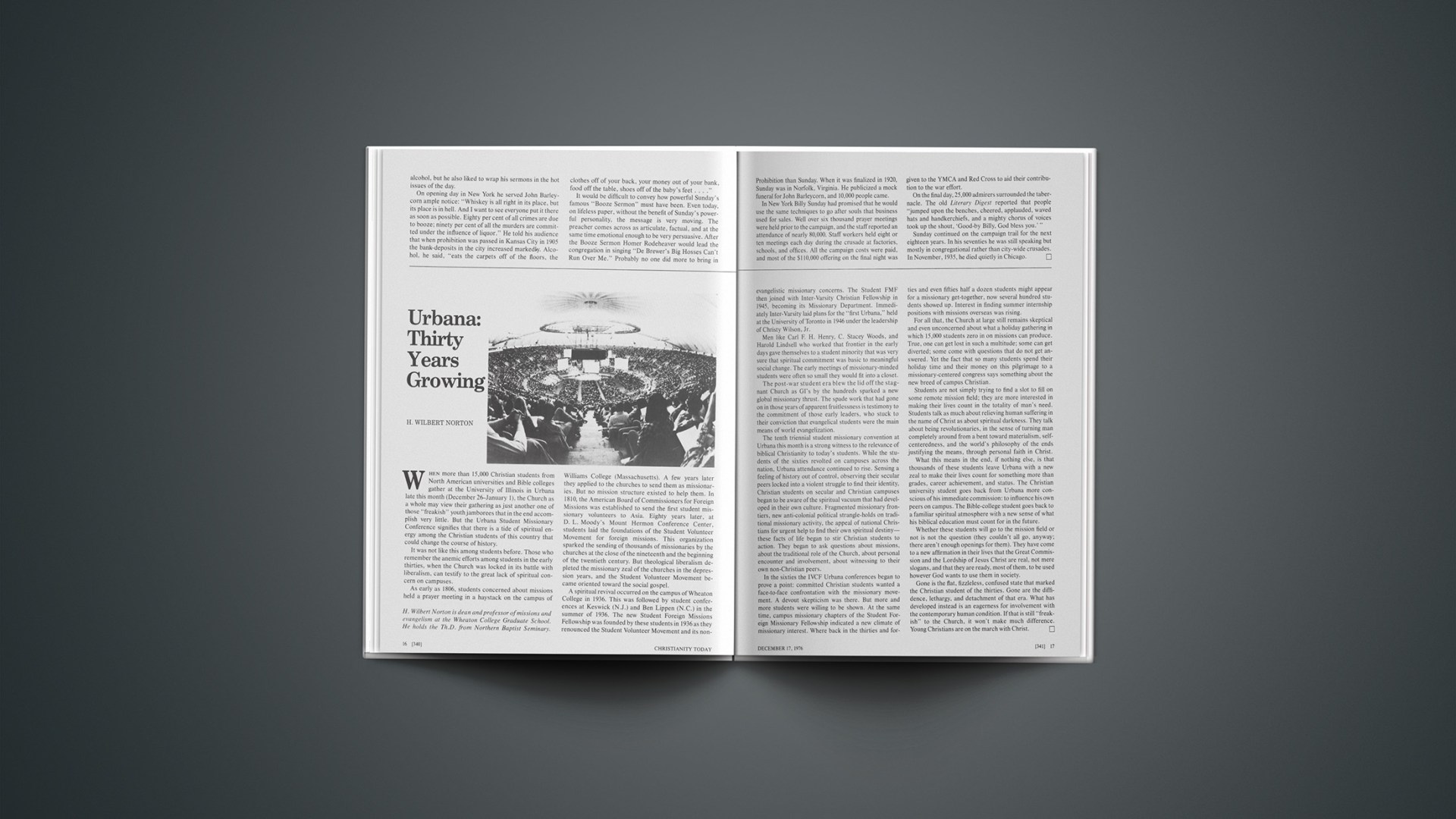

When more than 15,000 Christian students from North American universities and Bible colleges gather at the University of Illinois in Urbana late this month (December 26–January 1), the Church as a whole may view their gathering as just another one of those “freakish” youth jamborees that in the end accomplish very little. But the Urbana Student Missionary Conference signifies that there is a tide of spiritual energy among the Christian students of this country that could change the course of history.
It was not like this among students before. Those who remember the anemic efforts among students in the early thirties, when the Church was locked in its battle with liberalism, can testify to the great lack of spiritual concern on campuses.
As early as 1806, students concerned about missions held a prayer meeting in a haystack on the campus of Williams College (Massachusetts). A few years later they applied to the churches to send them as missionaries. But no mission structure existed to help them. In 1810, the American Board of Commissioners for Foreign Missions was established to send the first student missionary volunteers to Asia. Eighty years later, at D. L. Moody’s Mount Hermon Conference Center, students laid the foundations of the Student Volunteer Movement for foreign missions. This organization sparked the sending of thousands of missionaries by the churches at the close of the nineteenth and the beginning of the twentieth century. But theological liberalism depleted the missionary zeal of the churches in the depression years, and the Student Volunteer Movement became oriented toward the social gospel.
A spiritual revival occurred on the campus of Wheaton College in 1936. This was followed by student conferences at Keswick (N.J.) and Ben Lippen (N.C.) in the summer of 1936. The new Student Foreign Missions Fellowship was founded by these students in 1936 as they renounced the Student Volunteer Movement and its non-evangelistic missionary concerns. The Student FMF then joined with Inter-Varsity Christian Fellowship in 1945, becoming its Missionary Department. Immediately Inter-Varsity laid plans for the “first Urbana,” held at the University of Toronto in 1946 under the leadership of Christy Wilson, Jr.
Men like Carl F. H. Henry, C. Stacey Woods, and Harold Lindsell who worked that frontier in the early days gave themselves to a student minority that was very sure that spiritual commitment was basic to meaningful social change. The early meetings of missionary-minded students were often so small they would fit into a closet.
The post-war student era blew the lid off the stagnant Church as GI’s by the hundreds sparked a new global missionary thrust. The spade work that had gone on in those years of apparent fruitlessness is testimony to the commitment of those early leaders, who stuck to their conviction that evangelical students were the main means of world evangelization.
The tenth triennial student missionary convention at Urbana this month is a strong witness to the relevance of biblical Christianity to today’s students. While the students of the sixties revolted on campuses across the nation, Urbana attendance continued to rise. Sensing a feeling of history out of control, observing their secular peers locked into a violent struggle to find their identity, Christian students on secular and Christian campuses began to be aware of the spiritual vacuum that had developed in their own culture. Fragmented missionary frontiers, new anti-colonial political strangle-holds on traditional missionary activity, the appeal of national Christians for urgent help to find their own spiritual destiny—these facts of life began to stir Christian students to action. They began to ask questions about missions, about the traditional role of the Church, about personal encounter and involvement, about witnessing to their own non-Christian peers.
In the sixties the IVCF Urbana conferences began to prove a point: committed Christian students wanted a face-to-face confrontation with the missionary movement. A devout skepticism was there. But more and more students were willing to be shown. At the same time, campus missionary chapters of the Student Foreign Missionary Fellowship indicated a new climate of missionary interest. Where back in the thirties and forties and even fifties half a dozen students might appear for a missionary get-together, now several hundred students showed up. Interest in finding summer internship positions with missions overseas was rising.
For all that, the Church at large still remains skeptical and even unconcerned about what a holiday gathering in which 15,000 students zero in on missions can produce. True, one can get lost in such a multitude; some can get diverted; some come with questions that do not get answered. Yet the fact that so many students spend their holiday time and their money on this pilgrimage to a missionary-centered congress says something about the new breed of campus Christian.
Students are not simply trying to find a slot to fill on some remote mission field; they are more interested in making their lives count in the totality of man’s need. Students talk as much about relieving human suffering in the name of Christ as about spiritual darkness. They talk about being revolutionaries, in the sense of turning man completely around from a bent toward materialism, self-centeredness, and the world’s philosophy of the ends justifying the means, through personal faith in Christ.
What this means in the end, if nothing else, is that thousands of these students leave Urbana with a new zeal to make their lives count for something more than grades, career achievement, and status. The Christian university student goes back from Urbana more conscious of his immediate commission: to influence his own peers on campus. The Bible-college student goes back to a familiar spiritual atmosphere with a new sense of what his biblical education must count for in the future.
Whether these students will go to the mission field or not is not the question (they couldn’t all go, anyway; there aren’t enough openings for them). They have come to a new affirmation in their lives that the Great Commission and the Lordship of Jesus Christ are real, not mere slogans, and that they are ready, most of them, to be used however God wants to use them in society.
Gone is the flat, fizzleless, confused state that marked the Christian student of the thirties. Gone are the diffidence, lethargy, and detachment of that era. What has developed instead is an eagerness for involvement with the contemporary human condition. If that is still “freakish” to the Church, it won’t make much difference. Young Christians are on the march with Christ.