
We become personally culpable when we acquiesce to the status quo.
In my article in the last issue I argued that equality is not a synonym for identity; that by creation, equality of human worth and inequality of human ability are combined; and that what we should be seeking is equal opportunity for all human beings (through education, medical care, housing, nutrition, and trade) to develop their full, God-given potential. This is the minimum that love and justice should demand.
Such an acceptance of responsibility is not the same as an admission of guilt. To apportion blame for the present situation of worldwide economic inequality seems to me neither possible nor profitable. It is certainly not God’s fault, since he has provided ample resources for everybody. Nor is it the fault of the poor, for almost invariably they were born in it. But neither is the situation necessarily our fault, although our colonial forefathers doubtless had a share in creating it and our governments in perpetuating it by not tackling the problem more energetically. We ourselves become personally culpable, however, only if we acquiesce in it by doing nothing. Yet what, in practice, can we do?
To begin with, God may well be calling more Christian people than hear and respond to his call to give their lives in the service of the poor and powerless, in practical philanthropy or Third World development, in politics, or in economics. I would love to see in every country a team of well-qualified Christian economists band together both to work out new international economic policies and to labor for political solutions. Yet this is bound to be the calling of only a minority. What can the rest of us do?
First and foremost, there is the challenge to our heart. When Jesus saw the multitudes, hungry and leaderless, he was moved with compassion, and then fed them or taught them or both. It was compassion that aroused and directed his action, and it is compassion that we need most. We have to feel what Jesus felt—the pangs of the hungry, the alienation of the powerless, and the indignities of the wretched of the earth. For ultimately, the unacceptable inequalities between North and South are neither political nor economic, but rather moral. Until we feel moral indignation about worldwide social injustice and strong compassion for worldwide human suffering, I seriously doubt if we shall be moved to take action.
The challenge to our head comes next. We need to inform ourselves of the facts. The Third World lies at our gate today much as Lazarus lay at the rich man’s. Dives may not have known he was there, but a plea of ignorance would not have exonerated him. Nor can we plead ignorance. Nearly all of us drink tea and coffee, probably sweeten it with sugar, eat bananas, and wear textile clothing. We cannot enjoy these things responsibly if we remain indifferent to the wages and living conditions of those who produce them, and to the trade agreements by which they become available to us. So we should take steps to find out. Does the daily paper we read have adequate Third World coverage? Do we subscribe to a magazine devoted to Third World needs? Is there a “Work Development Movement” in our country for us to join (as there is in Britain), which exists to supply the public with factual information? More personally still, could we make friends with a Third World citizen or travel to some region of the Third World in order to educate ourselves at first hand? Or could we offer ourselves for short-term service in a developing country? And does our church have a “world development group” in addition to a “world mission group,” whose responsibility is to inform itself and to keep the congregation informed?
Our mouth also needs to be involved. We have a duty to spread the information we have obtained in order to arouse the concern of our relatives, friends, and colleagues as well. It is only when we are sure of our facts (for we all have a tendency to pontificate from a position of ignorance) that we shall be equipped to join in any form of political agitation. Most communities have pressure groups, which are seeking to influence public opinion and increase public concern about development issues. They could benefit from a Christian contribution to their thought and action; it is anomalous that sometimes humanists show more compassion for the deprived than Christians. Again, most congressmen have times when they are available to the public (British members of Parliament borrow an expression from the medical profession and call them “surgery hours”), Christians should take advantage of such opportunities to ask informed questions about trade tariffs and quotas, to press for the government to increase its ODA (Official Development Assistance), and to inquire why, in Tanzanian President Julius Nyerere’s words, so many developing countries are forced to “sell cheap and buy dear.”
Finally, there is our pocket. Emotional arousal, self-education, and political agitation are all necessary. But there is an element of hypocrisy about all of them if they are not accompanied by personal commitment. In comparison to the 800 million destitute people of the world, we who subscribe to CHRISTIANITY TODAY are rich. We could not afford it otherwise! Now, we should be thankful to God our Creator and Father for the good things he has given us to enjoy; a negative asceticism—self-denial as an end in itself—is a contradiction of the biblical doctrine of creation, for it overlooks the generosity of God “who richly furnishes us with everything to enjoy” (1 Tim. 6:17). At the same time, we have to remember the numerous biblical warnings against the dangers of wealth (that it easily engenders pride, materialism, and a false sense of security), against the evils of covetousness, and against the injustice of condoning the inequalities of privilege. So, recalling the principles of unity and equality which I elaborated in my previous article, most of us (for I include myself) ought to give more generously to aid and development, as well as to world evangelization. In order to do so, we ought further to develop a simple lifestyle. The two most discussed sentences in the Lausanne Covenant (1974) read: “All of us are shocked by the poverty of millions and disturbed by the injustices which cause it. Those of us who live in affluent circumstances accept our duty to develop a simple lifestyle in order to contribute generously to both relief and evangelism.”
I am writing this a few days before the International Consultation on Simple Lifestyle to be held in London, and naturally I am in no position to anticipate its findings. But I am confident that it will remind us of the biblical call to renounce covetousness and to cultivate contentment. I hope it will summon us deliberately to develop a standard of living lower than we could afford, out of solidarity with the world’s poor. It is true that such a purposeful renunciation of luxurious living would not solve the world’s economic problems or transform the poverty of the destitute into plenty. But it would be a sign and symbol of our Christian obedience, of our love for the needy, and of our resolve to imitate that grace of our Lord Jesus Christ who, though rich, became poor in order that through his poverty we might become rich.
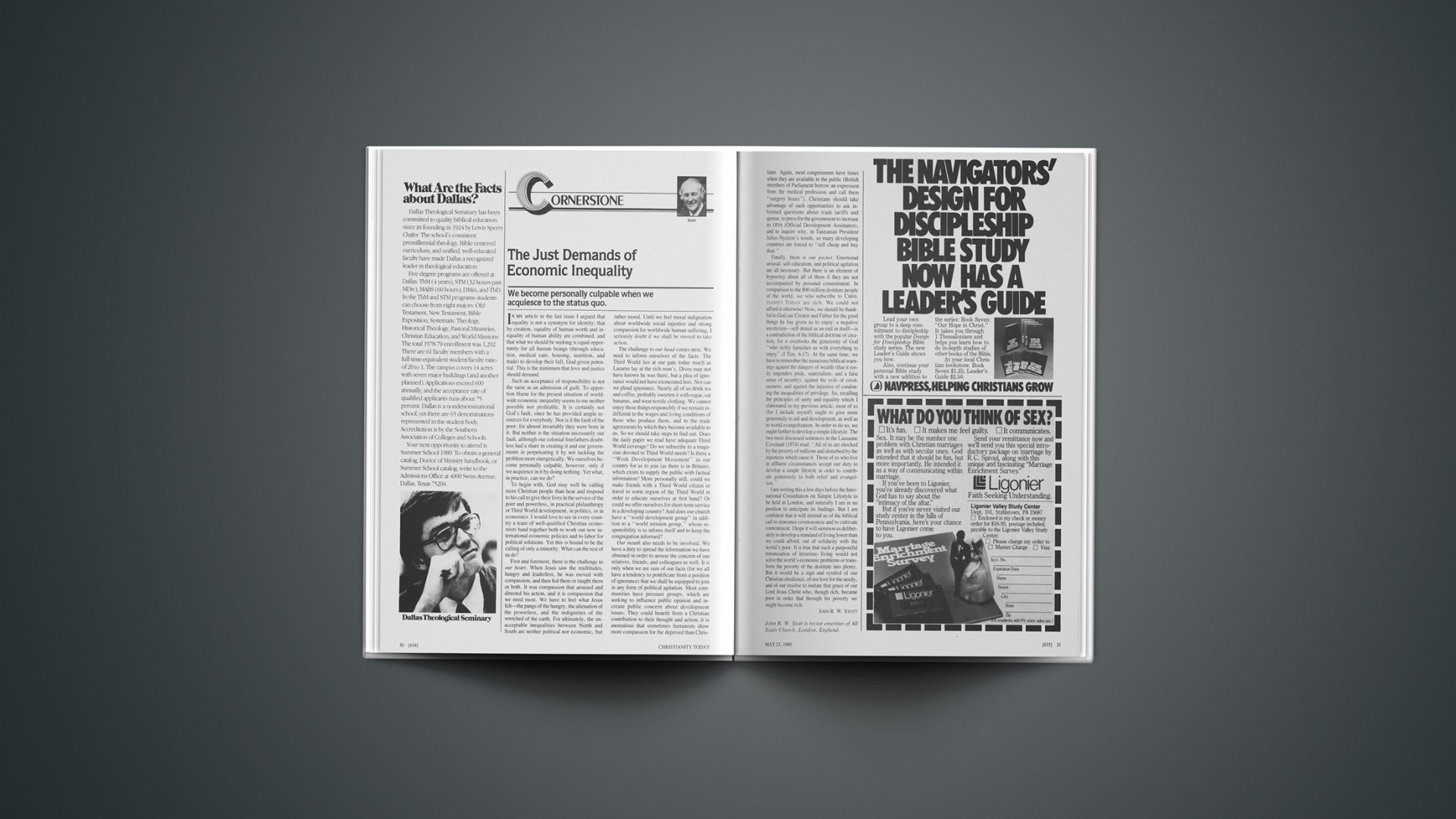
John R. W. Stott is rector emeritus of All Souls Church, London. England.