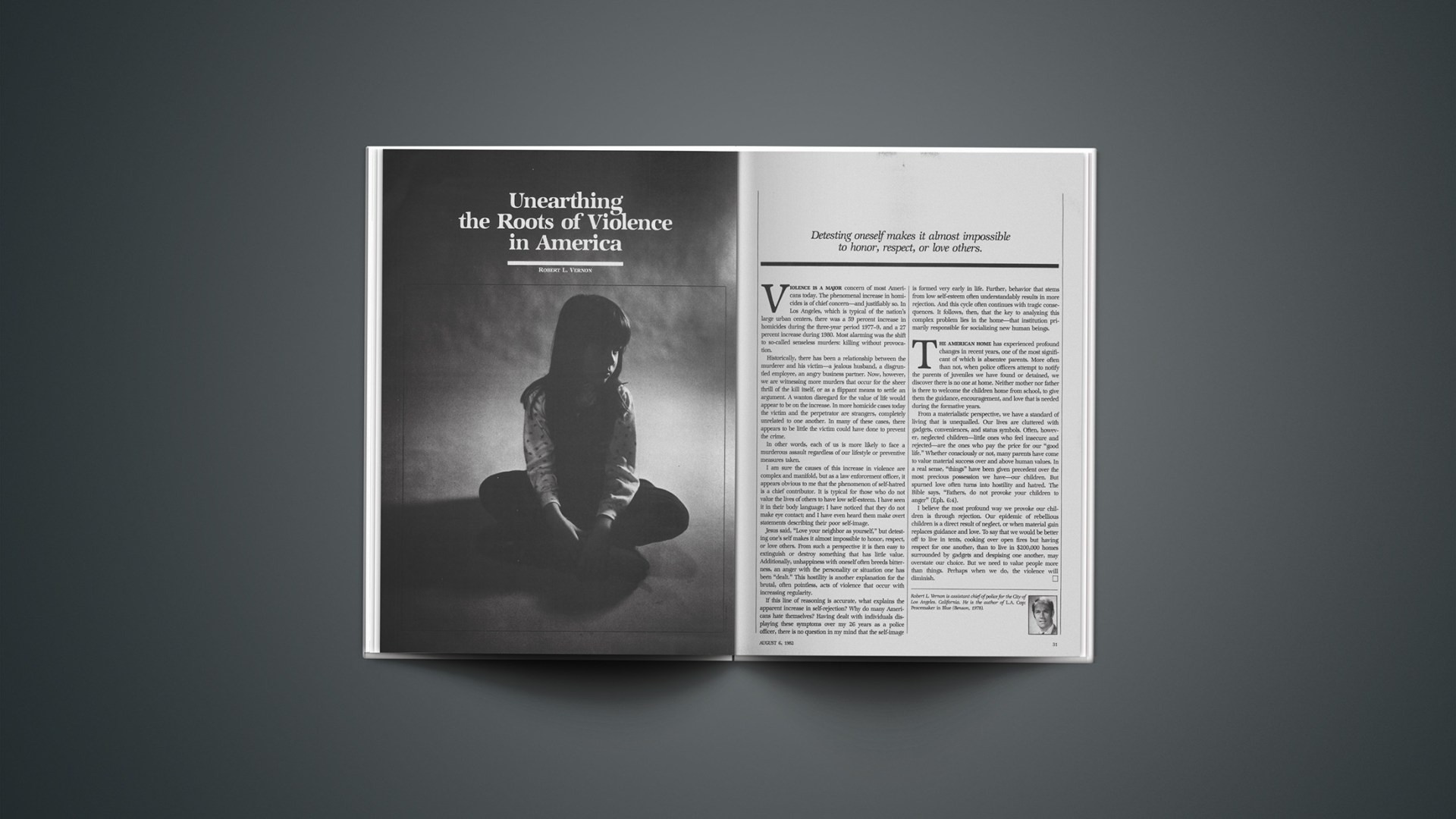

Detesting oneself makes it almost impossible to honor respect or love others.
Violence is a major concern of most Americans today. The phenomenal increase in homicides is of chief concern—and justifiably so. In Los Angeles, which is typical of the nation’s large urban centers, there was a 59 percent increase in homicides during the three-year period 1977–9, and a 27 percent increase during 1980. Most alarming was the shift to so-called senseless murders: killing without provocation.
Historically, there has been a relationship between the murderer and his victim—a jealous husband, a disgruntled employee, an angry business partner. Now, however, we are witnessing more murders that occur for the sheer thrill of the kill itself, or as a flippant means to settle an argument. A wanton disregard for the value of life would appear to be on the increase. In more homicide cases today the victim and the perpetrator are strangers, completely unrelated to one another. In many of these cases, there appears to be little the victim could have done to prevent the crime.
In other words, each of us is more likely to face a murderous assault regardless of our lifestyle or preventive measures taken.
I am sure the causes of this increase in violence are complex and manifold, but as a law enforcement officer, it appears obvious to me that the phenomenon of self-hatred is a chief contributor. It is typical for those who do not value the lives of others to have low self-esteem. I have seen it in their body language; I have noticed that they do not make eye contact; and I have even heard them make overt statements describing their poor self-image.
Jesus said, “Love your neighbor as yourself,” but detesting one’s self makes it almost impossible to honor, respect, or love others. From such a perspective it is then easy to extinguish or destroy something that has little value. Additionally, unhappiness with oneself often breeds bitterness, an anger with the personality or situation one has been “dealt.” This hostility is another explanation for the brutal, often pointless, acts of violence that occur with increasing regularity.
If this line of reasoning is accurate, what explains the apparent increase in self-rejection? Why do many Americans hate themselves? Having dealt with individuals displaying these symptoms over my 26 years as a police officer, there is no question in my mind that the self-image is formed very early in life. Further, behavior that stems from low self-esteem often understandably results in more rejection. And this cycle often continues with tragic consequences. It follows, then, that the key to analyzing this complex problem lies in the home—that institution primarily responsible for socializing new human beings.
The American home has experienced profound changes in recent years, one of the most significant of which is absentee parents. More often than not, when police officers attempt to notify the parents of juveniles we have found or detained, we discover there is no one at home. Neither mother nor father is there to welcome the children home from school, to give them the guidance, encouragement, and love that is needed during the formative years.
From a materialistic perspective, we have a standard of living that is unequalled. Our lives are cluttered with gadgets, conveniences, and status symbols. Often, however, neglected children—little ones who feel insecure and rejected—are the ones who pay the price for our “good life.” Whether consciously or not, many parents have come to value material success over and above human values. In a real sense, “things” have been given precedent over the most precious possession we have—our children. But spumed love often turns into hostility and hatred. The Bible says, “Fathers, do not provoke your children to anger” (Eph. 6:4).
I believe the most profound way we provoke our children is through rejection. Our epidemic of rebellious children is a direct result of neglect, or when material gain replaces guidance and love. To say that we would be better off to live in tents, cooking over open fires but having respect for one another, than to live in $200,000 homes surrounded by gadgets and despising one another, may overstate our choice. But we need to value people more than things. Perhaps when we do, the violence will diminish.
Robert L. Vernon is assistant chief of police for the City of Los Angeles. California. He is the author of L.A. Cop: Peacemaker in Blue (Benson, 1978).