
Protestant organizations will try to prevent it.
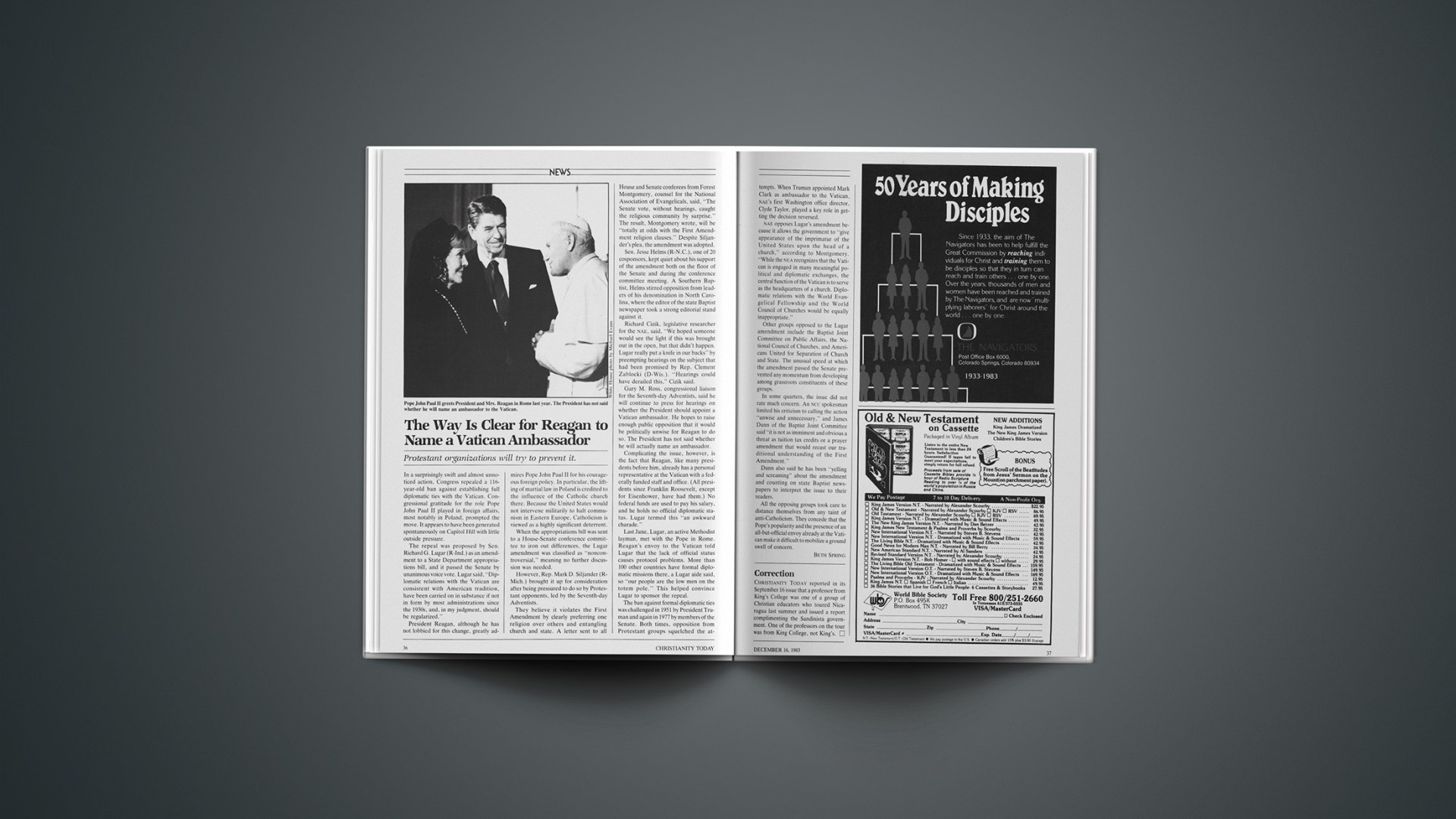
In a surprisingly swift and almost unnoticed action. Congress repealed a 116-year-old ban against establishing full diplomatic ties with the Vatican. Congressional gratitude for the role Pope John Paul II played in foreign affairs, most notably in Poland, prompted the move. It appears to have been generated spontaneously on Capitol Hill with little outside pressure.
The repeal was proposed by Sen. Richard G. Lugar (R-Ind.) as an amendment to a State Department appropriations bill, and it passed the Senate by unanimous voice vote. Lugar said, “Diplomatic relations with the Vatican are consistent with American tradition, have been carried on in substance if not in form by most administrations since the 1930s, and, in my judgment, should be regularized.”
President Reagan, although he has not lobbied for this change, greatly admires Pope John Paul II for his courageous foreign policy. In particular, the lifting of martial law in Poland is credited to the influence of the Catholic church there. Because the United States would not intervene militarily to halt communism in Eastern Europe, Catholicism is viewed as a highly significant deterrent.
When the appropriations bill was sent to a House-Senate conference committee to iron out differences, the Lugar amendment was classified as “noncontroversial,” meaning no further discussion was needed.
However, Rep. Mark D. Siljander (R-Mich.) brought it up for consideration after being pressured to do so by Protestant opponents, led by the Seventh-day Adventists.
They believe it violates the First Amendment by clearly preferring one religion over others and entangling church and state. A letter sent to all House and Senate conferees from Forest Montgomery, counsel for the National Association of Evangelicals, said, “The Senate vote, without hearings, caught the religious community by surprise.” The result, Montgomery wrote, will be “totally at odds with the First Amendment religion clauses.” Despite Siljander’s plea, the amendment was adopted.
Sen. Jesse Helms (R-N.C.), one of 20 cosponsors, kept quiet about his support of the amendment both on the floor of the Senate and during the conference committee meeting. A Southern Baptist, Helms stirred opposition from leaders of his denomination in North Carolina, where the editor of the state Baptist newspaper took a strong editorial stand against it.
Richard Cizik, legislative researcher for the NAE, said, “We hoped someone would see the light if this was brought out in the open, but that didn’t happen. Lugar really put a knife in our backs” by preempting hearings on the subject that had been promised by Rep. Clement Zablocki (D-Wis.). “Hearings could have derailed this,” Cizik said.
Gary M. Ross, congressional liaison for the Seventh-day Adventists, said he will continue to press for hearings on whether the President should appoint a Vatican ambassador. He hopes to raise enough public opposition that it would be politically unwise for Reagan to do so. The President has not said whether he will actually name an ambassador.
Complicating the issue, however, is the fact that Reagan, like many presidents before him, already has a personal representative at the Vatican with a federally funded staff and office. (All presidents since Franklin Roosevelt, except for Eisenhower, have had them.) No federal funds are used to pay his salary, and he holds no official diplomatic status. Lugar termed this “an awkward charade.”
Last June, Lugar, an active Methodist layman, met with the Pope in Rome. Reagan’s envoy to the Vatican told Lugar that the lack of official status causes protocol problems. More than 100 other countries have formal diplomatic missions there, a Lugar aide said, so “our people are the low men on the totem pole.” This helped convince Lugar to sponsor the repeal.
The ban against formal diplomatic ties was challenged in 1951 by President Truman and again in 1977 by members of the Senate. Both times, opposition from Protestant groups squelched the attempts. When Truman appointed Mark Clark as ambassador to the Vatican, NAE’s first Washington office director, Clyde Taylor, played a key role in getting the decision reversed.
NAE opposes Lugar’s amendment because it allows the government to “give appearance of the imprimatur of the United States upon the head of a church,” according to Montgomery. “While the NEA recognizes that the Vatican is engaged in many meaningful political and diplomatic exchanges, the central function of the Vatican is to serve as the headquarters of a church. Diplomatic relations with the World Evangelical Fellowship and the World Council of Churches would be equally inappropriate.”
Other groups opposed to the Lugar amendment include the Baptist Joint Committee on Public Affairs, the National Council of Churches, and Americans United for Separation of Church and State. The unusual speed at which the amendment passed the Senate prevented any momentum from developing among grassroots constituents of these groups.
In some quarters, the issue did not rate much concern. An NCC spokesman limited his criticism to calling the action “unwise and unnecessary,” and James Dunn of the Baptist Joint Committee said “it is not as immiment and obvious a threat as tuition tax credits or a prayer amendment that would recast our traditional understanding of the First Amendment.”
Dunn also said he has been “yelling and screaming” about the amendment and counting on state Baptist newspapers to interpret the issue to their readers.
All the opposing groups took care to distance themselves from any taint of anti-Catholicism. They concede that the Pope’s popularity and the presence of an all-but-official envoy already at the Vatican make it difficult to mobilize a ground swell of concern.
BETH SPRING
Correction
Christianity Today reported in its September 16 issue that a professor from King’s College was one of a group of Christian educators who toured Nicaragua last summer and issued a report complimenting the Sandinista government. One of the professors on the tour was from King College, not King’s.