
A new inclusive-language lectionary, funded by a division of the National Council of the Churches of Christ in the U.S.A. (NCC), is encountering a storm of protest.
During last month’s meeting of the NCC’s governing board, a caucus of Orthodox delegates disavowed the lectionary, calling it “a new apocryphal canon.” The Orthodox delegates asked the governing board to pass a resolution that would make it clear that the lectionary was “produced only by a committee of interested groups and individuals” and that the translation “is neither a product nor a consensus” of the NCC. Last month’s meeting was the first opportunity for governing board members to raise questions about the document.
The lectionary—Scripture readings for use in public worship—attempts to eliminate what translation committee members call “male bias” in Scripture. The Orthodox delegates agreed that the generic Greek word anthropos, often translated as “man” in English Bibles, can accurately be rendered as “person” or “human being.” But they said the lectionary goes too far in its attempts to remove male bias.
Any change in the biblical text that refers to God as both male and female implies “a false theology and substantially alters crucial biblical witness to the church’s understanding of God—Father, Son, and Holy Spirit,” the Orthodox statement said. In response to the Orthodox appeal, the governing board approved a resolution that recognized “divisions within and among” NCC member communions regarding the project. Besides the Orthodox church’s opposition, the head of the NCC-affiliated Lutheran Church in America advised his denomination against using it. Recently, NCC headquarters in New York City received a death threat against members of the lectionary committee.
The lectionary was produced by an 11-member committee appointed by the NCC’s Division of Education and Ministry. It is intended for voluntary and experimental use, and did not require approval of the governing board.
Much of the controversy (CT, Nov. 11, 1983, p. 50) revolves around such references to God as “Father (and Mother)”: the substitution of “Sovereign One” for “Lord”; and “the Human One” for “the Son of Man.” Lectionary committee members at the governing board meeting defended their translation as a document in which “the whole congregation is being addressed in its Scripture.”
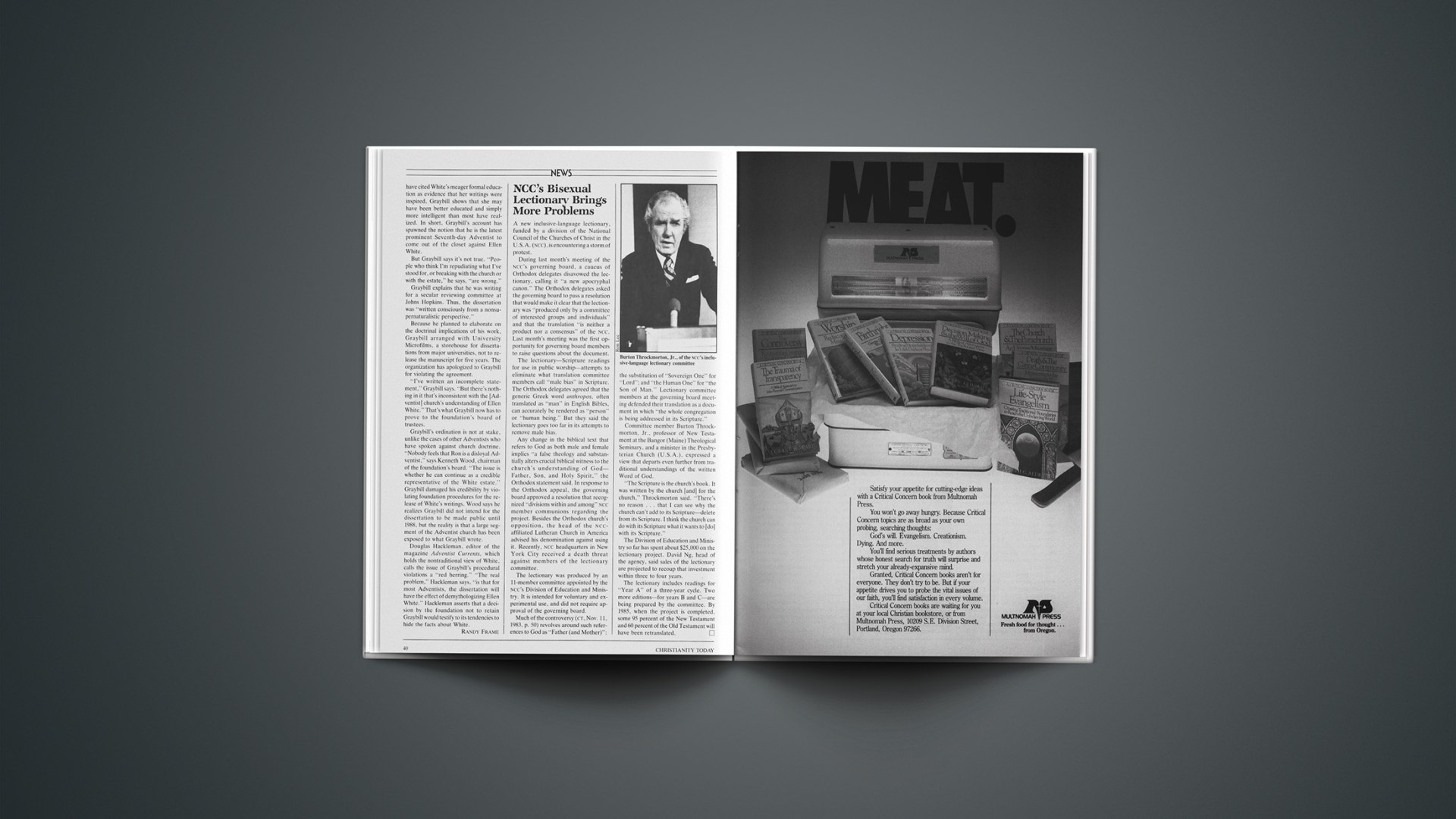
Committee member Burton Throckmorton. Jr., professor of New Testament at the Bangor (Maine) Theological Seminary, and a minister in the Presbyterian Church (U.S.A.), expressed a view that departs even further from traditional understandings of the written Word of God.
“The Scripture is the church’s book. It was written by the church [and] for the church,” Throckmorton said. “There’s no reason … that I can see why the church can’t add to its Scripture—delete from its Scripture. I think the church can do with its Scripture what it wants to [do] with its Scripture.”
The Division of Education and Ministry so far has spent about $25,000 on the lectionary project. David Ng, head of the agency, said sales of the lectionary are projected to recoup that investment within three to four years.
The lectionary includes readings for “Year A” of a three-year cycle. Two more editions—for years B and C—are being prepared by the committee. By 1985, when the project is completed, some 95 percent of the New Testament and 60 percent of the Old Testament will have been retranslated.