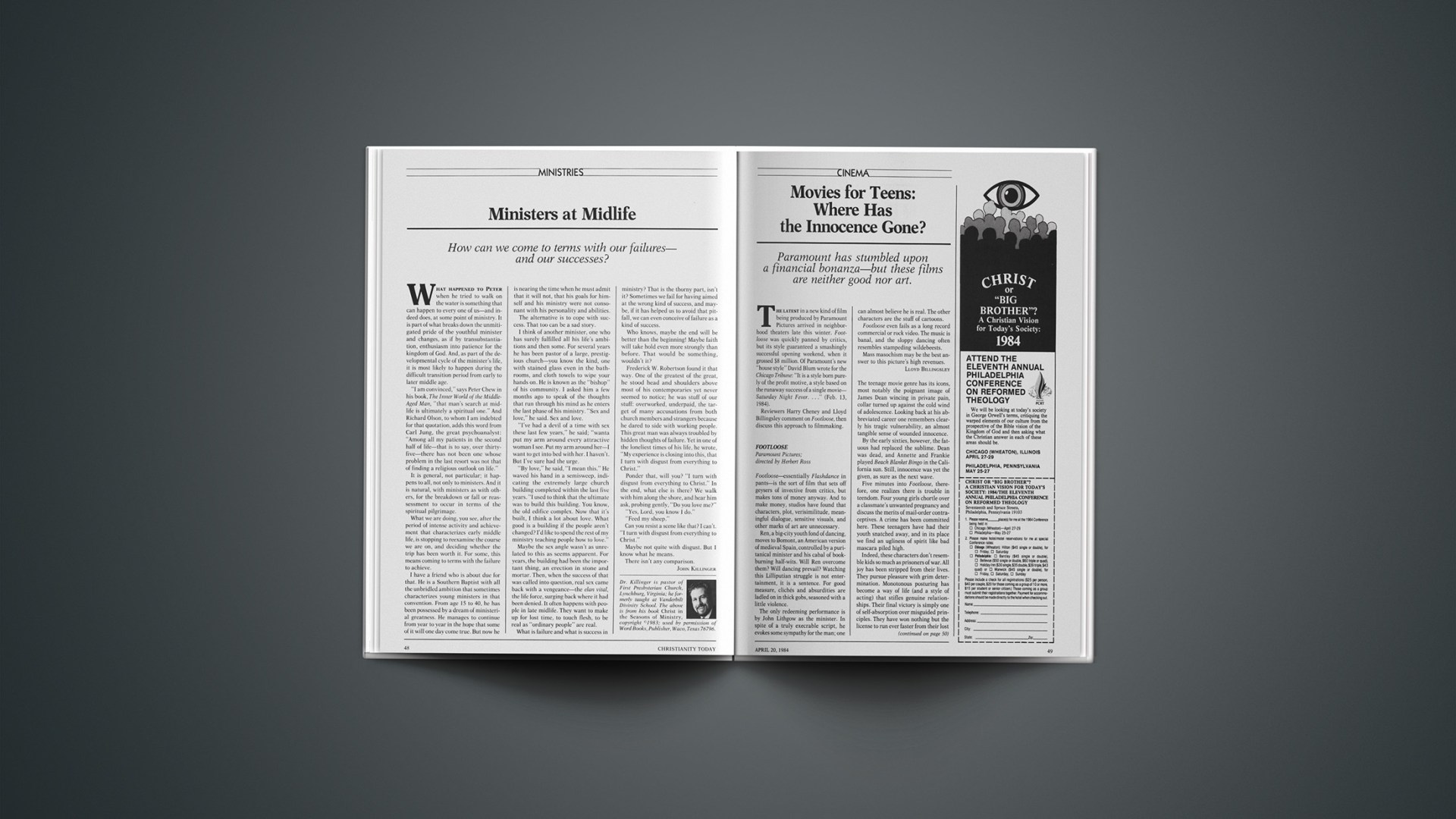
Paramount has stumbled upon a financial bonanza—but these films are neither good nor art.
The Latest in a new kind of film being produced by Paramount Pictures arrived in neighborhood theaters late this winter. Footloose was quickly panned by critics, but its style guaranteed a smashingly successful opening weekend, when it grossed $8 million. Of Paramount’s new “house style” David Blum wrote for the Chicago Tribune: “It is a style born purely of the profit motive, a style based on the runaway success of a single movie—Saturday Night Fever.…” (Feb. 13, 1984).
Reviewers Harry Cheney and Lloyd Billingsley comment on Footloose, then discuss this approach to filmmaking.
Footloose
Paramount Pictures;
directed by Herbert Ross
Footloose—essentially Flashdance in pants—is the sort of film that sets off geysers of invective from critics, but makes tons of money anyway. And to make money, studios have found that characters, plot, verisimilitude, meaningful dialogue, sensitive visuals, and other marks of art are unnecessary.
Ren, a big-city youth fond of dancing, moves to Bomont, an American version of medieval Spain, controlled by a puritanical minister and his cabal of book-burning half-wits. Will Ren overcome them? Will dancing prevail? Watching this Lilliputian struggle is not entertainment, it is a sentence. For good measure, clichés and absurdities are ladled on in thick gobs, seasoned with a little violence.
The only redeeming performance is by John Lithgow as the minister. In spite of a truly execrable script, he evokes some sympathy for the man; one can almost believe he is real. The other characters are the stuff of cartoons.
Footloose even fails as a long record commercial or rock video. The music is banal, and the sloppy dancing often resembles stampeding wildebeests.
Mass masochism may be the best answer to this picture’s high revenues.
LLOYD BILLINGSLEY
The teenage movie genre has its icons, most notably the poignant image of James Dean wincing in private pain, collar turned up against the cold wind of adolescence. Looking back at his abbreviated career one remembers clearly his tragic vulnerability, an almost tangible sense of wounded innocence.
By the early sixties, however, the fatuous had replaced the sublime. Dean was dead, and Annette and Frankie played Beach Blanket Bingo in the California sun. Still, innocence was yet the given, as sure as the next wave.
Five minutes into Footloose, therefore, one realizes there is trouble in teendom. Four young girls chortle over a classmate’s unwanted pregnancy and discuss the merits of mail-order contraceptives. A crime has been committed here. These teenagers have had their youth snatched away, and in its place we find an ugliness of spirit like bad mascara piled high.
Indeed, these characters don’t resemble kids so much as prisoners of war. All joy has been stripped from their lives. They pursue pleasure with grim determination. Monotonous posturing has become a way of life (and a style of acting) that stifles genuine relationships. Their final victory is simply one of self-absorption over misguided principles. They have won nothing but the license to run ever faster from their lost innocence.
HARRY M. CHENEY
Why are films like Footloose so popular when they are panned by the critics?
Cheney: Most kids don’t read anymore.
Billingsley: A recent MTV press packet said that kids can’t follow plots and aren’t into well-developed characters.
The Tribune story said these films are “made for a generation of moviegoers bred on the sameness of television.”
Billingsley: I’d agree. Also, the actors suffer. They get horrible scripts. The studios go more just for appearances—it doesn’t matter how good the actor is.
Cheney: I get the impression a lot of the kids in these movies have a kind of smug maturity about them that’s really irritating—although I like Kevin Bacon in this. But others are terrible actors, and they seem to revel in their obnoxious roles.
Who goes to see these films?
Cheney: When I went, the audience was mostly kids 14 and under. Footloose is rated PG, but a lot of these movies are rated R. I wonder who the studios are really trying to sell them to? It seems as if the ratings system is breaking down—the kids are all getting in. Films like Porkys seem to be made more for dirty old men than the kids.
Billingsley: The films only reflect the problem, which is a tasteless populace.
Cheney: But you know, parents are indiscriminate—they drop their kids off at any movie and go shopping.
Films like Footloose and Flashdance may not be a novel trend, though—they’ve been making mindless movies for kids for ages. I think the difference is that visually these films are much more serious; they come off as high art and high truth.
Billingsley: It must be happy days in the studios now that they’ve discovered they don’t need any of the component parts of good film to make money.
Cheney: It’s really sad. I don’t know any teenagers like these.
Billingsley: When I saw it, some teenagers seemed to be scoffing at it. I think it’s peer pressure and conformity: “Have you seen this?” or “You must see it.”
Isn’t one of the problems that kids who see these films can fantasize that this is the way life is?
Cheney: Movies and TV may not have as big an influence as some people feel. But yes, they can go in and think: This is the way I’d like to be.