






A pastorale thriller in which pacifism confronts violence.
Paramount Pictures, directed by Peter Weir; rated R.
As a pastorale thriller, Witness is a deliberate contradiction in terms: a tale of murder and corruption set in a rural pacifist community. Throughout the film, similar juxtapositions of opposites are calculated to achieve an atmosphere of tension as two incompatible societies circle each other in wary curiosity. The resulting sensation is delightfully disorienting—a constant subversion of our expectations—as the ethical and social conflicts of the plot work themselves out in ways alien to modern twentieth-century logic.
The basic story is simple. With his widowed mother, a young Amish boy is visiting the city for the first time when he witnesses a murder. Investigating the crime, Detective John Book (Harrison Ford) discovers the killers are among his own colleagues in the police department and flees with the boy to hide out in an Amish community in Pennsylvania. A rather standard Hollywood concept thus becomes an instant metaphor for the differences between concepts of violent law enforcement and theological pacifism: active participation or hopeful neglect.
For each side, it is a question of involvement. The Amish believe the path to righteousness entails withdrawal from all entanglements with modernity. Detective Book, on the other hand, follows the broad path of punitive justice and revenge. Both traditions ultimately contribute to each other’s redemption, defeating sin in vastly different ways. But it is obvious from the start that this modern man has brought a plague upon their houses, and any collaboration can only be temporary. “Come out from among them and touch not the evil thing,” a bearded patriarch sternly warns his grandson.
The amount of separation required to preserve spiritual purity has always been a concern within the church. The Amish maintain their religious heritage at the expense of Christ’s command, “Go ye into all the world.” Yet the obvious piety of this simple group remains impressive.
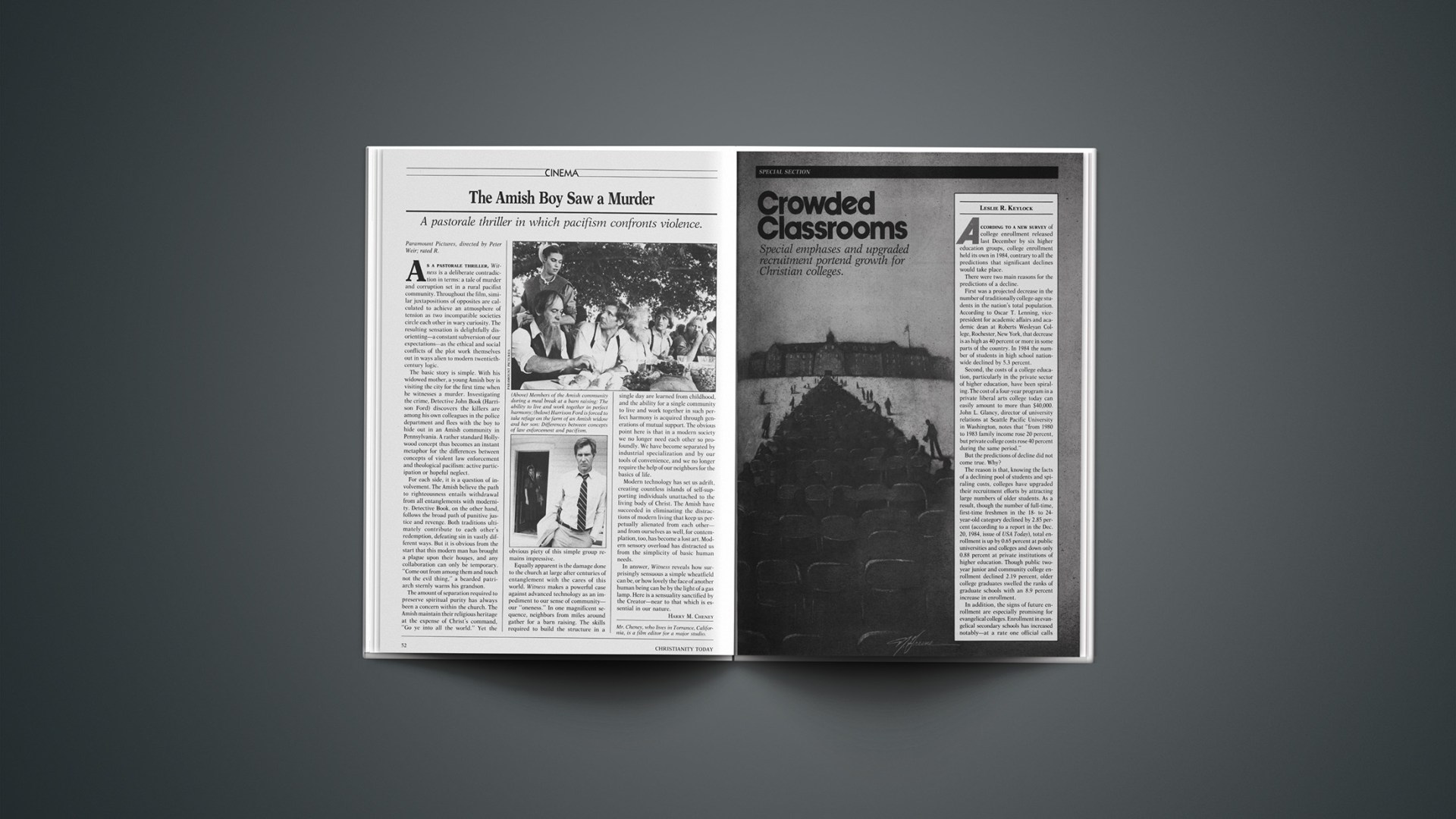
Equally apparent is the damage done to the church at large after centuries of entanglement with the cares of this world. Witness makes a powerful case against advanced technology as an impediment to our sense of community—our “oneness.” In one magnificent sequence, neighbors from miles around gather for a barn raising. The skills required to build the structure in a single day are learned from childhood, and the ability for a single community to live and work together in such perfect harmony is acquired through generations of mutual support. The obvious point here is that in a modern society we no longer need each other so profoundly. We have become separated by industrial specialization and by our tools of convenience, and we no longer require the help of our neighbors for the basics of life.
Modern technology has set us adrift, creating countless islands of self-supporting individuals unattached to the living body of Christ. The Amish have succeeded in eliminating the distractions of modern living that keep us perpetually alienated from each other—and from ourselves as well, for contemplation, too, has become a lost art. Modern sensory overload has distracted us from the simplicity of basic human needs.
In answer, Witness reveals how surprisingly sensuous a simple wheatfield can be, or how lovely the face of another human being can be by the light of a gas lamp. Here is a sensuality sanctified by the Creator—near to that which is essential in our nature.
1 Mr. Cheney, who lives in Torrance, California, is a film editor for a major studio.







