






National Association of Evangelicals executive stresses that the trip will be nonpolitical.
Church leaders representing the National Association of Evangelicals (NAE) plan to visit Nicaragua next month to assess how NAE-member denominations are faring in that Central American country, NAE executive director Billy Melvin said the church leaders will meet with pastors in Nicaragua. He said the visitors will travel independently and not as invited guests of any Nicaraguan group.
“We are going to show love and concern for our brothers and sisters in our churches in the country. It is not our purpose to get involved in the politics of the situation,” Melvin said. “It is our intent to simply identify with the evangelicals and express our concern so we can more intelligently pray for them and encourage our churches here to pray for them.”
NAE executives discussed plans for the visit at the organization’s forty-third annual convention in Los Angeles last month. The meeting emphasized evangelism, evangelical cooperation, ministry to families, and, for the first time, included program activities in Spanish for Hispanic evangelical leaders.
Discussing next month’s trip to Nicaragua, Melvin told CHRISTIANITY TODAY that churches in that country are growing rapidly. The ruling Sandinistas claim to support religious freedom. However, serious questions have surfaced about civil rights there and the treatment accorded certain religious groups. Christians have been outspoken on both sides of the issue, and visits to Nicaragua by U.S. church representatives have resulted in widely discrepant views of what is happening.
NAE officials note that some groups making pronouncements about Nicaragua have no constituency there. Because NAE-member denominations have a presence there, Melvin said, “we’re not going to sit idly by when our people need encouragement and love and prayer.” The NAE group has not contacted cepad, an evangelical pastors’ coalition that is supportive of the Sandinistas. Melvin said that if the NAE delegates meet with CEPAD or any other ecumenical group, they will simply pay “courtesy calls” so there is no confusion over NAE’S intent to remain apolitical.
A significant portion of last month’s NAE convention was devoted to discussion of a report from the organization’s Task Force on the Family. The task force discussed survey results suggesting that pastors in NAE-member denominations may be poorly equipped to deal with problems of family discord in their churches. More than half of the pastors who responded to the survey said family breakups are on the rise in their churches. Yet, paradoxically, they said they believe they can minister in those situations without seeking assistance.
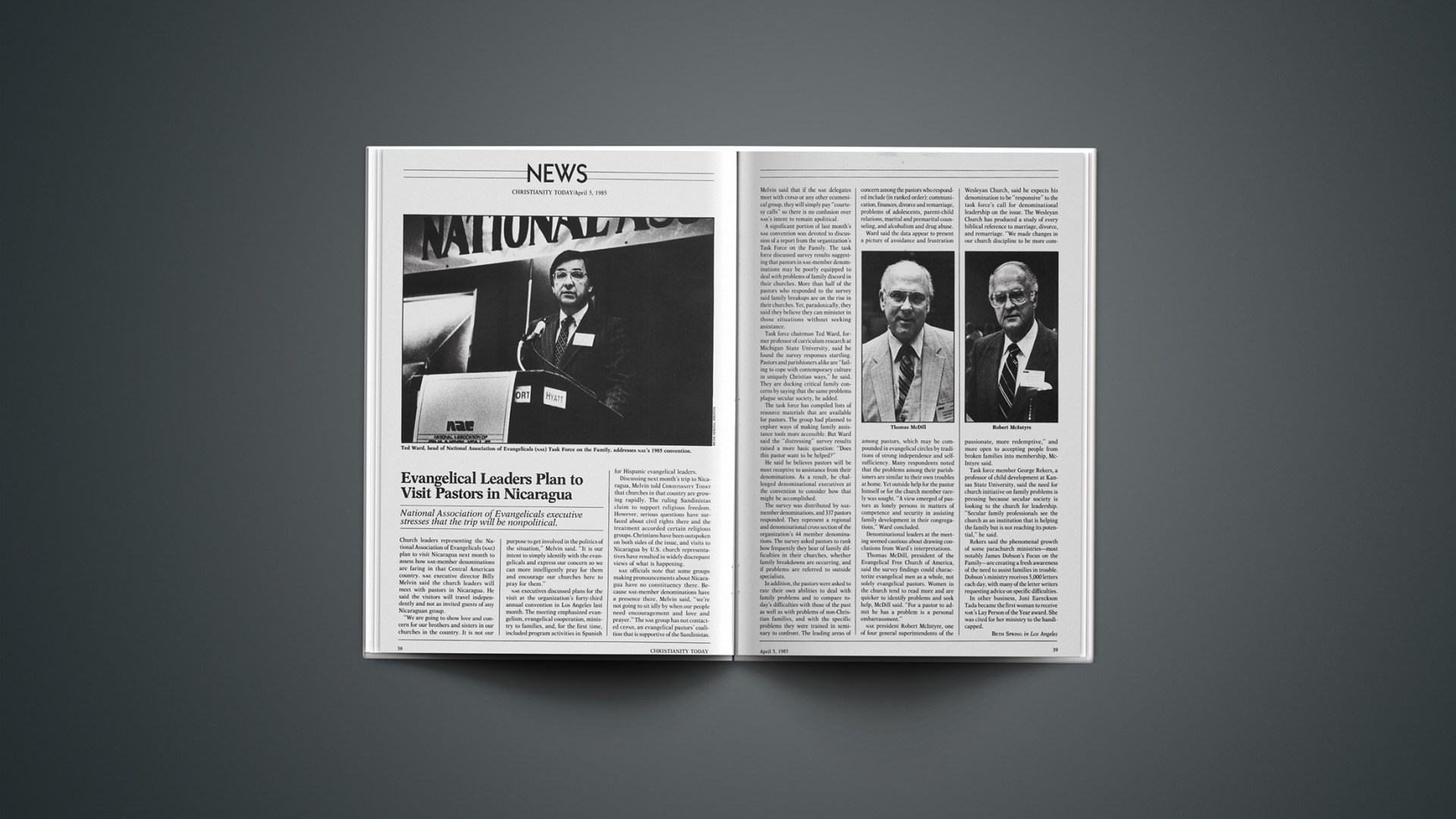
Task force chairman Ted Ward, former professor of curriculum research at Michigan State University, said he found the survey responses startling. Pastors and parishioners alike are “failing to cope with contemporary culture in uniquely Christian ways,” he said. They are ducking critical family concerns by saying that the same problems plague secular society, he added.
The task force has compiled lists of resource materials that are available for pastors. The group had planned to explore ways of making family assistance tools more accessible. But Ward said the “distressing” survey results raised a more basic question: “Does this pastor want to be helped?”
He said he believes pastors will be most receptive to assistance from their denominations. As a result, he challenged denominational executives at the convention to consider how that might be accomplished.
The survey was distributed by NAE-member denominations, and 337 pastors responded. They represent a regional and denominational cross section of the organization’s 44 member denominations. The survey asked pastors to rank how frequently they hear of family difficulties in their churches, whether family breakdowns are occurring, and if problems are referred to outside specialists.
In addition, the pastors were asked to rate their own abilities to deal with family problems and to compare today’s difficulties with those of the past as well as with problems of non-Christian families, and with the specific problems they were trained in seminary to confront. The leading areas of concern among the pastors who responded include (in ranked order): communication, finances, divorce and remarriage, problems of adolescents, parent-child relations, marital and premarital counseling, and alcoholism and drug abuse.
Ward said the data appear to present a picture of avoidance and frustration among pastors, which may be compounded in evangelical circles by traditions of strong independence and self-sufficiency. Many respondents noted that the problems among their parishioners are similar to their own troubles at home. Yet outside help for the pastor himself or for the church member rarely was sought. “A view emerged of pastors as lonely persons in matters of competence and security in assisting family development in their congregations,” Ward concluded.
Denominational leaders at the meeting seemed cautious about drawing conclusions from Ward’s interpretations.
Thomas McDill, president of the Evangelical Free Church of America, said the survey findings could characterize evangelical men as a whole, not solely evangelical pastors. Women in the church tend to read more and are quicker to identify problems and seek help, McDill said. “For a pastor to admit he has a problem is a personal embarrassment.”
NAE president Robert McIntyre, one of four general superintendents of the Wesleyan Church, said he expects his denomination to be “responsive” to the task force’s call for denominational leadership on the issue. The Wesleyan Church has produced a study of every biblical reference to marriage, divorce, and remarriage. “We made changes in our church discipline to be more compassionate, more redemptive,” and more open to accepting people from broken families into membership, McIntyre said.
Task force member George Rekers, a professor of child development at Kansas State University, said the need for church initiative on family problems is pressing because secular society is looking to the church for leadership. “Secular family professionals see the church as an institution that is helping the family but is not reaching its potential,” he said.
Rekers said the phenomenal growth of some parachurch ministries—most notably James Dobson’s Focus on the Family—are creating a fresh awareness of the need to assist families in trouble. Dobson’s ministry receives 5,000 letters each day, with many of the letter writers requesting advice on specific difficulties.
In other business, Joni Eareckson Tada became the first woman to receive NAE’s Lay Person of the Year award. She was cited for her ministry to the handicapped.







