This little Babe so few days old,
Is come to rifle Satan’s fold,
All hell doth at his presence quake,
Though he himself for cold do shake.
—“This Little Babe” Robert Southwell (16th century)
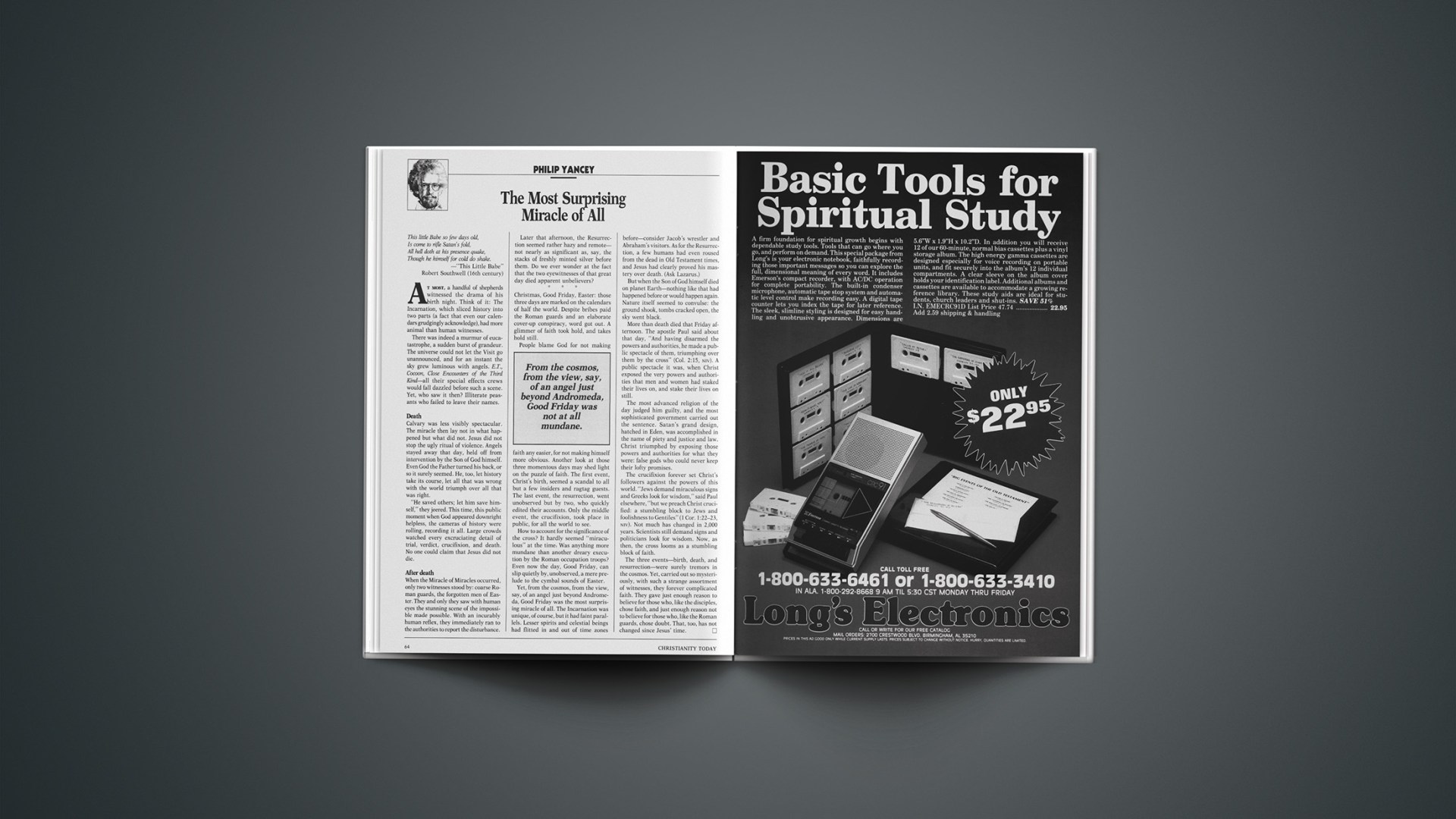
At most, a handful of shepherds witnessed the drama of his birth night. Think of it: The Incarnation, which sliced history into two parts (a fact that even our calendars grudgingly acknowledge), had more animal than human witnesses.
There was indeed a murmur of eucatastrophe, a sudden burst of grandeur. The universe could not let the Visit go unannounced, and for an instant the sky grew luminous with angels. E.T., Cocoon, Close Encounters of the Third Kind—all their special effects crews would fall dazzled before such a scene. Yet, who saw it then? Illiterate peasants who failed to leave their names.
Death
Calvary was less visibly spectacular. The miracle then lay not in what happened but what did not. Jesus did not stop the ugly ritual of violence. Angels stayed away that day, held off from intervention by the Son of God himself. Even God the Father turned his back, or so it surely seemed. He, too, let history take its course, let all that was wrong with the world triumph over all that was right.
“He saved others; let him save himself,” they jeered. This time, this public moment when God appeared downright helpless, the cameras of history were rolling, recording it all. Large crowds watched every excruciating detail of trial, verdict, crucifixion, and death. No one could claim that Jesus did not die.
After Death
When the Miracle of Miracles occurred, only two witnesses stood by: coarse Roman guards, the forgotten men of Easter. They and only they saw with human eyes the stunning scene of the impossible made possible. With an incurably human reflex, they immediately ran to the authorities to report the disturbance.
Later that afternoon, the Resurrection seemed rather hazy and remote—not nearly as significant as, say, the stacks of freshly minted silver before them. Do we ever wonder at the fact that the two eyewitnesses of that great day died apparent unbelievers?
Christmas, Good Friday, Easter: those three days are marked on the calendars of half the world. Despite bribes paid the Roman guards and an elaborate cover-up conspiracy, word got out. A glimmer of faith took hold, and takes hold still.
People blame God for not making faith any easier, for not making himself more obvious. Another look at those three momentous days may shed light on the puzzle of faith. The first event, Christ’s birth, seemed a scandal to all but a few insiders and ragtag guests. The last event, the resurrection, went unobserved but by two, who quickly edited their accounts. Only the middle event, the crucifixion, took place in public, for all the world to see.
How to account for the significance of the cross? It hardly seemed “miraculous” at the time-. Was anything more mundane than another dreary execution by the Roman occupation troops? Even now the day, Good Friday, can slip quietly by, unobserved, a mere prelude to the cymbal sounds of Easter.
Yet, from the cosmos, from the view, say, of an angel just beyond Andromeda, Good Friday was the most surprising miracle of all. The Incarnation was unique, of course, but it had faint parallels. Lesser spirits and celestial beings had flitted in and out of time zones before—consider Jacob’s wrestler and Abraham’s visitors. As for the Resurrection, a few humans had even roused from the dead in Old Testament times, and Jesus had clearly proved his mastery over death. (Ask Lazarus.)
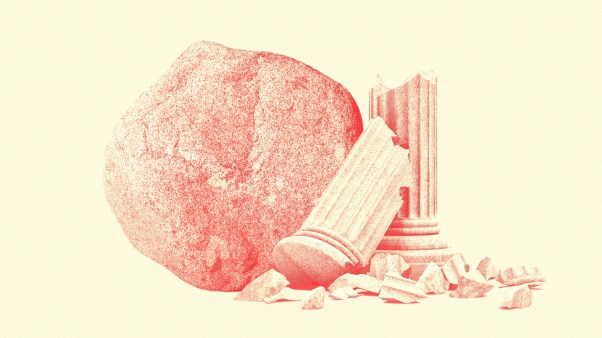
But when the Son of God himself died on planet Earth—nothing like that had happened before or would happen again. Nature itself seemed to convulse: the ground shook, tombs cracked open, the sky went black.
More than death died that Friday afternoon. The apostle Paul said about that day, “And having disarmed the powers and authorities, he made a public spectacle of them, triumphing over them by the cross” (Col. 2:15, NIV). A public spectacle it was, when Christ exposed the very powers and authorities that men and women had staked their lives on, and stake their lives on still.
The most advanced religion of the day judged him guilty, and the most sophisticated government carried out the sentence. Satan’s grand design, hatched in Eden, was accomplished in the name of piety and justice and law. Christ triumphed by exposing those powers and authorities for what they were: false gods who could never keep their lofty promises.
The crucifixion forever set Christ’s followers against the powers of this world. “Jews demand miraculous signs and Greeks look for wisdom,” said Paul elsewhere, “but we preach Christ crucified: a stumbling block to Jews and foolishness to Gentiles” (1 Cor. 1:22–23, NIV). Not much has changed in 2,000 years. Scientists still demand signs and politicians look for wisdom. Now, as then, the cross looms as a stumbling block of faith.
The three events—birth, death, and resurrection—were surely tremors in the cosmos. Yet, carried out so mysteriously, with such a strange assortment of witnesses, they forever complicated faith. They gave just enough reason to believe for those who, like the disciples, chose faith, and just enough reason not to believe for those who, like the Roman guards, chose doubt. That, too, has not changed since Jesus’ time.