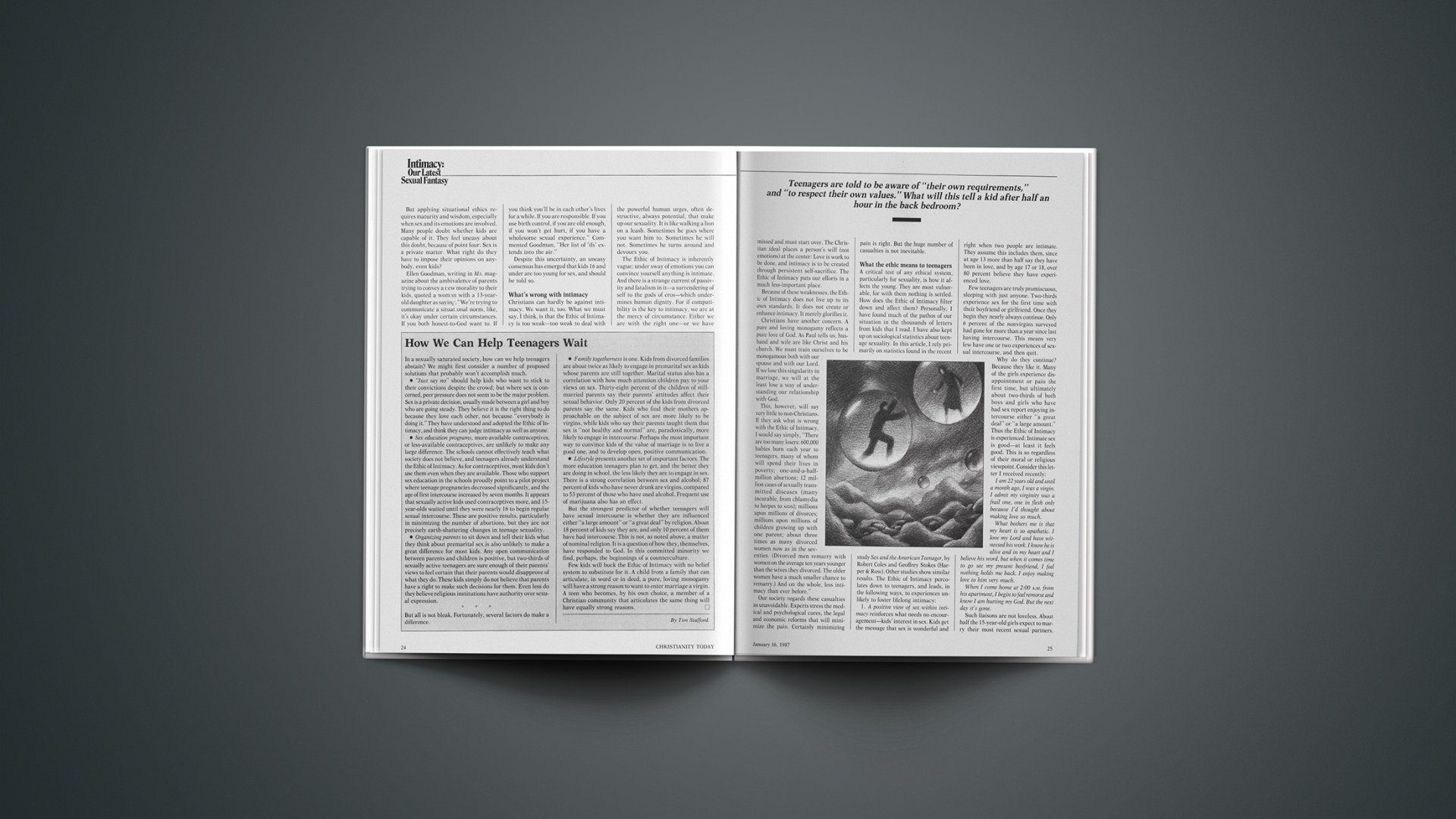

In a sexually saturated society, how can we help teenagers abstain? We might first consider a number of proposed solutions that probably won’t accomplish much.
- “Just say no” should help kids who want to stick to their convictions despite the crowd; but where sex is concerned, peer pressure does not seem to be the major problem. Sex is a private decision, usually made between a girl and boy who are going steady. They believe it is the right thing to do because they love each other, not because “everybody is doing it.” They have understood and adopted the Ethic of Intimacy, and think they can judge intimacy as well as anyone.
- Sex education programs, more-available contraceptives, or less-available contraceptives, are unlikely to make any large difference. The schools cannot effectively teach what society does not believe, and teenagers already understand the Ethic of Intimacy. As for contraceptives, most kids don’t use them even when they are available. Those who support sex education in the schools proudly point to a pilot project where teenage pregnancies decreased significantly, and the age of first intercourse increased by seven months. It appears that sexually active kids used contraceptives more, and 15-year-olds waited until they were nearly 16 to begin regular sexual intercourse. These are positive results, particularly in minimizing the number of abortions, but they are not precisely earth-shattering changes in teenage sexuality.
- Organizing parents to sit down and tell their kids what they think about premarital sex is also unlikely to make a great difference for most kids. Any open communication between parents and children is positive, but two-thirds of sexually active teenagers are sure enough of their parents’ views to feel certain that their parents would disapprove of what they do. These kids simply do not believe that parents have a right to make such decisions for them. Even less do they believe religious institutions have authority over sexual expression.
But all is not bleak. Fortunately, several factors do make a difference.
- Family togetherness is one. Kids from divorced families are about twice as likely to engage in premarital sex as kids whose parents are still together. Marital status also has a correlation with how much attention children pay to your views on sex. Thirty-eight percent of the children of still-married parents say their parents’ attitudes affect their sexual behavior. Only 20 percent of the kids from divorced parents say the same. Kids who find their mothers approachable on the subject of sex are more likely to be virgins, while kids who say their parents taught them that sex is “not healthy and normal” are, paradoxically, more likely to engage in intercourse. Perhaps the most important way to convince kids of the value of marriage is to live a good one, and to develop open, positive communication.
- Lifestyle presents another set of important factors. The more education teenagers plan to get, and the better they are doing in school, the less likely they are to engage in sex. There is a strong correlation between sex and alcohol; 87 percent of kids who have never drunk are virgins, compared to 53 percent of those who have used alcohol. Frequent use of marijuana also has an effect.
But the strongest predictor of whether teenagers will have sexual intercourse is whether they are influenced either “a large amount” or “a great deal” by religion. About 18 percent of kids say they are, and only 10 percent of them have had intercourse. This is not, as noted above, a matter of nominal religion. It is a question of how they, themselves, have responded to God. In this committed minority we find, perhaps, the beginnings of a counterculture.
Few kids will buck the Ethic of Intimacy with no belief system to substitute for it. A child from a family that can articulate, in word or in deed, a pure, loving monogamy will have a strong reason to want to enter marriage a virgin. A teen who becomes, by his own choice, a member of a Christian community that articulates the same thing will have equally strong reasons.
By Tim Stafford.