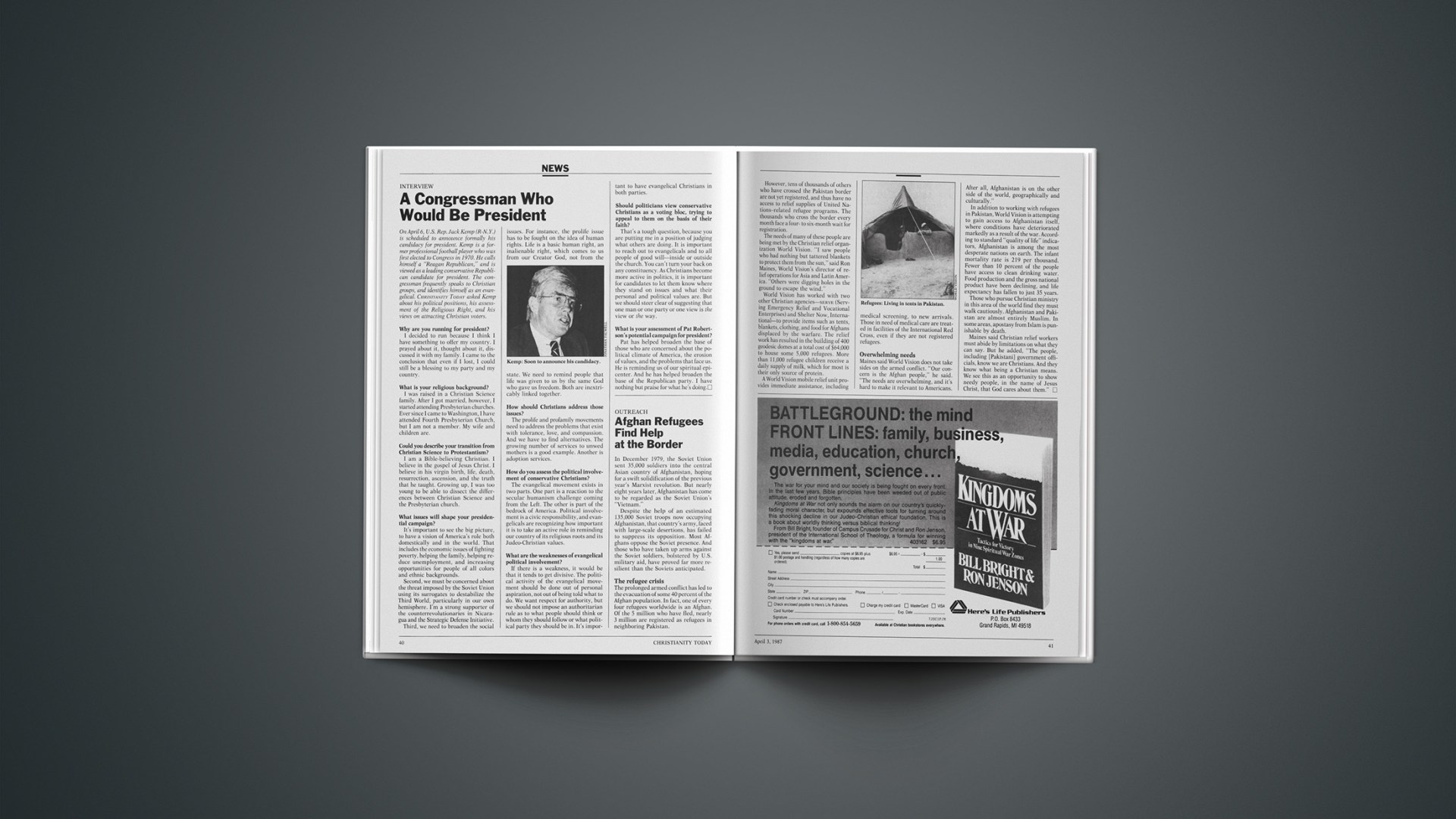

In December 1979, the Soviet Union sent 35,000 soldiers into the central Asian country of Afghanistan, hoping for a swift solidification of the previous year’s Marxist revolution. But nearly eight years later, Afghanistan has come to be regarded as the Soviet Union’s “Vietnam.”
Despite the help of an estimated 135,000 Soviet troops now occupying Afghanistan, that country’s army, faced with large-scale desertions, has failed to suppress its opposition. Most Afghans oppose the Soviet presence. And those who have taken up arms against the Soviet soldiers, bolstered by U.S. military aid, have proved far more resilient than the Soviets anticipated.
The Refugee Crisis
The prolonged armed conflict has led to the evacuation of some 40 percent of the Afghan population. In fact, one of every four refugees worldwide is an Afghan. Of the 5 million who have fled, nearly 3 million are registered as refugees in neighboring Pakistan.
However, tens of thousands of others who have crossed the Pakistan border are not yet registered, and thus have no access to relief supplies of United Nations-related refugee programs. The thousands who cross the border every month face a four-to six-month wait for registration.
The needs of many of these people are being met by the Christian relief organization World Vision. “I saw people who had nothing but tattered blankets to protect them from the sun,” said Ron Maines, World Vision’s director of relief operations for Asia and Latin America. “Others were digging holes in the ground to escape the wind.”
World Vision has worked with two other Christian agencies—SERVE (Serving Emergency Relief and Vocational Enterprises) and Shelter Now, International—to provide items such as tents, blankets, clothing, and food for Afghans displaced by the warfare. The relief work has resulted in the building of 400 geodesic domes at a total cost of $64,000 to house some 5,000 refugees. More than 11,000 refugee children receive a daily supply of milk, which for most is their only source of protein.
A World Vision mobile relief unit provides immediate assistance, including medical screening, to new arrivals. Those in need of medical care are treated in facilities of the International Red Cross, even if they are not registered refugees.
Overwhelming Needs
Maines said World Vision does not take sides on the armed conflict. “Our concern is the Afghan people,” he said. “The needs are overwhelming, and it’s hard to make it relevant to Americans. After all, Afghanistan is on the other side of the world, geographically and culturally.”
In addition to working with refugees in Pakistan, World Vision is attempting to gain access to Afghanistan itself, where conditions have deteriorated markedly as a result of the war. According to standard “quality of life” indicators, Afghanistan is among the most desperate nations on earth. The infant mortality rate is 219 per thousand. Fewer than 10 percent of the people have access to clean drinking water. Food production and the gross national product have been declining, and life expectancy has fallen to just 35 years.
Those who pursue Christian ministry in this area of the world find they must walk cautiously. Afghanistan and Pakistan are almost entirely Muslim. In some areas, apostasy from Islam is punishable by death.
Maines said Christian relief workers must abide by limitations on what they can say. But he added, “The people, including [Pakistani] government officials, know we are Christians. And they know what being a Christian means. We see this as an opportunity to show needy people, in the name of Jesus Christ, that God cares about them.”