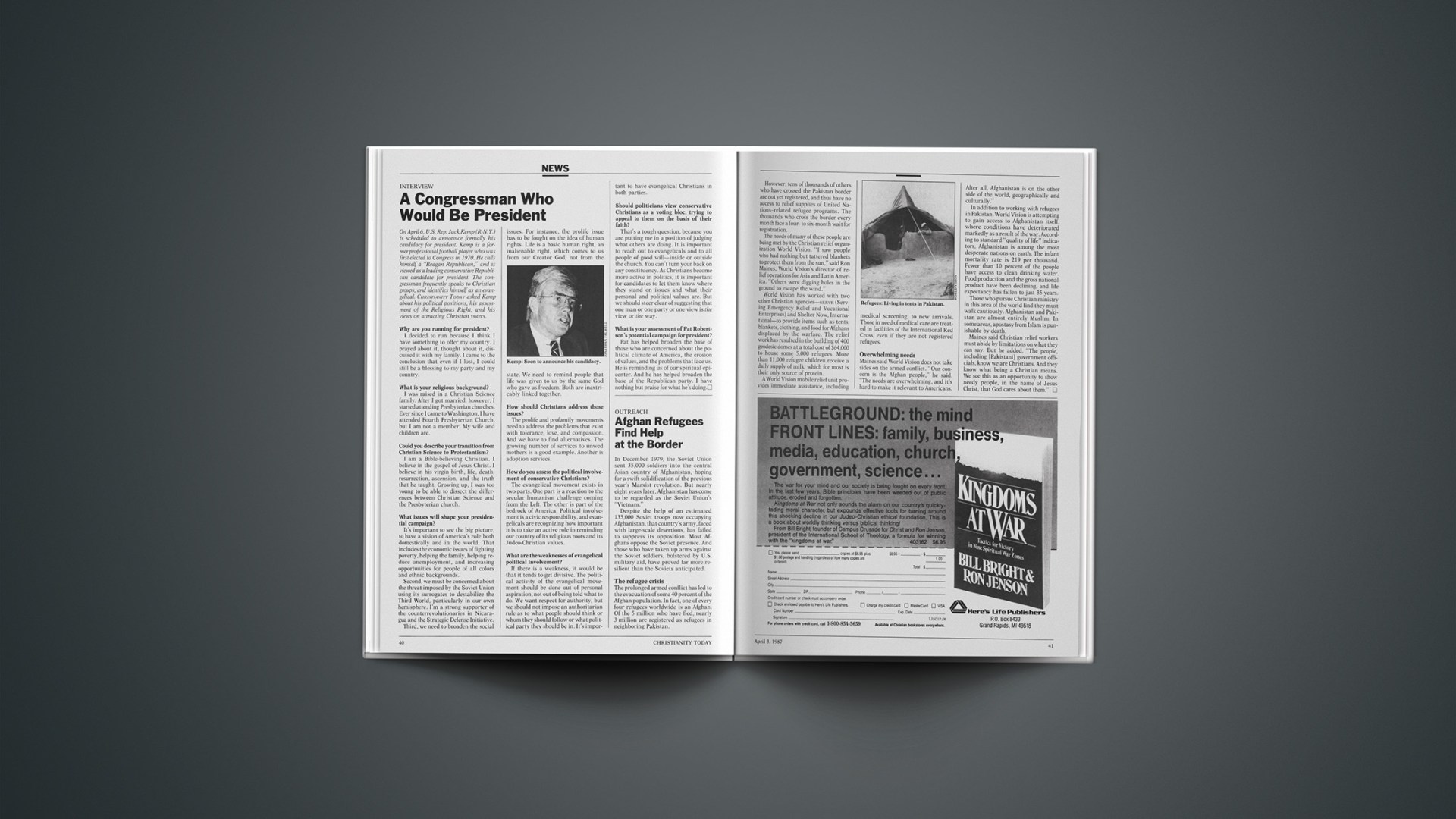

On April 6, U.S. Rep. Jack Kemp (R-N.Y.) is scheduled to announce formally his candidacy for president. Kemp is a former professional football player who was first elected to Congress in 1970. He calls himself a “Reagan Republican,” and is viewed as a leading conservative Republican candidate for president. The congressman frequently speaks to Christian groups, and identifies himself as an evangelical. CHRISTIANITY TODAY asked Kemp about his political positions, his assessment of the Religious Right, and his views on attracting Christian voters.
Why are you running for president?
I decided to run because I think I have something to offer my country. I prayed about it, thought about it, discussed it with my family. I came to the conclusion that even if I lost, I could still be a blessing to my party and my country.
What is your religious background?
I was raised in a Christian Science family. After I got married, however, I started attending Presbyterian churches. Ever since I came to Washington, I have attended Fourth Presbyterian Church, but I am not a member. My wife and children are.
Could you describe your transition from Christian Science to Protestantism?
I am a Bible-believing Christian. I believe in the gospel of Jesus Christ. I believe in his virgin birth, life, death, resurrection, ascension, and the truth that he taught. Growing up, I was too young to be able to dissect the differences between Christian Science and the Presbyterian church.
What issues will shape your presidential campaign?
It’s important to see the big picture, to have a vision of America’s role both domestically and in the world. That includes the economic issues of fighting poverty, helping the family, helping reduce unemployment, and increasing opportunities for people of all colors and ethnic backgrounds.
Second, we must be concerned about the threat imposed by the Soviet Union using its surrogates to destabilize the Third World, particularly in our own hemisphere. I’m a strong supporter of the counterrevolutionaries in Nicaragua and the Strategic Defense Initiative.
Third, we need to broaden the social issues. For instance, the prolife issue has to be fought on the idea of human rights. Life is a basic human right, an inalienable right, which comes to us from our Creator God, not from the state. We need to remind people that life was given to us by the same God who gave us freedom. Both are inextricably linked together.
How should Christians address those issues?
The prolife and profamily movements need to address the problems that exist with tolerance, love, and compassion. And we have to find alternatives. The growing number of services to unwed mothers is a good example. Another is adoption services.
How do you assess the political involvement of conservative Christians?
The evangelical movement exists in two parts. One part is a reaction to the secular humanism challenge coming from the Left. The other is part of the bedrock of America. Political involvement is a civic responsibility, and evangelicals are recognizing how important it is to take an active role in reminding our country of its religious roots and its Judeo-Christian values.
What are the weaknesses of evangelical political involvement?
If there is a weakness, it would be that it tends to get divisive. The political activity of the evangelical movement should be done out of personal aspiration, not out of being told what to do. We want respect for authority, but we should not impose an authoritarian rule as to what people should think or whom they should follow or what political party they should be in. It’s important to have evangelical Christians in both parties.
Should politicians view conservative Christians as a voting bloc, trying to appeal to them on the basis of their faith?
That’s a tough question, because you are putting me in a position of judging what others are doing. It is important to reach out to evangelicals and to all people of good will—inside or outside the church. You can’t turn your back on any constituency. As Christians become more active in politics, it is important for candidates to let them know where they stand on issues and what their personal and political values are. But we should steer clear of suggesting that one man or one party or one view is the view or the way.
What is your assessment of Pat Robertson’s potential campaign for president?
Pat has helped broaden the base of those who are concerned about the political climate of America, the erosion of values, and the problems that face us. He is reminding us of our spiritual epicenter. And he has helped broaden the base of the Republican party. I have nothing but praise for what he’s doing.