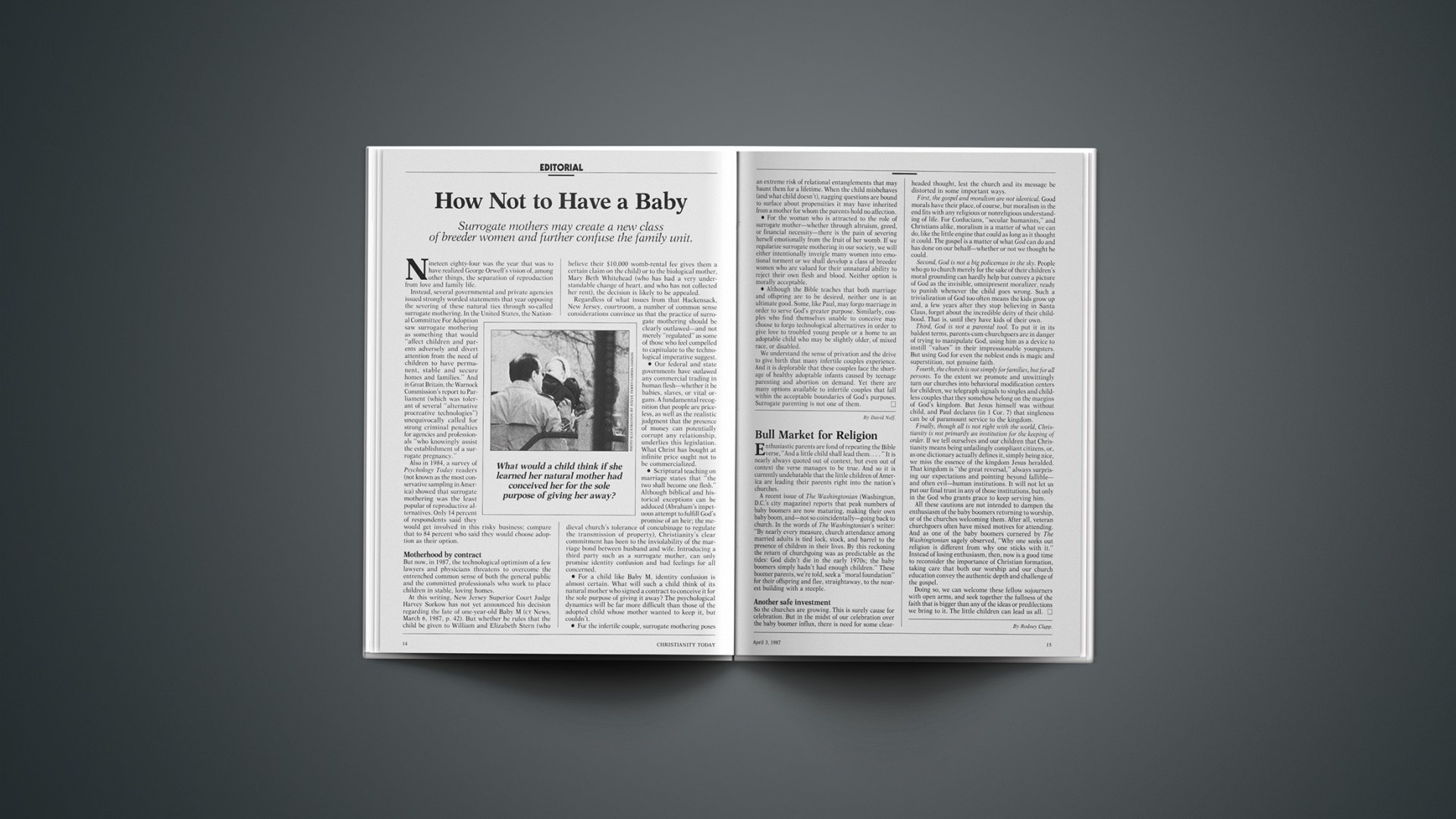

Enthusiastic parents are fond of repeating the Bible verse, “And a little child shall lead them.…” It is nearly always quoted out of context, but even out of context the verse manages to be true. And so it is currently undebatable that the little children of America are leading their parents right into the nation’s churches.
A recent issue of The Washingtonian (Washington, D.C.’s city magazine) reports that peak numbers of baby boomers are now maturing, making their own baby boom, and—not so coincidentally—going back to church. In the words of The Washingtonian’s writer: “By nearly every measure, church attendance among married adults is tied lock, stock, and barrel to the presence of children in their lives. By this reckoning the return of churchgoing was as predictable as the tides: God didn’t die in the early 1970s; the baby boomers simply hadn’t had enough children.” These boomer parents, we’re told, seek a “moral foundation” for their offspring and flee, straightaway, to the nearest building with a steeple.
Another Safe Investment
So the churches are growing. This is surely cause for celebration. But in the midst of our celebration over the baby boomer influx, there is need for some clearheaded thought, lest the church and its message be distorted in some important ways.
First, the gospel and moralism are not identical. Good morals have their place, of course, but moralism in the end fits with any religious or nonreligious understanding of life. For Confucians, “secular humanists,” and Christians alike, moralism is a matter of what we can do, like the little engine that could as long as it thought it could. The gospel is a matter of what God can do and has done on our behalf—whether or not we thought he could.
Second, God is not a big policeman in the sky. People who go to church merely for the sake of their children’s moral grounding can hardly help but convey a picture of God as the invisible, omnipresent moralizer, ready to punish whenever the child goes wrong. Such a trivialization of God too often means the kids grow up and, a few years after they stop believing in Santa Claus, forget about the incredible deity of their childhood. That is, until they have kids of their own.
Third, God is not a parental tool. To put it in its baldest terms, parents-cum-churchgoers are in danger of trying to manipulate God, using him as a device to instill “values” in their impressionable youngsters. But using God for even the noblest ends is magic and superstition, not genuine faith.
Fourth, the church is not simply for families, but for all persons. To the extent we promote and unwittingly turn our churches into behavioral modification centers for children, we telegraph signals to singles and childless couples that they somehow belong on the margins of God’s kingdom. But Jesus himself was without child, and Paul declares (in 1 Cor. 7) that singleness can be of paramount service to the kingdom.
Finally, though all is not right with the world, Christianity is not primarily an institution for the keeping of order. If we tell ourselves and our children that Christianity means being unfailingly compliant citizens, or, as one dictionary actually defines it, simply being nice, we miss the essence of the kingdom Jesus heralded. That kingdom is “the great reversal,” always surprising our expectations and pointing beyond fallible—and often evil—human institutions. It will not let us put our final trust in any of those institutions, but only in the God who grants grace to keep serving him.
All these cautions are not intended to dampen the enthusiasm of the baby boomers returning to worship, or of the churches welcoming them. After all, veteran churchgoers often have mixed motives for attending. And as one of the baby boomers cornered by The Washingtonian sagely observed, “Why one seeks out religion is different from why one sticks with it.” Instead of losing enthusiasm, then, now is a good time to reconsider the importance of Christian formation, taking care that both our worship and our church education convey the authentic depth and challenge of the gospel.
Doing so, we can welcome these fellow sojourners with open arms, and seek together the fullness of the faith that is bigger than any of the ideas or predilections we bring to it. The little children can lead us all.
By Rodney Clapp.