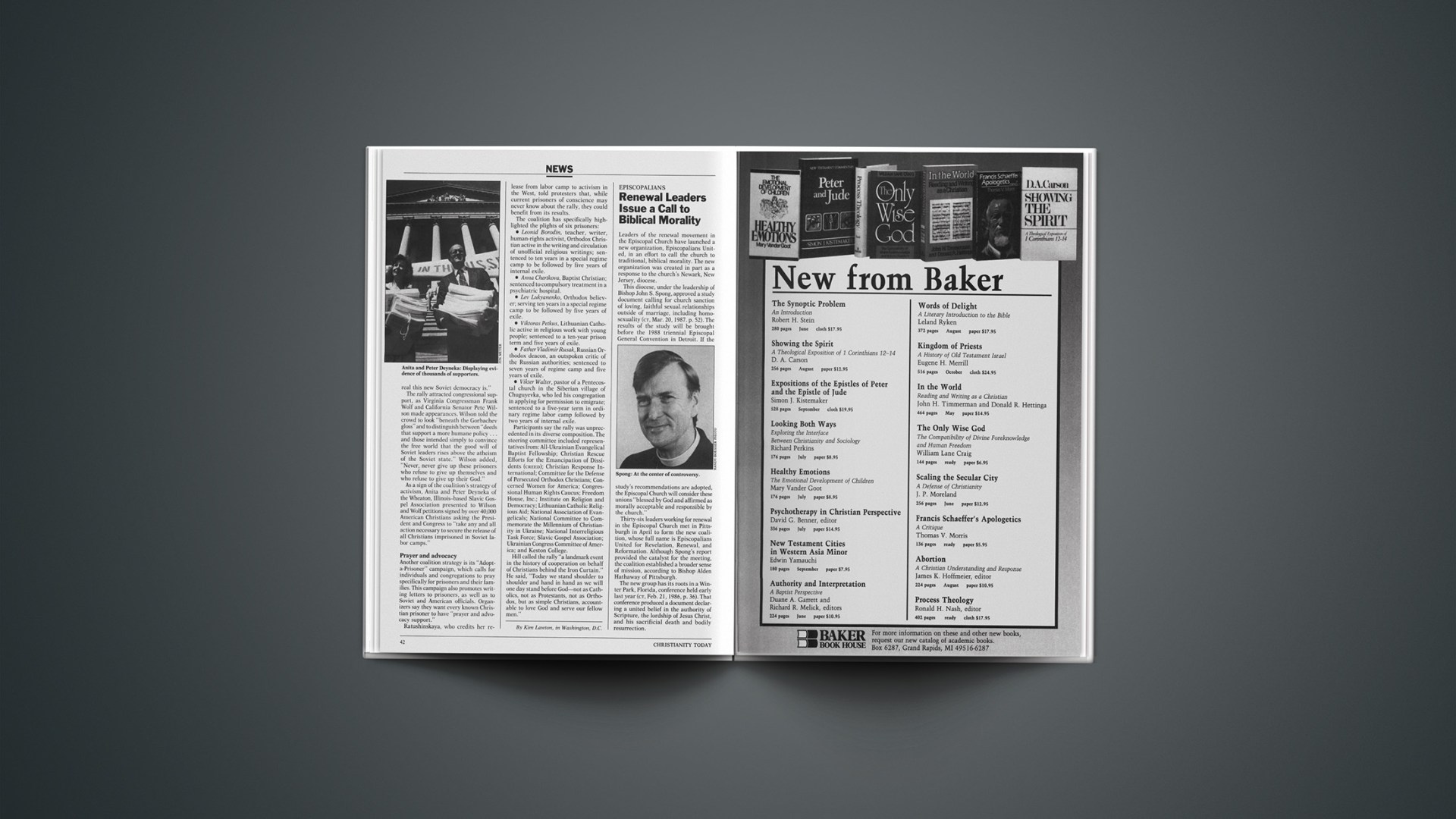
Leaders of the renewal movement in the Episcopal Church have launched a new organization, Episcopalians United, in an effort to call the church to traditional, biblical morality. The new organization was created in part as a response to the church’s Newark, New Jersey, diocese.
This diocese, under the leadership of Bishop John S. Spong, approved a study document calling for church sanction of loving, faithful sexual relationships outside of marriage, including homosexuality (CT, Mar. 20, 1987. p. 52). The results of the study will be brought before the 1988 triennial Episcopal General Convention in Detroit. If the study’s recommendations are adopted, the Episcopal Church will consider these unions “blessed by God and affirmed as morally acceptable and responsible by the church.”
Thirty-six leaders working for renewal in the Episcopal Church met in Pittsburgh in April to form the new coalition, whose full name is Episcopalians United for Revelation, Renewal, and Reformation. Although Spong’s report provided the catalyst for the meeting, the coalition established a broader sense of mission, according to Bishop Alden Hathaway of Pittsburgh.
The new group has its roots in a Winter Park, Florida, conference held early last year (CT, Feb. 21, 1986, p. 36). That conference produced a document declaring a united belief in the authority of Scripture, the lordship of Jesus Christ, and his sacrificial death and bodily resurrection.
Goals of Episcopalians United include working to defeat the Newark document at the 1988 general convention and injecting fresh, theologically conservative leadership into the denomination’s structures.
In the past, Episcopalians who identify themselves as evangelicals have been largely absent from these structures. “Christians in renewal just want to love the Lord, do the Lord’s work, and share him with other people,” explained John W. Yates II, rector of the Falls Church (Episcopal) in Falls Church, Virginia. “They do not want to have to worry about reforming a denomination.”
Many Episcopal bishops have strongly disputed Spong’s position. The diocese of South Carolina, for example, passed a resolution stating, “The time-honored and biblically rooted standard of chastity for Christian people remains unchanged. This means that sexual relations are to be confined to one’s partner in marriage.”
Renewal leaders maintain that if most Episcopalians knew of the issues and the biblical teaching pertaining to them, they would support traditional standards. Said Yates, “Certainly the vast majority of Episcopalians are committed to the sanctity of marriage and oppose homosexuality and sexual liaisons outside of marriage.” The Episcopal Church’s presiding bishop, Edmond L. Browning, has not taken a position on the Spong controversy.
Meanwhile, official advocacy groups in the Episcopal Church are scheduled to promote their causes at the denominationally sponsored “Conference of Episcopal Networks” this month in St. Louis. Formally recognized groups include Integrity, the homosexual advocacy group; and the Episcopal Women’s Caucus, which supports the removal of sexist language from public worship.
By Ann Hibbard.