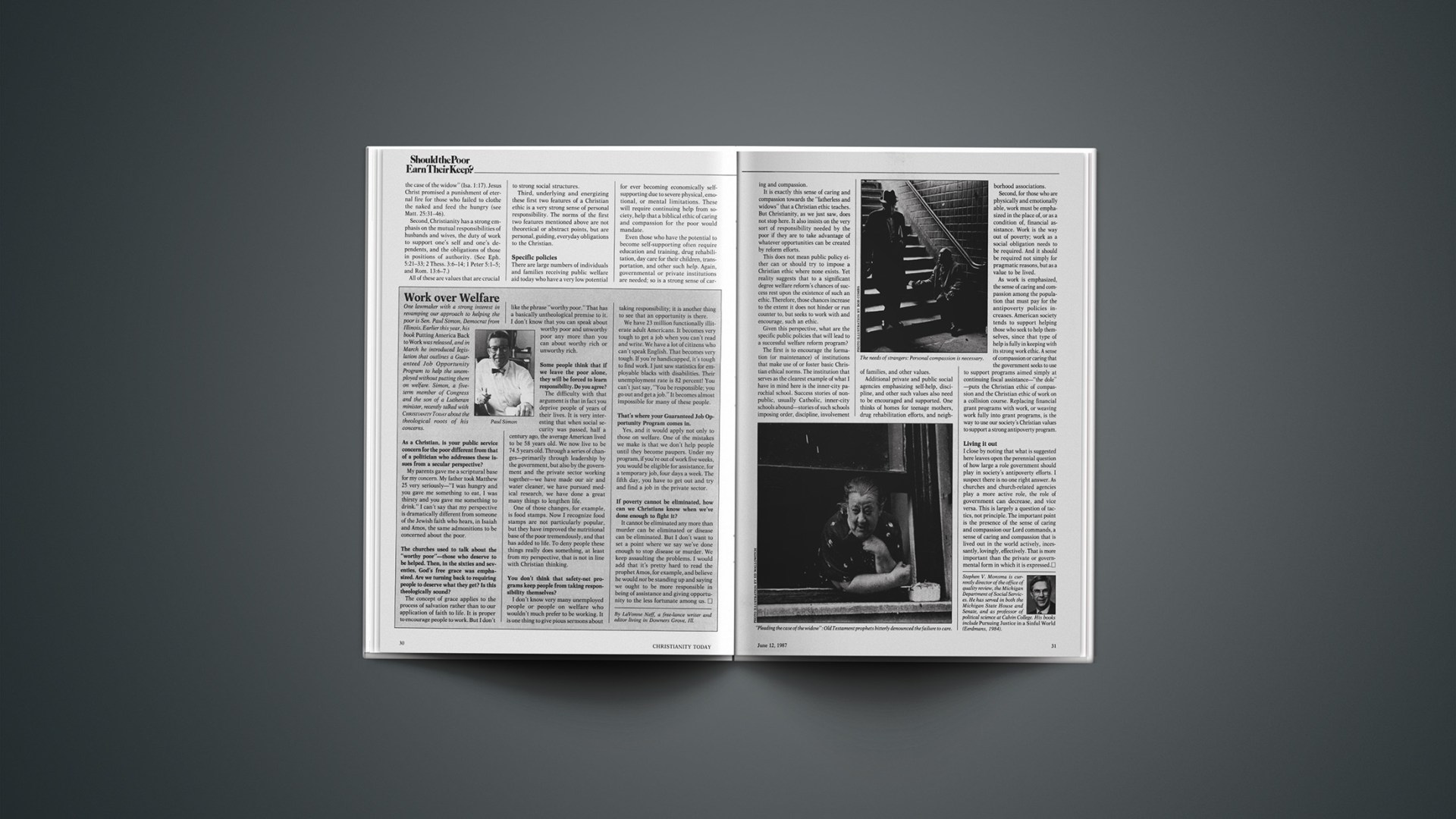
One lawmaker with a strong interest in revamping our approach to helping the poor is Sen. Paul Simon, Democrat from Illinois. Earlier this year, his book Putting America Back to Work was released, and in March he introduced legislation that outlines a Guaranteed Job Opportunity Program to help the unemployed without putting them on welfare. Simon, a five-term member of Congress and the son of a Lutheran minister, recently talked with CHRISTIANITY TODAY about the theological roots of his concerns.
As a Christian, is your public service concern for the poor different from that of a politician who addresses these issues from a secular perspective?
My parents gave me a scriptural base for my concern. My father took Matthew 25 very seriously—“I was hungry and you gave me something to eat, I was thirsty and you gave me something to drink.” I can’t say that my perspective is dramatically different from someone of the Jewish faith who hears, in Isaiah and Amos, the same admonitions to be concerned about the poor.
The churches used to talk about the “worthy poor”—those who deserve to be helped. Then, in the sixties and seventies, God’s free grace was emphasized. Are we turning back to requiring people to deserve what they get? Is this theologically sound?
The concept of grace applies to the process of salvation rather than to our application of faith to life. It is proper to encourage people to work. But I don’t like the phrase “worthy poor.” That has a basically untheological premise to it. I don’t know that you can speak about worthy poor and unworthy poor any more than you can about worthy rich or unworthy rich.
Some people think that if we leave the poor alone, they will be forced to learn responsibility. Do you agree?
The difficulty with that argument is that in fact you deprive people of years of their lives. It is very interesting that when social security was passed, half a century ago, the average American lived to be 58 years old. We now live to be 74.5 years old. Through a series of changes—primarily through leadership by the government, but also by the government and the private sector working together—we have made our air and water cleaner, we have pursued medical research, we have done a great many things to lengthen life.
One of those changes, for example, is food stamps. Now I recognize food stamps are not particularly popular, but they have improved the nutritional base of the poor tremendously, and that has added to life. To deny people these things really does something, at least from my perspective, that is not in line with Christian thinking.
You don’t think that safety-net programs keep people from taking responsibility themselves?
I don’t know very many unemployed people or people on welfare who wouldn’t much prefer to be working. It is one thing to give pious sermons about taking responsibility; it is another thing to see that an opportunity is there.
We have 23 million functionally illiterate adult Americans. It becomes very tough to get a job when you can’t read and write. We have a lot of citizens who can’t speak English. That becomes very tough. If you’re handicapped, it’s tough to find work. I just saw statistics for employable blacks with disabilities. Their unemployment rate is 82 percent! You can’t just say, “You be responsible; you go out and get a job.” It becomes almost impossible for many of these people.
That’s where your Guaranteed Job Opportunity Program comes in.
Yes, and it would apply not only to those on welfare. One of the mistakes we make is that we don’t help people until they become paupers. Under my program, if you’re out of work five weeks, you would be eligible for assistance, for a temporary job, four days a week. The fifth day, you have to get out and try and find a job in the private sector.
If poverty cannot be eliminated, how can we Christians know when we’ve done enough to fight it?
It cannot be eliminated any more than murder can be eliminated or disease can be eliminated. But I don’t want to set a point where we say we’ve done enough to stop disease or murder. We keep assaulting the problems. I would add that it’s pretty hard to read the prophet Amos, for example, and believe he would not be standing up and saying we ought to be more responsible in being of assistance and giving opportunity to the less fortunate among us.
By LaVonne Neff, a free-lance writer and editor living in Downers Grove, Ill.