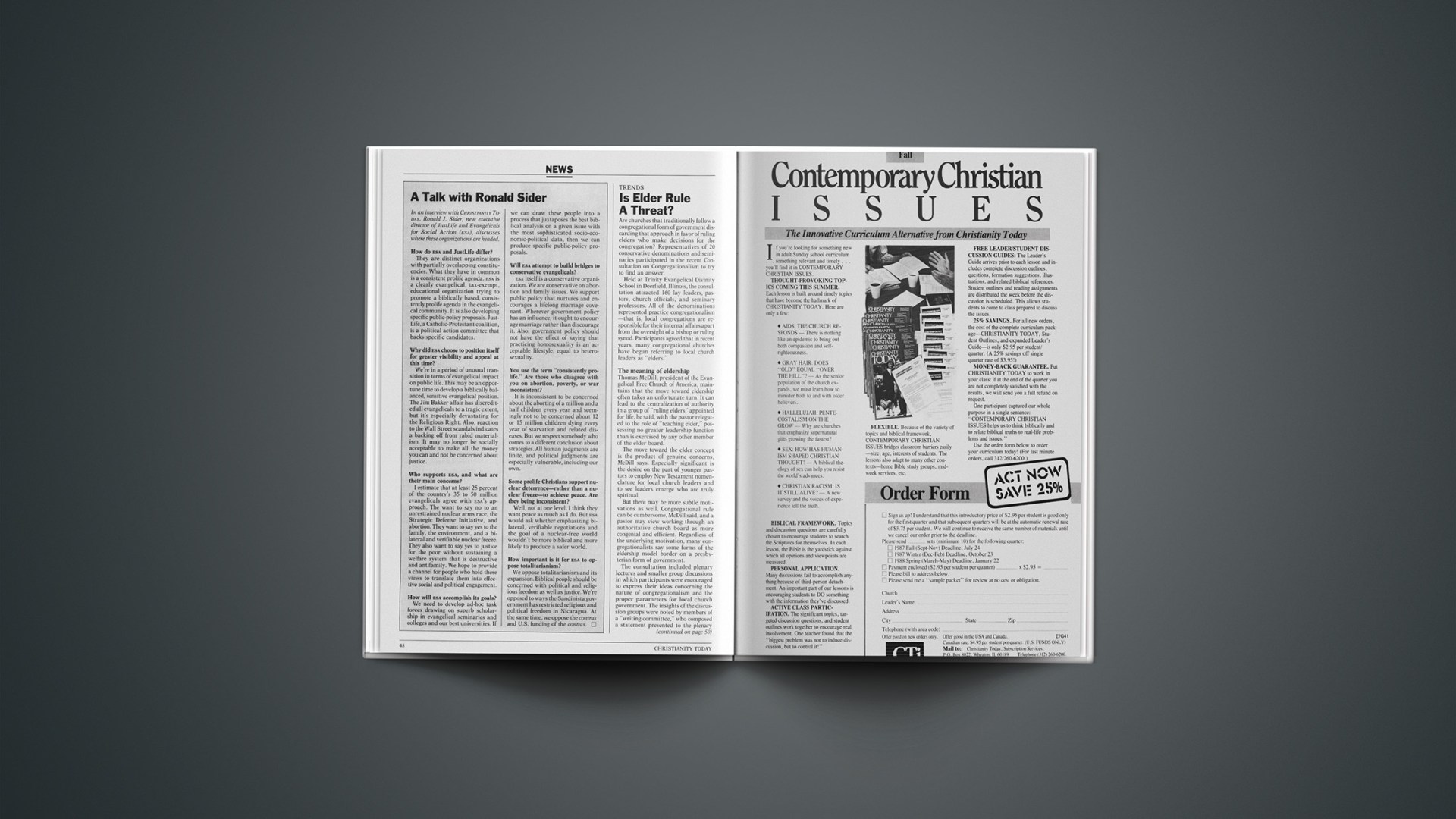

Are churches that traditionally follow a congregational form of government discarding that approach in favor of ruling elders who make decisions for the congregation? Representatives of 20 conservative denominations and seminaries participated in the recent Consultation on Congregationalism to try to find an answer.
Held at Trinity Evangelical Divinity School in Deerfield, Illinois, the consultation attracted 160 lay leaders, pastors, church officials, and seminary professors. All of the denominations represented practice Congregationalism—that is, local congregations are responsible for their internal affairs apart from the oversight of a bishop or ruling synod. Participants agreed that in recent years, many congregational churches have begun referring to local church leaders as “elders.”
The Meaning Of Eldership
Thomas McDill, president of the Evangelical Free Church of America, maintains that the move toward eldership often takes an unfortunate turn. It can lead to the centralization of authority in a group of “ruling elders” appointed for life, he said, with the pastor relegated to the role of “teaching elder,” possessing no greater leadership function than is exercised by any other member of the elder board.
The move toward the elder concept is the product of genuine concerns, McDill says. Especially significant is the desire on the part of younger pastors to employ New Testament nomenclature for local church leaders and to see leaders emerge who are truly spiritual.
But there may be more subtle motivations as well. Congregational rule can be cumbersome, McDill said, and a pastor may view working through an authoritative church board as more congenial and efficient. Regardless of the underlying motivation, many congregationalists say some forms of the eldership model border on a presbyterian form of government.
The consultation included plenary lectures and smaller group discussions in which participants were encouraged to express their ideas concerning the nature of Congregationalism and the proper parameters for local church government. The insights of the discussion groups were noted by members of a “writing committee,” who composed a statement presented to the plenary gathering on the final morning.
Disagreement concerning the biblical model for local church leadership was evident among the plenary speakers. Grant Osborne, associate professor of New Testament at Trinity Evangelical Divinity School, argued for the traditional model of a single ordained leader for each congregation, based on the rootage of modern local churches in the “house churches” of the New Testament era. The plural use of the term “elder” in the New Testament, often cited in support of the necessity for a number of leaders in each local church, is to be understood as operative on the broader community level, Osborne maintained.
In contrast, Earl Radmacher, president of Western Conservative Baptist Seminary, argued that “multiple leadership was the norm in the early church.” And John Hedegaard, director of home ministries for the Missionary Church, approached the subject from a more sociological and practical perspective. Size, more than denominational affiliation, determines church organizational structures, he said. As a congregation grows, he said, it tends to modify its form of government until a quasi board of directors is developed to monitor the life of the large church.
Conclusions
The statement presented at the end of the consultation reflected both the consensus and the tensions that pervaded the meeting. The statement defined Congregationalism as a form of church government in which authority and responsibility for ministry reside in the entire local church membership.
The document was careful not to suggest that only this form of government can appeal to biblical precedence. But it affirmed the values emphasized by congregationalism, especially the concern for the free movement of the Holy Spirit and the involvement of all members in the life of the church.
It also limited the “clearly defined offices” in the New Testament to elder/bishop and deacon, a conclusion that appears to question the threefold office structure of other traditions. The statement left room for the use of “elder” nomenclature, but denied that “a self-perpetuating board of elders … best fulfills the congregational form of government.”
By Stanley J. Grenz, in Deerfield, Illinois.