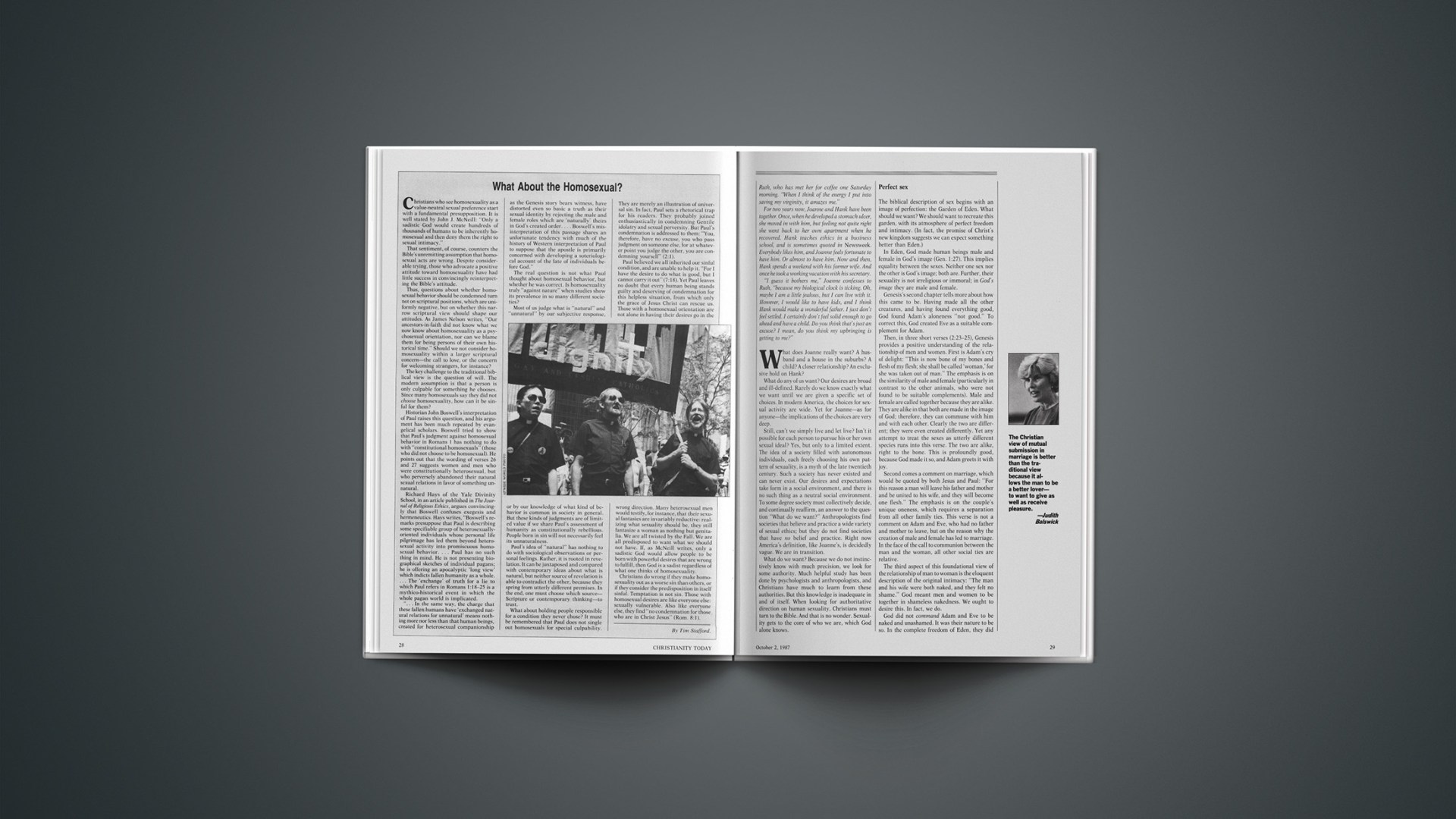

What About The Homosexual?
Christians who see homosexuality as a value-neutral sexual preference start with a fundamental presupposition. It is well stated by John J. McNeill: “Only a sadistic God would create hundreds of thousands of humans to be inherently homosexual and then deny them the right to sexual intimacy.”
That sentiment, of course, counters the Bible’s unremitting assumption that homosexual acts are wrong. Despite considerable trying, those who advocate a positive attitude toward homosexuality have had little success in convincingly reinterpreting the Bible’s attitude.
Thus, questions about whether homosexual behavior should be condemned turn not on scriptural positions, which are uniformly negative, but on whether this narrow scriptural view should shape our attitudes. As James Nelson writes, “Our ancestors-in-faith did not know what we now know about homosexuality as a psychosexual orientation, nor can we blame them for being persons of their own historical time.” Should we not consider homosexuality within a larger scriptural concern—the call to love, or the concern for welcoming strangers, for instance?
The key challenge to the traditional biblical view is the question of will. The modern assumption is that a person is only culpable for something he chooses. Since many homosexuals say they did not choose homosexuality, how can it be sinful for them?
Historian John Boswell’s interpretation of Paul raises this question, and his argument has been much repeated by evangelical scholars. Boswell tried to show that Paul’s judgment against homosexual behavior in Romans 1 has nothing to do with “constitutional homosexuals” (those who did not choose to be homosexual). He points out that the wording of verses 26 and 27 suggests women and men who were constitutionally heterosexual, but who perversely abandoned their natural sexual relations in favor of something unnatural.
Richard Hays of the Yale Divinity School, in an article published in The Journal of Religious Ethics, argues convincingly that Boswell confuses exegesis and hermeneutics. Hays writes, “Boswell’s remarks presuppose that Paul is describing some specifiable group of heterosexually-oriented individuals whose personal life pilgrimage has led them beyond heterosexual activity into promiscuous homosexual behavior.… Paul has no such thing in mind. He is not presenting biographical sketches of individual pagans; he is offering an apocalyptic ‘long view’ which indicts fallen humanity as a whole.… The ‘exchange’ of truth for a lie to which Paul refers in Romans 1:18–25 is a mythico-historical event in which the whole pagan world is implicated.
“… In the same way, the charge that these fallen humans have ‘exchanged natural relations for unnatural’ means nothing more nor less than that human beings, created for heterosexual companionship as the Genesis story bears witness, have distorted even so basic a truth as their sexual identity by rejecting the male and female roles which are ‘naturally’ theirs in God’s created order.… Boswell’s misinterpretation of this passage shares an unfortunate tendency with much of the history of Western interpretation of Paul to suppose that the apostle is primarily concerned with developing a soteriological account of the fate of individuals before God.”
The real question is not what Paul thought about homosexual behavior, but whether he was correct. Is homosexuality truly “against nature” when studies show its prevalence in so many different societies?
Most of us judge what is “natural” and “unnatural” by our subjective response, or by our knowledge of what kind of behavior is common in society in general. But these kinds of judgments are of limited value if we share Paul’s assessment of humanity as constitutionally rebellious. People born in sin will not necessarily feel its unnaturalness.
Paul’s idea of “natural” has nothing to do with sociological observations or personal feelings. Rather, it is rooted in revelation. It can be juxtaposed and compared with contemporary ideas about what is natural, but neither source of revelation is able to contradict the other, because they spring from utterly different premises. In the end, one must choose which source—Scripture or contemporary thinking—to trust.
What about holding people responsible for a condition they never chose? It must be remembered that Paul does not single out homosexuals for special culpability. They are merely an illustration of universal sin. In fact, Paul sets a rhetorical trap for his readers. They probably joined enthusiastically in condemning Gentile idolatry and sexual perversity. But Paul’s condemnation is addressed to them: “You, therefore, have no excuse, you who pass judgment on someone else, for at whatever point you judge the other, you are condemning yourself” (2:1).
Paul believed we all inherited our sinful condition, and are unable to help it. “For I have the desire to do what is good, but I cannot carry it out” (7:18). Yet Paul leaves no doubt that every human being stands guilty and deserving of condemnation for this helpless situation, from which only the grace of Jesus Christ can rescue us. Those with a homosexual orientation are not alone in having their desires go in the wrong direction. Many heterosexual men would testify, for instance, that their sexual fantasies are invariably reductive: realizing what sexuality should be, they still fantasize a woman as nothing but genitalia. We are all twisted by the Fall. We are all predisposed to want what we should not have. If, as McNeill writes, only a sadistic God would allow people to be born with powerful desires that are wrong to fulfill, then God is a sadist regardless of what one thinks of homosexuality.
Christians do wrong if they make homosexuality out as a worse sin than others, or if they consider the predisposition in itself sinful. Temptation is not sin. Those with homosexual desires are like everyone else: sexually vulnerable. Also like everyone else, they find “no condemnation for those who are in Christ Jesus” (Rom. 8:1).
By Tim Stafford.