
EVANGELISM
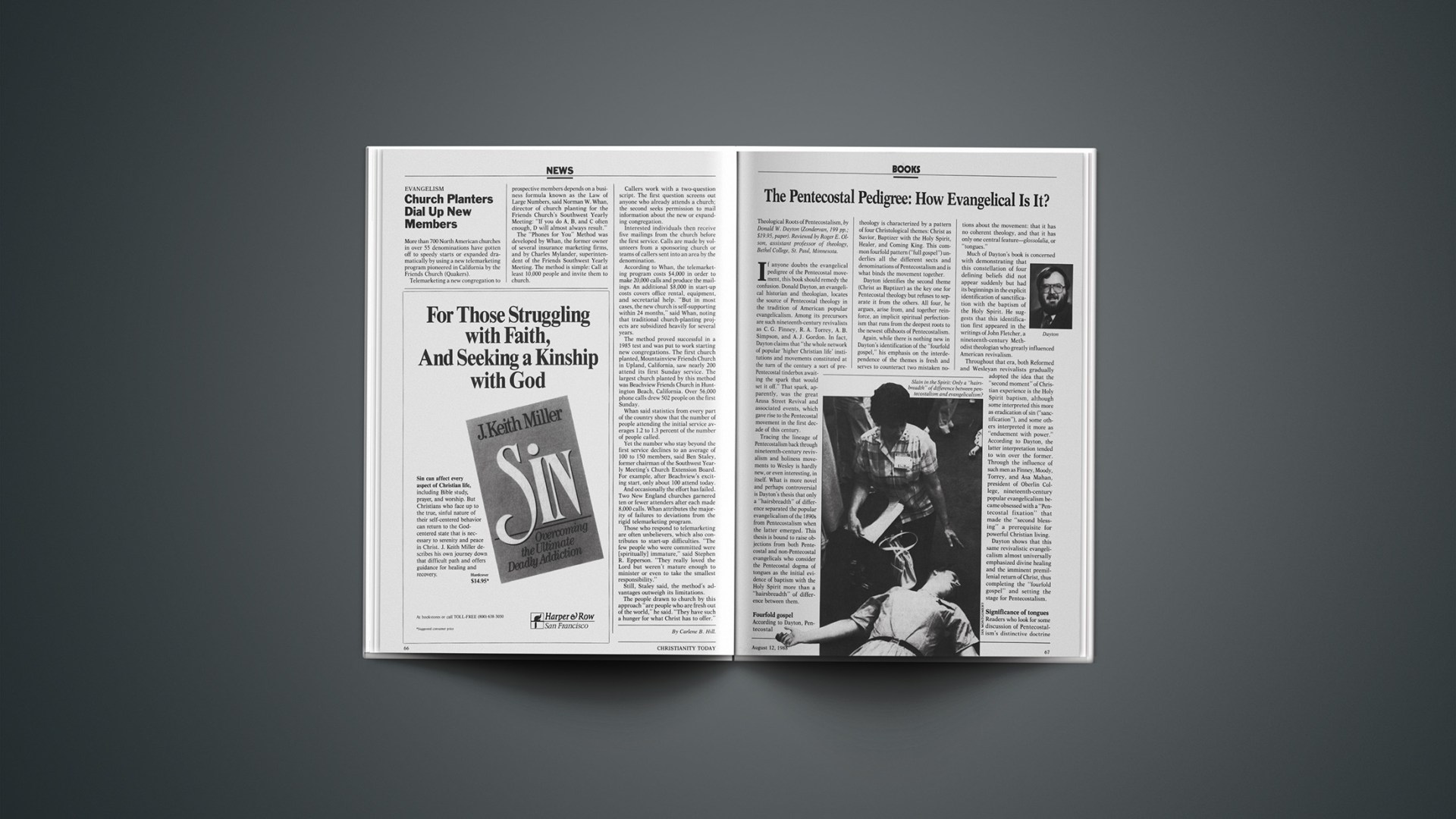
More than 700 North American churches in over 55 denominations have gotten off to speedy starts or expanded dramatically by using a new telemarketing program pioneered in California by the Friends Church (Quakers).
Telemarketing a new congregation to prospective members depends on a business formula known as the Law of Large Numbers, said Norman W. Whan, director of church planting for the Friends Church’s Southwest Yearly Meeting: “If you do A, B, and C often enough, D will almost always result.”
The “Phones for You” Method was developed by Whan, the former owner of several insurance marketing firms, and by Charles Mylander, superintendent of the Friends Southwest Yearly Meeting. The method is simple: Call at least 10,000 people and invite them to church.
Callers work with a two-question script. The first question screens out anyone who already attends a church; the second seeks permission to mail information about the new or expanding congregation.
Interested individuals then receive five mailings from the church before the first service. Calls are made by volunteers from a sponsoring church or teams of callers sent into an area by the denomination.
According to Whan, the telemarketing program costs $4,000 in order to make 20,000 calls and produce the mailings. An additional $8,000 in start-up costs covers office rental, equipment, and secretarial help. “But in most cases, the new church is self-supporting within 24 months,” said Whan, noting that traditional church-planting projects are subsidized heavily for several years.
The method proved successful in a 1985 test and was put to work starting new congregations. The first church planted, Mountainview Friends Church in Upland, California, saw nearly 200 attend its first Sunday service. The largest church planted by this method was Beachview Friends Church in Huntington Beach, California. Over 56,000 phone calls drew 502 people on the first Sunday.
Whan said statistics from every part of the country show that the number of people attending the initial service averages 1.2 to 1.3 percent of the number of people called.
Yet the number who stay beyond the first service declines to an average of 100 to 150 members, said Ben Staley, former chairman of the Southwest Yearly Meeting’s Church Extension Board. For example, after Beachview’s exciting start, only about 100 attend today.
And occasionally the effort has failed. Two New England churches garnered ten or fewer attenders after each made 8,000 calls. Whan attributes the majority of failures to deviations from the rigid telemarketing program.
Those who respond to telemarketing are often unbelievers, which also contributes to start-up difficulties. “The few people who were committed were [spiritually] immature,” said Stephen R. Epperson. “They really loved the Lord but weren’t mature enough to minister or even to take the smallest responsibility.”
Still, Staley said, the method’s advantages outweigh its limitations.
The people drawn to church by this approach “are people who are fresh out of the world,” he said. “They have such a hunger for what Christ has to offer.”
By Carlene B. Hill.