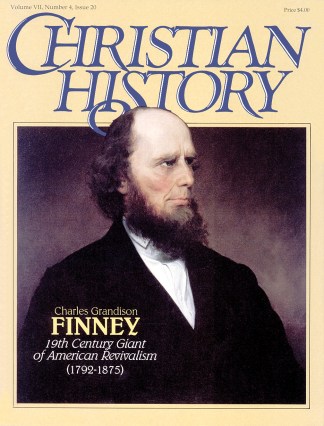
Oberlin College, where Finney taught for many years and served for a time as president, was in the 19th century a unique institution. Hated in the South because it symbolized abolition, allowing blacks to learn alongside whites, it was adored by abolitionists, and was a favorite project of the wealthy Tappans, who poured their financial support into it.
When Oberlin College opened its doors, it was not the only school in America to accept black students. However, inter-racial education was bitterly opposed by a great many in America, and not only from the South. Finney remarked about how even in Ohio where Oberlin was located, public support was low, and criticism was strong. Oberlin was considered a radical institution and was a symbol against which much hatred was directed. It was a busy station on the Underground Railroad, giving rest and protection to slaves being smuggled to freedom, and its friends, such as the Tappan brothers, and Theodore Weld, were renowned, or infamous (depending on where one stood) for their aggressive work for abolition. Oberlin provided a haven for the “oppressed race” and its dream was to allow an opportunity for black people to benefit from the blessings of education.
That Oberlin allowed women to attend the same classes with men, however, was another great shock, and even many who sympathized with the racial stand shuddered at the prospect of the two sexes mingling in a common classroom. And worse, mixed races and mixed sexes suggested the ghastly possibility of “amalgamation,” the mixed marriage of the races.
Charles Finney and the other members at Oberlin believed that Christianity had a lot to do with questions of rights for black people and for females. Finney saw slaveholding as a sin—the denial to another human being of their freedom was to him irreconcilable with Christian religion, especially in the day and age in which he lived. He went so far, while pastor at the Chatham Street Chapel in New York, as to deny communion to slaveowners. He was a friend to the cause of abolition for his whole career, though later the Tappans criticized him for not taking a strong enough stand.
They were too caught up to realize that Finney knew he was an evangelist first, no matter how important certain social causes were. He believed a converted society was the basis for social transformation.
At Oberlin there was a women’s department, and women also took classes with men. Women were not encouraged into higher education in those days, and especially not into mixed classrooms. But at Oberlin things were different. Finney had been criticized early on in his career for allowing women to participate in religious meetings with men. Now he was playing a part in the higher education of women. He knew that women were the main educators of children, and believed in their receiving excellent educations. He was not a promoter of women in church leadership, though Oberlin did educate women who went on to such work. The importance of the family seems to have been a major concern of Finneys, and the improvement of women, as well as men, would serve to strengthen the family and society. Oberlin was to be God’s college to prepare those who would be instruments for converting and transforming society.
A fitting tribute and symbol for Oberlin, Finney, and others who dared to take a stand, is Mary Jane Patterson, who in 1862 became the first American black woman to receive a bachelor’s degree in this country, probably in the world. A child of slaves, she went on to a career of teaching in Philadelphia and Washington. She taught until her death in 1894. Though Oberlin actually never had a large proportion of black students (average around 4%–5%), its contribution to the cause of fighting for the dignity of all people as made in the image of God, female, male, no matter what race, should be admired by all of us.
Copyright © 1988 by the author or Christianity Today/Christian History magazine. Click here for reprint information on Christian History.