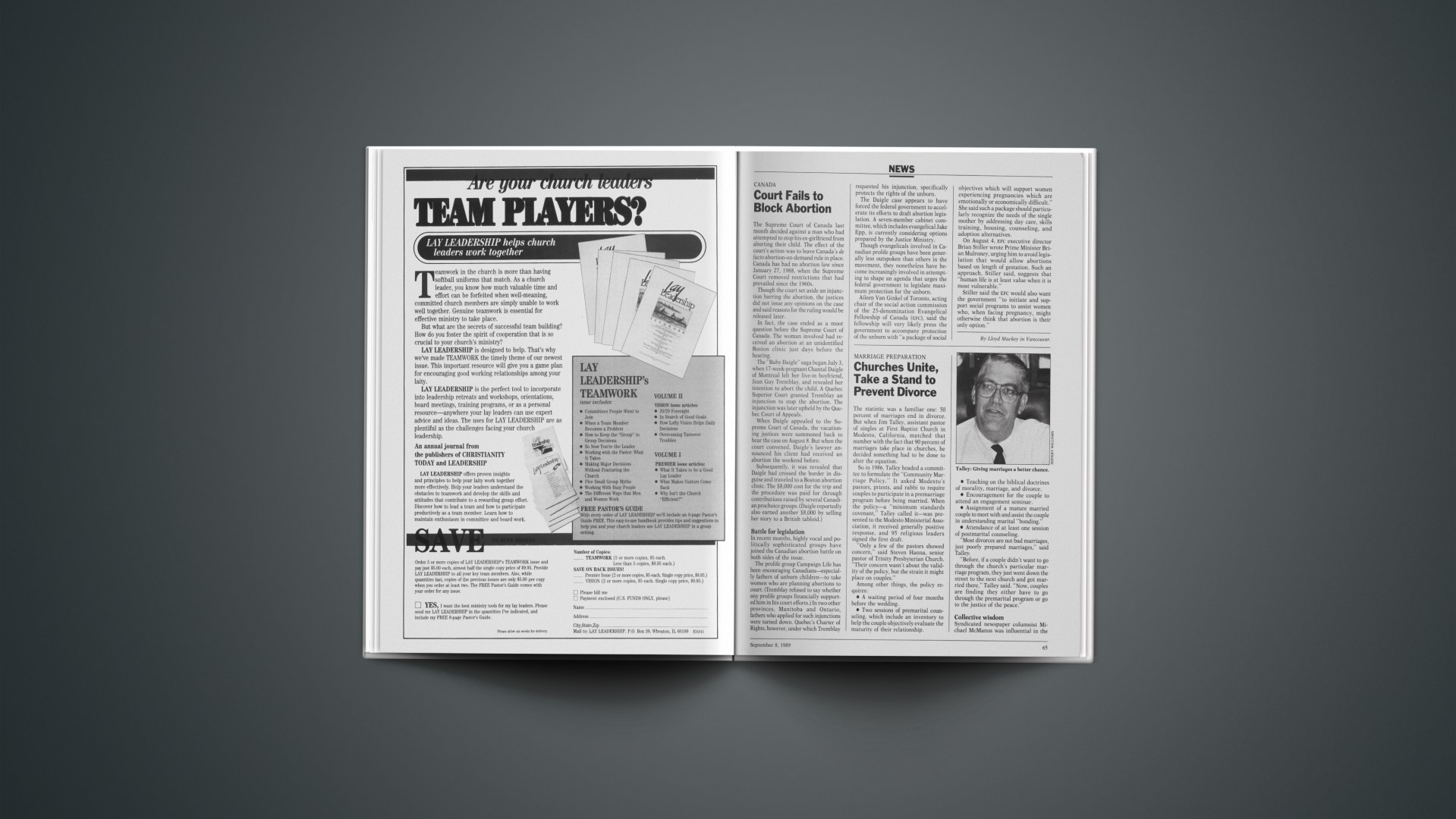

The statistic was a familiar one: 50 percent of marriages end in divorce. But when Jim Talley, assistant pastor of singles at First Baptist Church in Modesto, California, matched that number with the fact that 90 percent of marriages take place in churches, he decided something had to be done to alter the equation.
So in 1986, Talley headed a committee to formulate the “Community Marriage Policy.” It asked Modesto’s pastors, priests, and rabbi to require couples to participate in a premarriage program before being married. When the policy—a “minimum standards covenant,” Talley called it—was presented to the Modesto Ministerial Association, it received generally positive response, and 95 religious leaders signed the first draft.
“Only a few of the pastors showed concern,” said Steven Hanna, senior pastor of Trinity Presbyterian Church. “Their concern wasn’t about the validity of the policy, but the strain it might place on couples.”
Among other things, the policy requires:
• A waiting period of four months before the wedding.
• Two sessions of premarital counseling, which include an inventory to help the couple objectively evaluate the maturity of their relationship.
• Teaching on the biblical doctrines of morality, marriage, and divorce.
• Encouragement for the couple to attend an engagement seminar.
• Assignment of a mature married couple to meet with and assist the couple in understanding marital “bonding.”
• Attendance of at least one session of postmarital counseling.
“Most divorces are not bad marriages, just poorly prepared marriages,” said Talley.
“Before, if a couple didn’t want to go through the church’s particular marriage program, they just went down the street to the next church and got married there,” Talley said. “Now, couples are finding they either have to go through the premarital program or go to the justice of the peace.”
Collective Wisdom
Syndicated newspaper columnist Michael McManus was influential in the formation of the marriage policy. McManus had lectured many times on the need for better marriage preparation, and found a receptive audience in Modesto.
“The church has the collective wisdom of 2,000 years when it comes to marriage,” McManus said. “But our churches have been failing to effectively prepare couples for marriage.
“Marriage is the one issue Catholics, Jews, and Protestants agree on theologically, but we’re not working together,” said McManus. “Modesto is now doing something that works.”
Talley points with some satisfaction to a new set of statistics in his city. In 1987, Modesto had a population of 138,823 and 1,923 divorces. In 1988, the population jumped to 144,682, but the number of divorces dipped to 1,812. The city also had a slight drop in the number of marriages.
“After going through the premarriage program, many couples realize they’re not ready for a wedding. A broken engagement is easier than a broken marriage,” said Talley.
Each minister finds flexibility in the standards. “We already had a marriage policy in place,” said Hanna of Trinity Presbyterian. “But we offer extra premarital counseling based on the needs of the couple. If I feel they need more premarital preparation, I will strongly suggest it. If I feel the couple is ready, I will require a few postmarital counseling sessions.”
Hanna would like to develop further the part of the policy calling for a mature couple to help an engaged couple. “It’s been more difficult to recruit [mature] couples than I thought it would be,” he said.
Recognizing the policy’s minimum standards were but a starting point to prevent divorce, Talley and other pastors have created even more demanding programs. Talley asks seriously dating couples to go through two four-month programs entitled “Friendship Instruction” and “Relationship Instruction” before going through the premarital program. Couples agree to certain requirements, attend classes, and read books on relationships and marriage.
“I’ve married 85 couples,” Talley said, “and so far as I know, none have divorced.”
Another program for separated, divorced, or couples struggling in their marriages, entitled “Reconciliation Instruction,” helps couples rebuild their relationships and work toward reconciliation.
“Eighty percent of all divorces end in marriage,” Talley said. “But statistics show that with each remarriage the probability of divorce is higher,” he adds. “We’re trying to reverse that trend also.”
Talley is encouraging pastors to incorporate the policy into their church constitutions so that when they leave, the practice will continue.
Columns and lectures by McManus, as well as word-of-mouth endorsements from the Modesto ministers, have gotten the news out about the success of the policy.
Currently three cities near Modesto—Fresno, Turlock, and Tracy—have adopted the policy. And Talley knows of pastors in Singapore who are committing themselves to the same marriage policy.
The covenant is now getting even broader exposure through Love Inc., a domestic ministry of World Vision International, which recently produced a training video on the marriage policy based on McManus’s lectures.
By Jeffery Williams in Modesto.