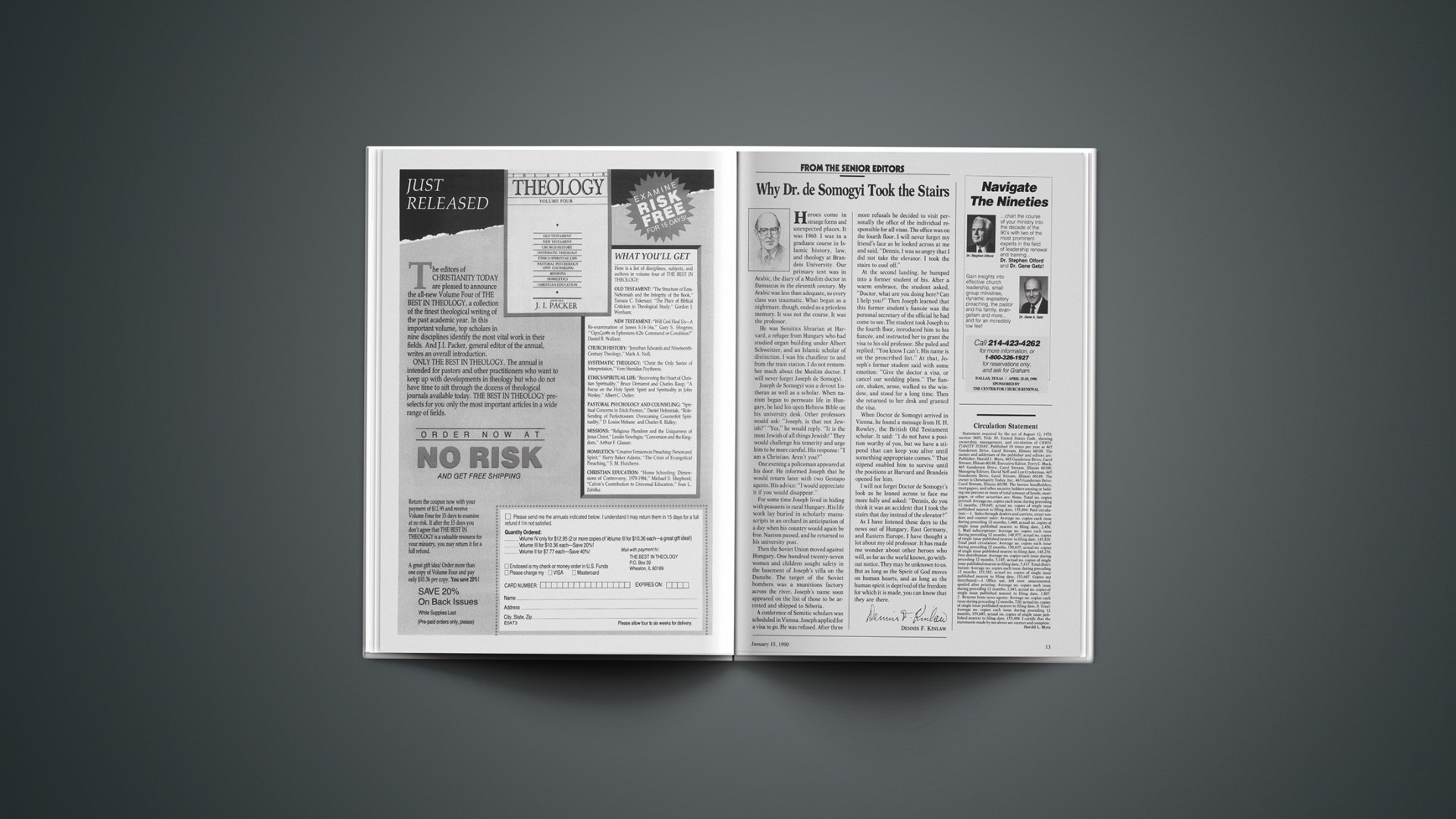

Heroes come in strange forms and unexpected places. It was 1960. I was in a graduate course in Islamic history, law, and theology at Brandeis University. Our primary text was in Arabic, the diary of a Muslim doctor in Damascus in the eleventh century. My Arabic was less than adequate, so every class was traumatic. What began as a nightmare, though, ended as a priceless memory. It was not the course. It was the professor.
He was Semitics librarian at Harvard, a refugee from Hungary who had studied organ building under Albert Schweitzer, and an Islamic scholar of distinction. I was his chauffeur to and from the train station. I do not remember much about the Muslim doctor. I will never forget Joseph de Somogyi.
Joseph de Somogyi was a devout Lutheran as well as a scholar. When nazism began to permeate life in Hungary, he laid his open Hebrew Bible on his university desk. Other professors would ask: “Joseph, is that not Jewish?” “Yes,” he would reply. “It is the most Jewish of all things Jewish!” They would challenge his temerity and urge him to be more careful. His response: “I am a Christian. Aren’t you?”
One evening a policeman appeared at his door. He informed Joseph that he would return later with two Gestapo agents. His advice: “I would appreciate it if you would disappear.”
For some time Joseph lived in hiding with peasants in rural Hungary. His life work lay buried in scholarly manuscripts in an orchard in anticipation of a day when his country would again be free. Nazism passed, and he returned to his university post.
Then the Soviet Union moved against Hungary. One hundred twenty-seven women and children sought safety in the basement of Joseph’s villa on the Danube. The target of the Soviet bombers was a munitions factory across the river. Joseph’s name soon appeared on the list of those to be arrested and shipped to Siberia.
A conference of Semitic scholars was scheduled in Vienna. Joseph applied for a visa to go. He was refused. After three more refusals he decided to visit personally the office of the individual responsible for all visas. The office was on the fourth floor. I will never forget my friend’s face as he looked across at me and said, “Dennis, I was so angry that I did not take the elevator. I took the stairs to cool off.”
At the second landing, he bumped into a former student of his. After a warm embrace, the student asked, “Doctor, what are you doing here? Can I help you?” Then Joseph learned that this former student’s fiancée was the personal secretary of the official he had come to see. The student took Joseph to the fourth floor, introduced him to his fiancée, and instructed her to grant the visa to his old professor. She paled and replied: “You know I can’t. His name is on the proscribed list.” At that, Joseph’s former student said with some emotion: “Give the doctor a visa, or cancel our wedding plans.” The fiancée, shaken, arose, walked to the window, and stood for a long time. Then she returned to her desk and granted the visa.
When Doctor de Somogyi arrived in Vienna, he found a message from H. H. Rowley, the British Old Testament scholar. It said: “I do not have a position worthy of you, but we have a stipend that can keep you alive until something appropriate comes.” That stipend enabled him to survive until the positions at Harvard and Brandeis opened for him.
I will not forget Doctor de Somogyi’s look as he leaned across to face me more fully and asked: “Dennis, do you think it was an accident that I took the stairs that day instead of the elevator?”
As I have listened these days to the news out of Hungary, East Germany, and Eastern Europe, I have thought a lot about my old professor. It has made me wonder about other heroes who will, as far as the world knows, go without notice. They may be unknown to us. But as long as the Spirit of God moves on human hearts, and as long as the human spirit is deprived of the freedom for which it is made, you can know that they are there.