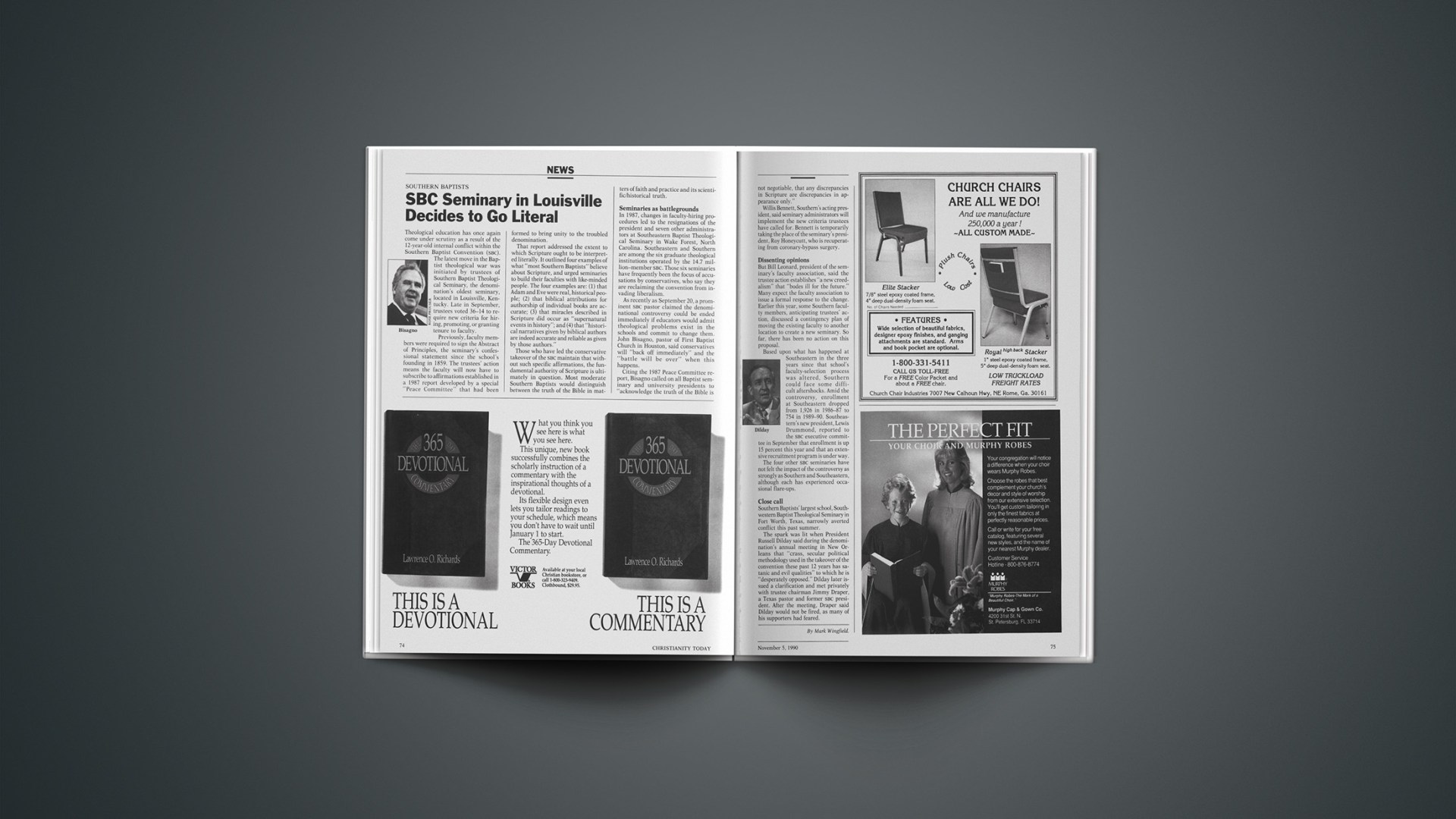

Theological education has once again come under scrutiny as a result of the 12-year-old internal conflict within the Southern Baptist Convention (SBC). The latest move in the Baptist theological war was initiated by trustees of Southern Baptist Theological Seminary, the denomination’s oldest seminary, located in Louisville, Kentucky. Late in September, trustees voted 36–14 to require new criteria for hiring, promoting, or granting tenure to faculty.
Previously, faculty members were required to sign the Abstract of Principles, the seminary’s confessional statement since the school’s founding in 1859. The trustees’ action means the faculty will now have to subscribe to affirmations established in a 1987 report developed by a special “Peace Committee” that had been formed to bring unity to the troubled denomination.
That report addressed the extent to which Scripture ought to be interpreted literally. It outlined four examples of what “most Southern Baptists” believe about Scripture, and urged seminaries to build their faculties with like-minded people. The four examples are: (1) that Adam and Eve were real, historical people; (2) that biblical attributions for authorship of individual books are accurate; (3) that miracles described in Scripture did occur as “supernatural events in history”; and (4) that “historical narratives given by biblical authors are indeed accurate and reliable as given by those authors.”
Those who have led the conservative takeover of the SBC maintain that without such specific affirmations, the fundamental authority of Scripture is ultimately in question. Most moderate Southern Baptists would distinguish between the truth of the Bible in matters of faith and practice and its scientific/historical truth.
Seminaries As Battlegrounds
In 1987, changes in faculty-hiring procedures led to the resignations of the president and seven other administrators at Southeastern Baptist Theological Seminary in Wake Forest, North Carolina. Southeastern and Southern are among the six graduate theological institutions operated by the 14.7 million-member SBC. Those six seminaries have frequently been the focus of accusations by conservatives, who say they are reclaiming the convention from invading liberalism.
As recently as September 20, a prominent SBC pastor claimed the denominational controversy could be ended immediately if educators would admit theological problems exist in the schools and commit to change them. John Bisagno, pastor of First Baptist Church in Houston, said conservatives will “back off immediately” and the “battle will be over” when this happens.
Citing the 1987 Peace Committee report, Bisagno called on all Baptist seminary and university presidents to “acknowledge the truth of the Bible is not negotiable, that any discrepancies in Scripture are discrepancies in appearance only.”
Willis Bennett, Southern’s acting president, said seminary administrators will implement the new criteria trustees have called for. Bennett is temporarily taking the place of the seminary’s president, Roy Honeycutt, who is recuperating from coronary-bypass surgery.
Dissenting Opinions
But Bill Leonard, president of the seminary’s faculty association, said the trustee action establishes “a new creedalism” that “bodes ill for the future.” Many expect the faculty association to issue a formal response to the change. Earlier this year, some Southern faculty members, anticipating trustees’ action, discussed a contingency plan of moving the existing faculty to another location to create a new seminary. So far, there has been no action on this proposal.
Based upon what has happened at Southeastern in the three years since that school’s faculty-selection process was altered, Southern could face some difficult aftershocks. Amid the controversy, enrollment at Southeastern dropped from 1,926 in 1986–87 to 754 in 1989–90. Southeastern’s new president, Lewis Drummond, reported to the SBC executive committee in September that enrollment is up 15 percent this year and that an extensive recruitment program is under way.
The four other SBC seminaries have not felt the impact of the controversy as strongly as Southern and Southeastern, although each has experienced occasional flare-ups.
Close Call
Southern Baptists’ largest school, Southwestern Baptist Theological Seminary in Fort Worth, Texas, narrowly averted conflict this past summer.
The spark was lit when President Russell Dilday said during the denomination’s annual meeting in New Orleans that “crass, secular political methodology used in the takeover of the convention these past 12 years has Satanic and evil qualities” to which he is “desperately opposed.” Dilday later issued a clarification and met privately with trustee chairman Jimmy Draper, a Texas pastor and former SBC president. After the meeting, Draper said Dilday would not be fired, as many of his supporters had feared.