





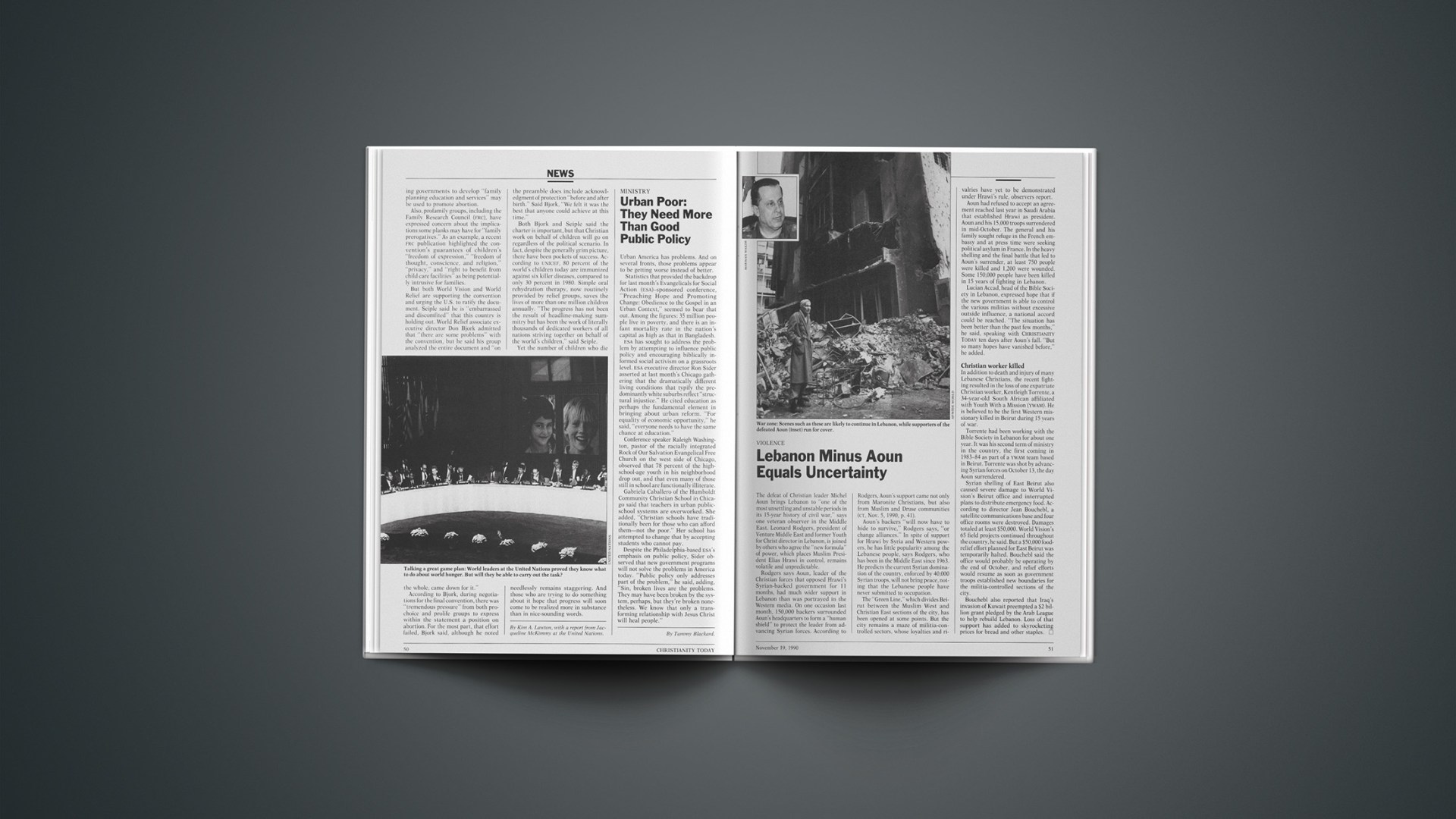

The defeat of Christian leader Michel Aoun brings Lebanon to “one of the most unsettling and unstable periods in its 15-year history of civil war,” says one veteran observer in the Middle East. Leonard Rodgers, president of Venture Middle East and former Youth for Christ director in Lebanon, is joined by others who agree the “new formula” of power, which places Muslim President Elias Hrawi in control, remains volatile and unpredictable.
Rodgers says Aoun, leader of the Christian forces that opposed Hrawi’s Syrian-backed government for 11 months, had much wider support in Lebanon than was portrayed in the Western media. On one occasion last month, 150,000 backers surrounded Aoun’s headquarters to form a “human shield” to protect the leader from advancing Syrian forces. According to Rodgers, Aoun’s support came not only from Maronite Christians, but also from Muslim and Druse communities (CT, Nov. 5, 1990, p. 41).
Aoun’s backers “will now have to hide to survive,” Rodgers says, “or change alliances.” In spite of support for Hrawi by Syria and Western powers, he has little popularity among the Lebanese people, says Rodgers, who has been in the Middle East since 1963. He predicts the current Syrian domination of the country, enforced by 40,000 Syrian troops, will not bring peace, noting that the Lebanese people have never submitted to occupation.
The “Green Line,” which divides Beirut between the Muslim West and Christian East sections of the city, has been opened at some points. But the city remains a maze of militia-controlled sectors, whose loyalties and rivalries have yet to be demonstrated under Hrawi’s rule, observers report.
Aoun had refused to accept an agreement reached last year in Saudi Arabia that established Hrawi as president. Aoun and his 15,000 troops surrendered in mid-October. The general and his family sought refuge in the French embassy and at press time were seeking political asylum in France. In the heavy shelling and the final battle that led to Aoun’s surrender, at least 750 people were killed and 1,200 were wounded. Some 150,000 people have been killed in 15 years of fighting in Lebanon.
Lucian Accad, head of the Bible Society in Lebanon, expressed hope that if the new government is able to control the various militias without excessive outside influence, a national accord could be reached. “The situation has been better than the past few months,” he said, speaking with CHRISTIANITY TODAY ten days after Aoun’s fall. “But so many hopes have vanished before,” he added.
Christian Worker Killed
In addition to death and injury of many Lebanese Christians, the recent fighting resulted in the loss of one expatriate Christian worker, Kentleigh Torrente, a 34-year-old South African affiliated with Youth With a Mission (YWAM). He is believed to be the first Western missionary killed in Beirut during 15 years of war.
Torrente had been working with the Bible Society in Lebanon for about one year. It was his second term of ministry in the country, the first coming in 1983–84 as part of a YWAM team based in Beirut. Torrente was shot by advancing Syrian forces on October 13, the day Aoun surrendered.
Syrian shelling of East Beirut also caused severe damage to World Vision’s Beirut office and interrupted plans to distribute emergency food. According to director Jean Bouchebl, a satellite communications base and four office rooms were destroyed. Damages totaled at least $50,000. World Vision’s 65 field projects continued throughout the country, he said. But a $50,000 food-relief effort planned for East Beirut was temporarily halted. Bouchebl said the office would probably be operating by the end of October, and relief efforts would resume as soon as government troops established new boundaries for the militia-controlled sections of the city.
Bouchebl also reported that Iraq’s invasion of Kuwait preempted a $2 billion grant pledged by the Arab League to help rebuild Lebanon. Loss of that support has added to skyrocketing prices for bread and other staples.







