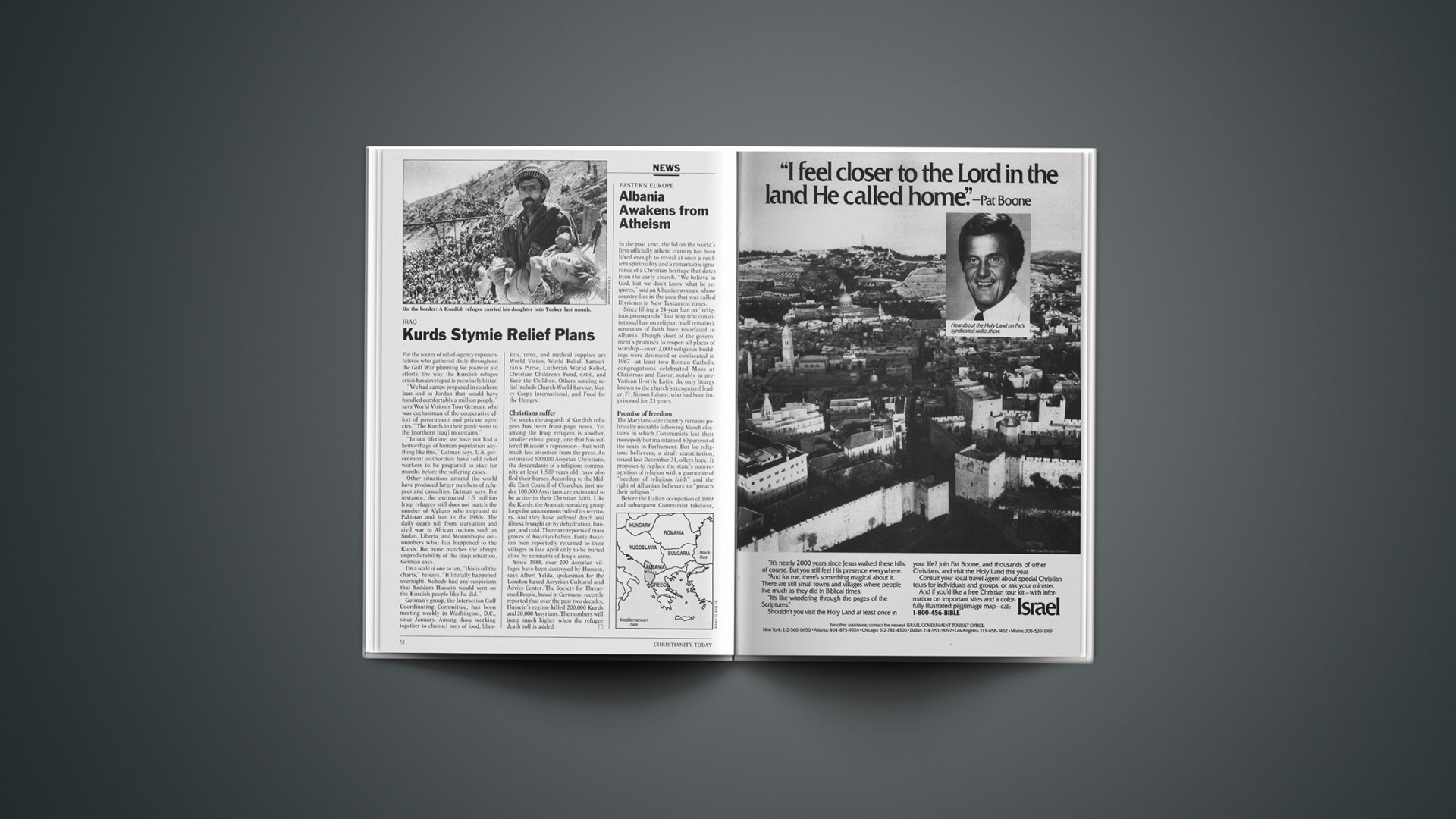

In the past year, the lid on the world’s first officially atheist country has been lifted enough to reveal at once a resilient spirituality and a remarkable ignorance of a Christian heritage that dates from the early church. “We believe in God, but we don’t know what he requires,” said an Albanian woman, whose country lies in the area that was called Illyricum in New Testament times.
Since lifting a 24-year ban on “religious propaganda” last May (the constitutional ban on religion itself remains), remnants of faith have resurfaced in Albania. Though short of the government’s promises to reopen all places of worship—over 2,000 religious buildings were destroyed or confiscated in 1967—at least two Roman Catholic congregations celebrated Mass at Christmas and Easter, notably in pre-Vatican II-style Latin, the only liturgy known to the church’s recognized leader, Fr. Simon Jubani, who had been imprisoned for 23 years.
Promise Of Freedom
The Maryland-size country remains politically unstable following March elections in which Communists lost their monopoly but maintained 60 percent of the seats in Parliament. But for religious believers, a draft constitution, issued last December 31, offers hope. It proposes to replace the state’s nonrecognition of religion with a guarantee of “freedom of religious faith” and the right of Albanian believers to “preach their religion.”
Before the Italian occupation of 1939 and subsequent Communist takeover, Albania’s 1 million people were estimated to be 70 percent Muslim, 20 percent Orthodox, and 10 percent Roman Catholic.
Little is known of the aftermath of an evangelical movement that grew to include about 100 in the late 1930s. But recent visitors tell of at least a handful who still remember American missionaries Edwin and Dorothy Jacques and their predecessors, the Kennedys, who began the work in 1908. (The government invited the Jacqueses back in 1986 to show them that nothing was left of their work.)
About a dozen people who identify themselves as evangelicals are known to gather irregularly now in the city of Korca, where the movement began. The group still sings with the organ supplied by the American missionaries. Though they don’t constitute an organized church, they are known in the town as “the Protestants” and have contact with small gatherings of ethnic Greek evangelicals in the central Albanian towns of Berat and Elbasan.
Christian tourists have begun only in the last year to visit Albanians in their homes. They note that whatever denominational affinity remains is largely cultural. “There is a tremendous spiritual hunger, but also an appalling ignorance,” said a frequent visitor to the country, who asked that his name be withheld for security reasons.
“When we give people a New Testament we have to tell them that the Bible is divided into two parts, and explain what chapters and verses are,” he said. “This is where they are.”
Islamic Heritage
Albania’s Islamic heritage is also resurfacing. Several mosques have been reopened. But many Albanians who call themselves Muslims are questioning their identity. In neighboring Kosovo, the troubled region of Serbia that is home to some two million ethnic Albanians, many Muslims are only now discovering that their ancestors were once Christian, forcibly converted to Islam under the Ottoman Empire that ruled from the fourteenth to the beginning of the twentieth century. This knowledge, which has provoked a new interest in Christianity, is beginning to spread through Albania as well.
Still, Islam clearly has a following in Albania. In January in Tirana, some 15,000 came to the first legal Muslim service in 24 years. Estimates now place Muslims at 30 percent, or about 1 million of Albania’s more than 3 million people. Their forms are diverse, ranging from the majority Sunnis to the home-grown Bektashi sect that incorporates elements of Christian doctrine and practice.
Recent reports have also revealed that the entire Jewish population of Albania secretly emigrated to Israel earlier in the year. About 325 arrived at reception centers in Israel.
Speculation varies widely as to how Albania’s religious mosaic might look in coming years. Some see the potential for Islam to take hold again in a region where Roman Catholic and Orthodox Christians have traditionally clashed. But evangelical Christians who observe Albania from the West are buoyed by the spiritual hunger they see in the thousands of Albanian refugees in Italy and Greece, who, as one missionary said, “want a Bible before food.”
Religious background may have little to do with how Albanians respond to the gospel. The average Albanian is just 26 years of age, born only two years before the government brutally erased religion from public law.