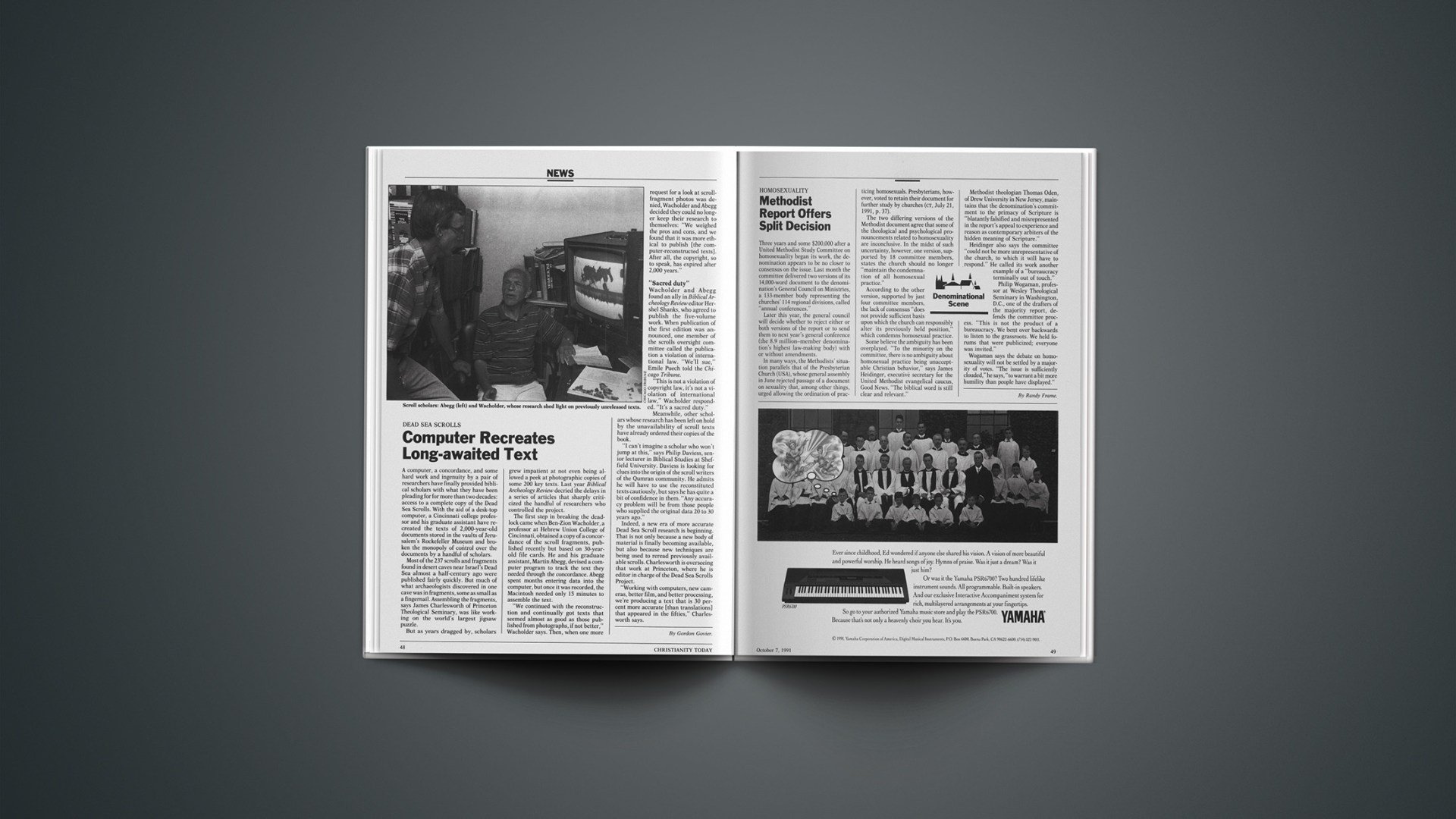

A computer, a concordance, and some hard work and ingenuity by a pair of researchers have finally provided biblical scholars with what they have been pleading for for more than two decades: access to a complete copy of the Dead Sea Scrolls. With the aid of a desk-top computer, a Cincinnati college professor and his graduate assistant have recreated the texts of 2,000-year-old documents stored in the vaults of Jerusalem’s Rockefeller Museum and broken the monopoly of control over the documents by a handful of scholars.
Most of the 237 scrolls and fragments found in desert caves near Israel’s Dead Sea almost a half-century ago were published fairly quickly. But much of what archaeologists discovered in one cave was in fragments, some as small as a fingernail. Assembling the fragments, says James Charlesworth of Princeton Theological Seminary, was like working on the world’s largest jigsaw puzzle.
But as years dragged by, scholars grew impatient at not even being allowed a peek at photographic copies of some 200 key texts. Last year Biblical Archeology Review decried the delays in a series of articles that sharply criticized the handful of researchers who controlled the project.
The first step in breaking the deadlock came when Ben-Zion Wacholder, a professor at Hebrew Union College of Cincinnati, obtained a copy of a concordance of the scroll fragments, published recently but based on 30-year-old file cards. He and his graduate assistant, Martin Abegg, devised a computer program to track the text they needed through the concordance. Abegg spent months entering data into the computer, but once it was recorded, the Macintosh needed only 15 minutes to assemble the text.
“We continued with the reconstruction and continually got texts that seemed almost as good as those published from photographs, if not better,” Wacholder says. Then, when one more request for a look at scroll-fragment photos was denied, Wacholder and Abegg decided they could no longer keep their research to themselves: “We weighed the pros and cons, and we found that it was more ethical to publish [the computer-reconstructed texts]. After all, the copyright, so to speak, has expired after 2,000 years.”
“Sacred Duty”
Wacholder and Abegg found an ally in Biblical Archeology Review editor Hershel Shanks, who agreed to publish the five-volume work. When publication of the first edition was announced, one member of the scrolls oversight committee called the publication a violation of international law. “We’ll sue,” Emile Puech told the Chicago Tribune.
“This is not a violation of copyright law, it’s not a violation of international law,” Wacholder responded. “It’s a sacred duty.”
Meanwhile, other scholars whose research has been left on hold by the unavailability of scroll texts have already ordered their copies of the book.
“I can’t imagine a scholar who won’t jump at this,” says Philip Daviess, senior lecturer in Biblical Studies at Sheffield University. Daviess is looking for clues into the origin of the scroll writers of the Qumran community. He admits he will have to use the reconstituted texts cautiously, but says he has quite a bit of confidence in them. “Any accuracy problem will be from those people who supplied the original data 20 to 30 years ago.”
Indeed, a new era of more accurate Dead Sea Scroll research is beginning. That is not only because a new body of material is finally becoming available, but also because new techniques are being used to reread previously available scrolls. Charlesworth is overseeing that work at Princeton, where he is editor in charge of the Dead Sea Scrolls Project.
“Working with computers, new cameras, better film, and better processing, we’re producing a text that is 30 percent more accurate [than translations] that appeared in the fifties,” Charlesworth says.
By Gordon Govier.