In this series

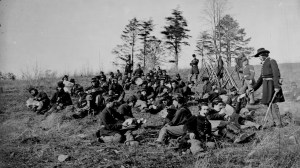
Two southern clergymen who had been active in the army revivals wrote books detailing the religious life of the Confederate forces.
In 1877, William W. Bennett, a minister who had headed the Methodist Soldiers’ Tract Association, published “A Narrative of the Great Revival Which Prevailed in the Southern Armies.” Bennett believed the southern army camp had truly been “a school of Christ,” where pious generals like Stonewall Jackson and Robert E. Lee led their men both in battles and in prayer meetings. The “moral miracles” that had taken place among Confederate soldiers were the most magnificent of all time; they truly became the “‘silver lining’ to the dark and heavy cloud” of the South’s defeat.
Bennett wrote: “In the army of General Lee, while it lay on the upper Rappahannock, the revival flame swept through every corps, division, brigade, and regiment. [One chaplain explained]: ‘The whole army is a vast field, ready and ripe to the harvest … The susceptibility of the soldiery to the gospel is wonderful, and, doubtful as the remark may appear, the military camp is most favorable to the work of revival. The soldiers, with the simplicity of little children, listen to and embrace the truth. Already over two thousand have professed conversion, and two thousand more are penitent … Oh, it is affecting to see the soldiers crowd and press about the preacher for what of tracts, etc., he has to distribute, and it is sad to see hundreds retiring without being supplied!’
“[Another minister wrote]: ‘The cold, mud, and rain, have produced great suffering and sickness among the troops; for we have been entirely without shelter in very exposed positions … In our field hospital we have over 350 sick …
“ ‘I never saw men who were better prepared to receive religious instruction and advice … The dying begged for our prayers and our songs. Every evening we would gather around the wounded and sing and pray with them. Many wounded, who had hitherto led wicked lives, became entirely changed … One young Tennessean, James Scott, of the 32d Tennessee, … continually begged us to sing for him and to pray with him. He earnestly desired to see his mother before he died, which was not permitted, as she was in the enemy’s lines, and he died rejoicing in the grace of God.’ ”
Published a decade after Bennett’s work, J. William Jones’s Christ in the Camp described what Jones had seen while chaplain to the Army of Northern Virginia.
“On the bloody campaign from the Rapidan to Cold Harbor in 1864,” he reported, when the army was constantly in the trenches or on the march, and fought almost daily, Bryan’s Georgia Brigade had a season of comparative repose, while held in reserve, when they had from three to five [religious] meetings a day, which resulted in about fifty professions of conversion, most of whom … [were] baptized in a pond which was exposed to the enemy’s fire, and where several men were wounded while the ordinance was being administered.”
Dr. Gardiner H. Shattuck, Jr. teaches church history in the School for Ministries of the Episcopal Diocese of Rhode Island. He is author of A Shield and Hiding Place: The Religious Life of the Civil War Armies (Mercer University Press, 1987).
Copyright © 1992 by the author or Christianity Today/Christian History magazine.Click here for reprint information on Christian History.