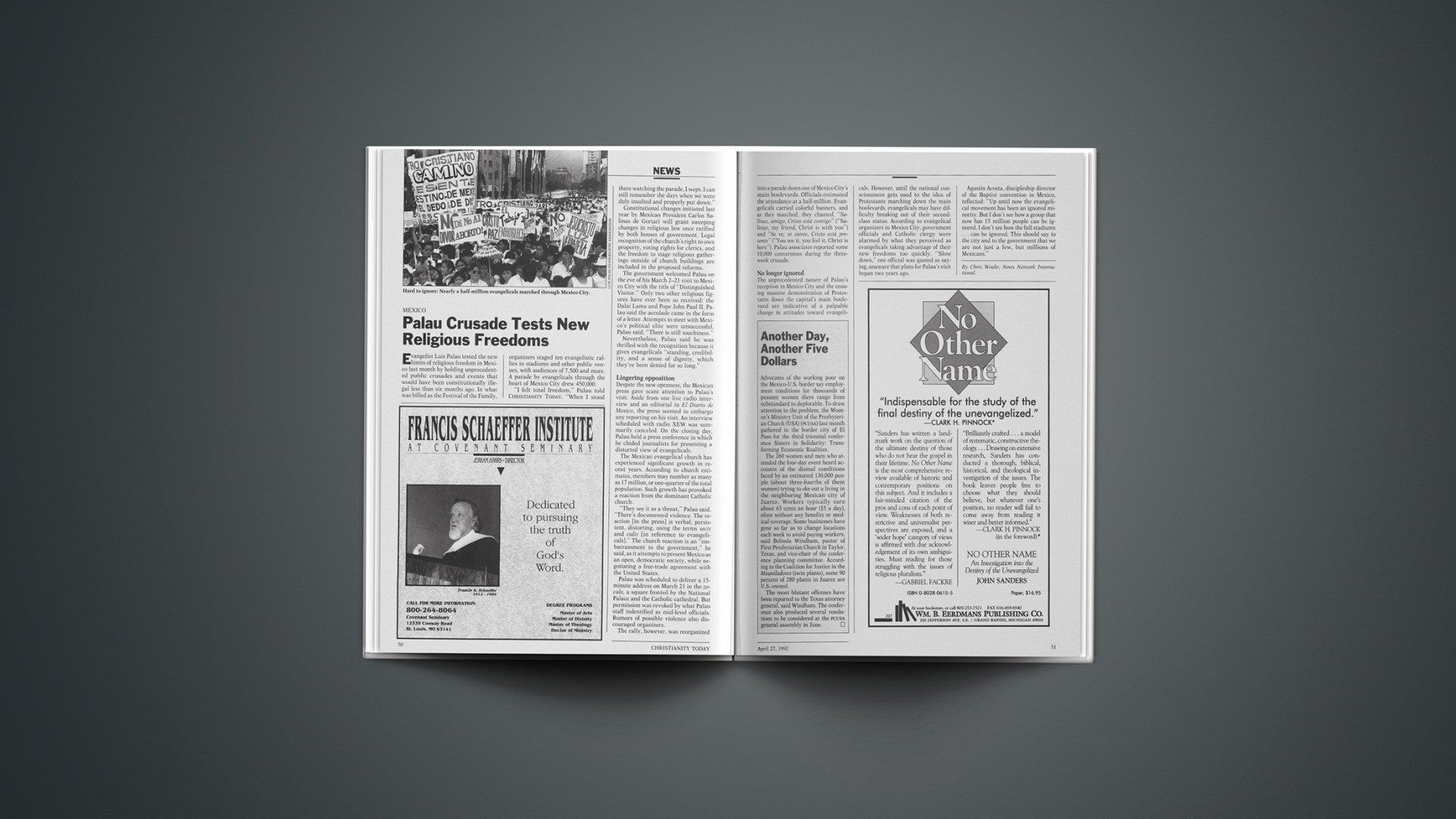

Evangelist Luis Palau tested the new limits of religious freedom in Mexico last month by holding unprecedented public crusades and events that would have been constitutionally illegal less than six months ago. In what was billed as the Festival of the Family, organizers staged ten evangelistic rallies in stadiums and other public venues, with audiences of 7,500 and more. A parade by evangelicals through the heart of Mexico City drew 450,000.
“I felt total freedom,” Palau told CHRISTIANITY TODAY. “When I stood there watching the parade, I wept. I can still remember the days when we were duly insulted and properly put down.”
Constitutional changes initiated last year by Mexican President Carlos Salinas de Gortari will grant sweeping changes in religious law once ratified by both houses of government. Legal recognition of the church’s right to own property, voting rights for clerics, and the freedom to stage religious gatherings outside of church buildings are included in the proposed reforms.
The government welcomed Palau on the eve of his March 2–21 visit to Mexico City with the title of “Distinguished Visitor.” Only two other religious figures have ever been so received: the Dalai Lama and Pope John Paul II. Palau said the accolade came in the form of a letter. Attempts to meet with Mexico’s political elite were unsuccessful, Palau said. “There is still touchiness.”
Nevertheless, Palau said he was thrilled with the recognition because it gives evangelicals “standing, credibility, and a sense of dignity, which they’ve been denied for so long.”
Lingering Opposition
Despite the new openness, the Mexican press gave scant attention to Palau’s visit. Aside from one live radio interview and an editorial in El Diario de Mexico, the press seemed to embargo any reporting on his visit. An interview scheduled with radio XEW was summarily canceled. On the closing day, Palau held a press conference in which he chided journalists for presenting a distorted view of evangelicals.
The Mexican evangelical church has experienced significant growth in recent years. According to church estimates, members may number as many as 17 million, or one-quarter of the total population. Such growth has provoked a reaction from the dominant Catholic church.
“They see it as a threat,” Palau said. “There’s documented violence. The reaction [in the press] is verbal, persistent, distorting, using the terms sects and cults [in reference to evangelicals].” The church reaction is an “embarrassment to the government,” he said, as it attempts to present Mexico as an open, democratic society, while negotiating a free trade agreement with the United States.
Palau was scheduled to deliver a 15-minute address on March 21 in the zocalo, a square fronted by the National Palace and the Catholic cathedral. But permission was revoked by what Palau staff indentified as mid-level officials. Rumors of possible violence also discouraged organizers.
The rally, however, was reorganized into a parade down one of Mexico City’s main boulevards. Officials estimated the attendance at a half-million. Evangelicals carried colorful banners, and as they marched, they chanted, “Salinas, amigo, Cristo está contigo” (“Salinas, my friend, Christ is with you”) and “Se ve, se siente, Cristo está presente” (“You see it, you feel it, Christ is here”). Palau associates reported some 10,000 conversions during the three-week crusade.
No Longer Ignored
The unprecedented nature of Palau’s reception in Mexico City and the ensuing massive demonstration of Protestants down the capital’s main boulevard are indicative of a palpable change in attitudes toward evangelicals. However, until the national consciousness gets used to the idea of Protestants marching down the main boulevards, evangelicals may have difficulty breaking out of their second-class status. According to evangelical organizers in Mexico City, government officials and Catholic clergy were alarmed by what they perceived as evangelicals taking advantage of their new freedoms too quickly. “Slow down,” one official was quoted as saying, unaware that plans for Palau’s visit began two years ago.
Agustin Acosta, discipleship director of the Baptist convention in Mexico, reflected: “Up until now the evangelical movement has been an ignored minority. But I don’t see how a group that now has 15 million people can be ignored. I don’t see how the full stadiums … can be ignored. This should say to the city and to the government that we are not just a few, but millions of Mexicans.”
By Chris Woehr, News Network International.
Another Day, Another Five Dollars
Advocates of the working poor on the Mexico-U.S. border say employment conditions for thousands of peasant women there range from substandard to deplorable. To draw attention to the problem, the Women’s Ministry Unit of the Presbyterian Church (USA) (PCUSA) last month gathered in the border city of El Paso for the third triennial conference Sisters in Solidarity: Transforming Economic Realities.
The 260 women and men who attended the four-day event heard accounts of the dismal conditions faced by an estimated 130,000 people (about three-fourths of them women) trying to eke out a living in the neighboring Mexican city of Juarez. Workers typically earn about 63 cents an hour ($5 a day), often without any benefits or medical coverage. Some businesses have gone so far as to change locations each week to avoid paying workers, said Belinda Windham, pastor of First Presbyterian Church in Taylor, Texas, and vice-chair of the conference planning committee. According to the Coalition for Justice in the Maquiladores (twin plants), some 90 percent of 280 plants in Juarez are U.S.-owned.
The most blatant offenses have been reported to the Texas attorney general, said Windham. The conference also produced several resolutions to be considered at the PCUSA general assembly in June.