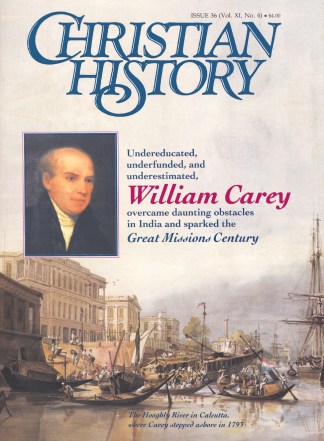
Here are excerpts from the “Form of Agreement” drafted by Carey and his colleagues in October 1805.
The Redeemer, in planting us in this heathen nation, rather than in any other, has imposed upon us the cultivation of peculiar qualifications. Upon these points we think it right to fix our serious and abiding attention.
First. In order to be prepared for our great and solemn work, it is absolutely necessary that we set an infinite value upon immortal souls; that we often endeavour to affect our minds with the dreadful loss sustained by an unconverted soul launched into eternity.
Secondly. It is very important that we should gain all the information we can of the snares and delusions in which these heathens are held. By this means we shall be able to converse with them in an intelligible manner.
Thirdly. It is necessary, in our intercourse with the Hindoos, that, as far as we are able, we abstain from those things which would increase their prejudices against the Gospel. Those parts of English manners which are most offensive to them should be kept out of sight as much as possible. [For example,] we should avoid every degree of cruelty to animals.
Fourthly. It becomes us to watch all opportunities of doing good. We are apt to relax in these active exertions, especially in a warm climate; but we shall do well always to fix it in our minds, that life is short, that all around us are perishing, and that we incur a dreadful woe if we proclaim not the glad tidings of salvation.
Fifthly. In preaching to the heathen, we must keep to the example of Paul, and make the great subject of our preaching, Christ the Crucified. It is a well-know fact that the most successful missionaries in the world at the present day make the atonement of Christ their theme.
Sixthly. It is absolutely necessary that the natives should have an entire confidence in us, and feel quite at home in our company. To gain this confidence we must on all occasions be willing to hear their complaints; we must give them kindest advice.
Seventhly. Another important part of our work is to build up, and watch over, the souls that may be gathered. A real missionary becomes in a sense a father to his people.
Eighthly. It is only by means of native preachers that we can hope for the universal spread of the Gospel throughout this immense continent. We think it our duty, as soon as possible, to advise the native brethren who may be formed into separate churches, to choose their pastors and deacons from their own countrymen.
Ninthly. It becomes us also to labor with all our might in forwarding translations of the sacred Scriptures in the languages of Hindoostan. The establishment of native free schools is also an object highly important to the future conquests of the Gospel.
Tenthly. That which, as a means is to fit us for the discharge of these laborious and unutterably important labours, is the being instant in prayer, and the cultivation of personal religion. Let each one of us lay it upon his heart that we will seek to be fervent in spirit, wrestling with God, till He famish these idols and cause the heathen to experience the blessedness that is in Christ.
Finally. Let us give ourselves up unreservedly to this glorious cause. Let us never think that our time, our gifts, our strength, our families, or even the clothes we wear, are our own. To keep these ideas alive in our minds, we resolve that this Agreement shall be read publicly, at every station, at our three annual meetings, viz., on the first Lord’s day in January, in May, and October.
Copyright © 1992 by the author or Christianity Today/Christian History magazine. Click here for reprint information on Christian History.