In this series
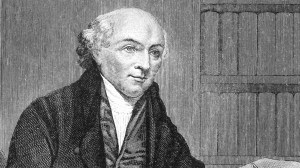

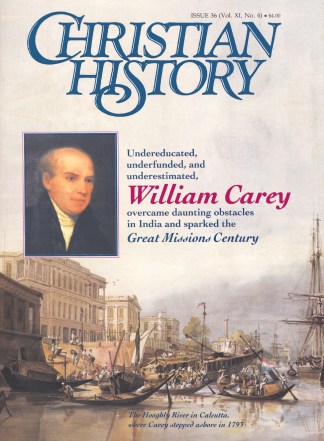
William and Dorothy Carey and their four sons arrived in Calcutta on November 11, 1793. They soon exhausted their funds and found themselves dependent on others for food and shelter. In the next seven months, they moved five times.
Dorothy struggled with bleeding brought on by tropical diseases. Then the family sustained a cruel blow on October 11, 1794, when their 5-year-old son Peter died. The painful weeks after his death passed slowly, but at Christmas the family made a brief holiday trip to Malda. William wrote in his last journal entry for the year that they were all much refreshed by the trip.
But no one could have predicted what was going to happen in the next three months. At some point before March 1795, Dorothy slipped across the subjective border between sanity and insanity. She was to remain locked in the grip of psychosis for the remaining twelve years of her life.
Murderous Jealousy
The first acknowledgment of a problem comes from a letter Carey wrote to his sisters in England on October 5, 1795. “I have greater affliction than any of these in my family. Known to my friends here, but I have never mentioned it to anyone in England before, is my poor wife, who is looked upon as insane to a great degree here by both native and Europeans.… I have been for some time past in danger of losing my life. Jealousy is the great evil that haunts her mind.”
The second major piece of evidence comes from a letter that Carey’s colleague, John Thomas, wrote to Andrew Fuller on January 11, 1796. Apparently, Carey and Thomas had planned to wait a number of months before informing the society in England of Dorothy’s poor mental state. Perhaps they hoped her delusions would disappear.
When her condition did not improve, Thomas wrote a detailed description of Dorothy’s plight. “Mrs. C[arey] has taken it into her head that C[arey] is a great whoremonger; and her jealousy burns like fire unquenchable.” Thomas added that Dorothy became obsessed with Carey’s supposed unfaithfulness and would follow him every time he left the house. “[She] declares in the most solemn manner that she has catched [sic] him with his servants, with his friends, with Mrs. Thomas, and that he is guilty every day and every night.… In all other things she talks sensibly.”
Carey and Thomas both wondered if Dorothy could be demon-possessed. After reading a psychiatric textbook, they concluded she suffered from mental illness. Today we would diagnose Dorothy’s condition as a Delusional Disorder (formerly paranoia), Jealous Type. The prognosis for intense delusional conditions is poor today, just as it proved to be for Dorothy 200 years ago. She never improved.
Life soon took on a frantic tone. Thomas wrote, “She has uttered the most blasphemous and bitter imprecations against him, when Mrs. Thomas and myself were present, seizing him by the hair of his head, and one time at the breakfast table held up a knife and said, Curse you. I could cut your throat. She has even made some attempt on his life.”
Plaintive Outpourings
Knowing the nature of Dorothy’s mental illness sheds light on a remarkable section in Carey’s journal. During the first three months of Dorothy’s retreat from reality (January-March 1795), Carey poured out his soul:
January 1–15: “This time I have had bitters (of a family kind) mingled with my soul.”
February 3: “This is indeed the Valley of the Shadow of Death to me.… O what would I give for a kind sympathetic friend such as I had in England to whom I might open my heart.”
February 5: “O what a load is a barren heart.”
February 7: “O that this day could be consigned to oblivion.”
February 17: “O that I had but the spirit to pray for myself.”
March 9–10: “Much to complain of, such another dead soul I think scarcely exists in the world.”
No doubt some of these plaintive outpourings refer to Dorothy’s deteriorating mental condition. William’s efforts to reason with Dorothy were proving futile. The best strategy he and Thomas could design was to confine her, probably in a locked room. During the next 12 years, Dorothy would enjoy only some brief times of liberty.
Life for all of the Careys was difficult. Carey especially worried about his sons in his October 5, 1795, letter to his sisters: “Bless God all the dirt which she throws is such as cannot stick; but it is the ruin of my children to hear such continual accusations.”
Unremitting Psychosis
What caused Dorothy to slip into her unremitting psychosis? We can only speculate.
• Her weakened physical health and the stress of adjusting to new foods, customs, and weather.
• Loss dogged Dorothy’s steps. She had buried two daughters in England and had lost contact with her extended family. (The first mail to arrive in Bengal from friends and family did not arrive until several weeks after Dorothy slipped into her psychotic state.) Her sister Kitty, who had accompanied her to India, married and left Dorothy in mid-1794. And she buried her son Peter in October 1794.
• By temperament, she was a fearful person. Perhaps the loss of Peter triggered the fear she might lose her remaining three sons to tropical diseases.
• She may have lost trust in William’s ability to care for her. Dorothy clearly had told William she did not want to come to India. Only under great pressure did she change her mind. The trust she had placed in Carey when she decided to accompany him to India may have evaporated soon after their arrival. In its place surged a flood of distrust, this time regarding William’s sexual faithfulness.
Fascinating Questions
Dorothy’s paranoia poses fascinating questions.
How did William accomplish all that he did with constant domestic turmoil?
Did Carey ever seek medical help for Dorothy? William may have hesitated having doctors from the British East India Company learn about Dorothy’s accusations. Surely an official investigation would have ensued, and the presence of missionaries in India may have been further jeopardized.
How did Dorothy function as a mother during these years? She did give birth to their seventh child, a son named Jonathan, approximately 11 months after paranoia began.
How did the family move 250 miles from Mudnabatti to Serampore during the first ten days of 1800?
We are left with more questions than answers.
Dorothy died on December 8, 1807, at the age of 51. The public learned of her death by reading a brief, telescoped notice in the 1808 Periodical Accounts: “Mrs. Carey, after having been ill about a fortnight, died.”
Dr. James R. Beck is associate professor of counseling at Denver Seminary and author of Dorothy Carey: The Tragic and Untold Story of Mrs. William Carey (Baker, 1992).
Copyright © 1992 by the author or Christianity Today/Christian History magazine.Click here for reprint information on Christian History.