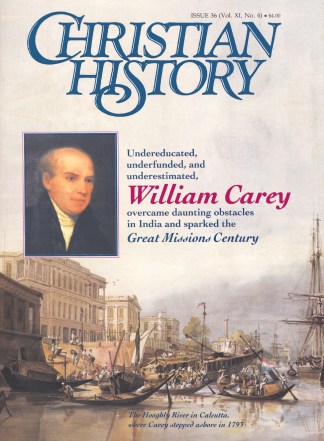
At the time of William Carey, there were probably only a few hundred Protestant missionaries in the world. They never numbered more than a few thousand during the following decades. By 1900, even after a second burst of Protestant missions, there were only 15,000 European and American Protestant missionaries throughout the world. Those who went had short careers; many died within the first two years on the field. Thus the numbers remained quite small.
But the magnitude of the modern missions movement must not be measured by the number of missionaries. It must be measured by the growth of the church.
In 1800, perhaps 1 percent of Protestant Christians lived in Asia, Africa, and Latin America. By 1900, this number had grown to 10 percent. Today, at least 67 percent of all active Protestant Christians live in countries once considered foreign mission fields. And the church is still growing rapidly, even explosively, in many areas—Korea, sub-Saharan Africa, Singapore, and the Peoples’ Republic of China.
Consider this remarkable turnaround. Only 200 years ago, Protestant Christianity was almost exclusively Western. Now Protestants are strongest in Asia, Africa, and Latin America. From a Christian standpoint, the modern missionary movement has turned the world upside down.
What caused this movement? Why did it start?
Powerful Pietists
The first European Protestant missionaries to Asia landed in India almost a century before Carey. Bartholomew Ziegenbalg and Heinrich Plütschau were Pietists from the University of Halle (in Germany) who went to the Danish colony of Tranquebar in India in 1706. More than fifty Pietist missionaries from Germany followed them to India during that century.
Pietism also influenced the young Count Nikolaus Ludwig von Zinzendorf, who became the leader of the Moravian movement. In 1732 the Moravian believers began to send missionaries all over the world—to 28 different countries in 28 years.
Susannah Wesley, mother of John and Charles Wesley, was greatly influenced by reading the memoirs of Ziegenbalg and Plutschau. Her sons deeply felt the spiritual impact of the Moravians, and their Methodist movement birthed many missionaries in the 1800s.
Astounding Awakenings
Evangelical revivals in the 1700s were a second major factor in the explosion of missionary activity. Jonathan Edwards, a leader of the first Great Awakening in North America, had a deep concern for missions. He encouraged concerts of prayer, which were organized in Scotland and North America. Perhaps most important, he published the journal of David Brainerd, who died after a brief but intense ministry with native Americans in central New Jersey. Carey later was inspired by Brainerd’s journal.
The evangelical awakening in England was led primarily by John and Charles Wesley and George Whitefield. The movement led to renewal in various churches, and Carey was awakened in his faith by the movement. It is significant that Carey wrote his Enquiry missions manifesto only one year after John Wesley died.
Colonial Commerce
The political and commercial context was a third factor. During the 1500s and 1600s, missions from Europe were carried on almost exclusively by Roman Catholics. The mission efforts were supported by the major Roman Catholic maritime powers—Spain, Portugal, and later France.
But by the early 1600s, the British East India Company was trading in India. Great Britain gradually began to control land there, and a century later nearly all of India was incorporated into the British Empire. England, with its growing commercial interests, had become the dominant maritime power of the world. News of Captain Cook’s explorations in the South Pacific came back to England, expanding peoples’ understanding of the world. When Carey read The Last Voyage of Captain Cook, it stirred his interest in missions.
Successive Societies
Thus, Carey arrived on the scene at a time of commercial and political expansion and religious revival. He insisted the Great Commission was binding on the church. He traced the historical roots of Protestant missions. And he recognized the changing historical context that made a missionary movement possible.
Carey’s call to mission launched a movement. More than any other individual, he moved European and North American churches to focus on the world beyond. For this reason he deserves to be called the Father of Protestant Missions.
In 1792, Carey sparked the creation of the Particular Baptist Society for the Propagation of the Gospel Amongst the Heathen. There soon followed an explosion of mission agencies: London Missionary Society (1795), Scottish and Glasgow Missionary Societies (1796), Church Missionary Society (1799), Religious Tract Society (1799), and the British and Foreign Bible Society (1804).
Similar groups formed in continental Europe and America, including the American Board of Commissioners for Foreign Missions (1810) and, among Baptists, the General Convention for Foreign Missions (1814).
Carey Continued
The missionary movement has not stopped growing since 1792. There are now approximately 40,000 career Protestant missionaries who have gone from the United States to other parts of the world. Ten percent are from older “mainline” churches; 90 percent come from newer evangelical or charismatic groups.
However, the missionary movement launched by Carey has changed radically. In the 1800s, with rare exceptions, cross-cultural missionaries came from the West. Even until forty years ago missionary generally meant a Westerner going to Asia, Africa, and Latin America.
Today, though, the number of cross-cultural missionaries is growing most rapidly among believers from Asia, Africa, and Latin America. Research indicates there were 3,400 such missionaries in 1972. Today, there are at least 48,000.
This is a new phenomenon in history. No message has been communicated so widely by so many people of so many races, languages, and cultures as the Christian message today.
Dr. Paul E. Pierson is dean emeritus and professor of history of mission in the School of World Mission, Fuller Theological Seminary, Pasadena, California.
Copyright © 1992 by the author or Christianity Today/Christian History magazine.Click here for reprint information on Christian History.