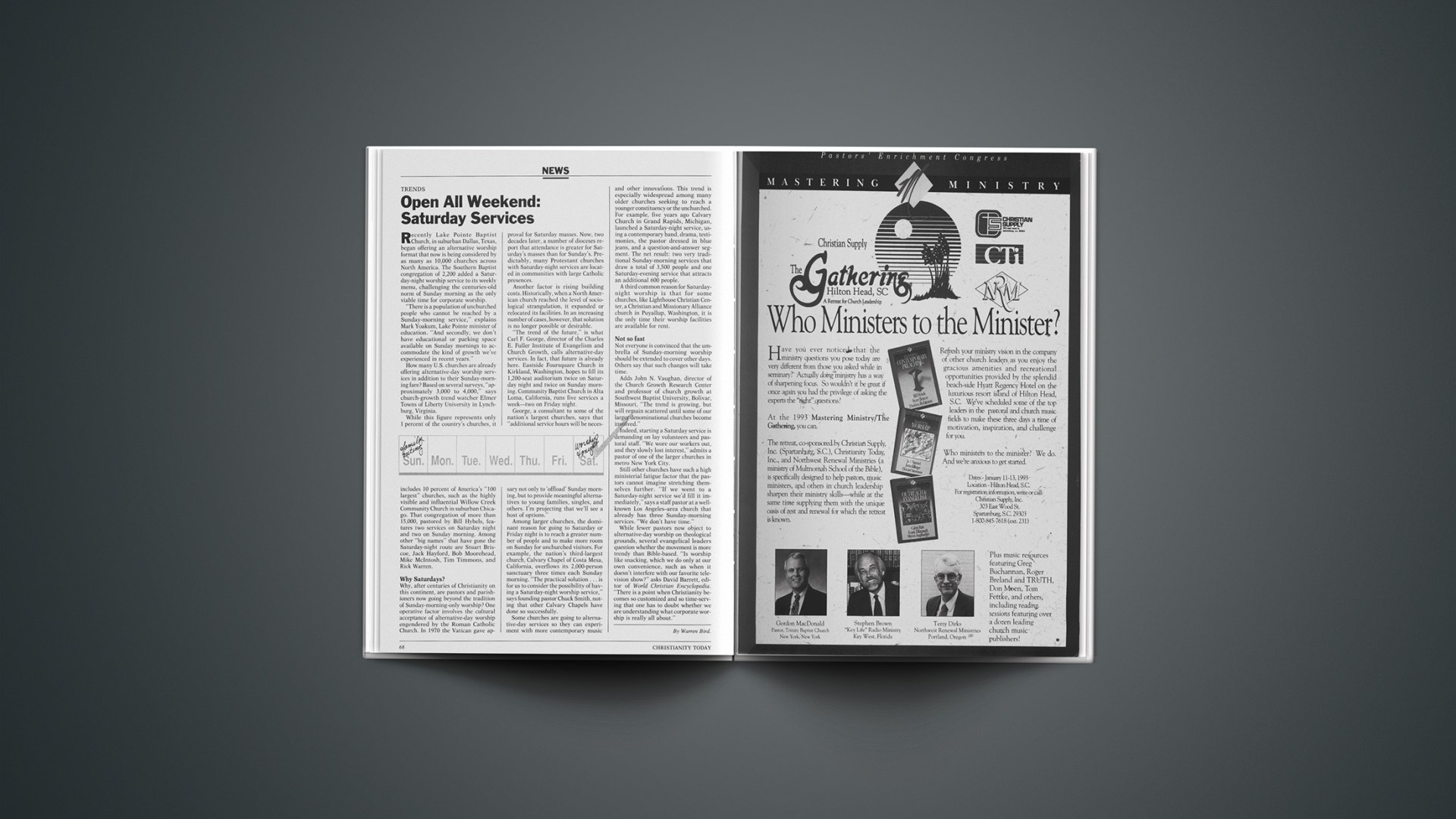

Recently Lake Pointe Baptist Church, in suburban Dallas, Texas, began offering an alternative worship format that now is being considered by as many as 10,000 churches across North America. The Southern Baptist congregation of 2,200 added a Saturday-night worship service to its weekly menu, challenging the centuries-old norm of Sunday morning as the only viable time for corporate worship.
“There is a population of unchurched people who cannot be reached by a Sunday-morning service,” explains Mark Yoakum, Lake Pointe minister of education. “And secondly, we don’t have educational or parking space available on Sunday mornings to accommodate the kind of growth we’ve experienced in recent years.”
How many U.S. churches are already offering alternative-day worship services in addition to their Sunday-morning fare? Based on several surveys, “approximately 3,000 to 4,000,” says church-growth trend watcher Elmer Towns of Liberty University in Lynchburg, Virginia.
While this figure represents only 1 percent of the country’s churches, it includes 10 percent of America’s “100 largest” churches, such as the highly visible and influential Willow Creek Community Church in suburban Chicago. That congregation of more than 15,000, pastored by Bill Hybels, features two services on Saturday night and two on Sunday morning. Among other “big names” that have gone the Saturday-night route are Stuart Briscoe, Jack Hayford, Bob Moorehead, Mike McIntosh, Tim Timmons, and Rick Warren.
Why Saturdays?
Why, after centuries of Christianity on this continent, are pastors and parishioners now going beyond the tradition of Sunday-morning-only worship? One operative factor involves the cultural acceptance of alternative-day worship engendered by the Roman Catholic Church. In 1970 the Vatican gave approval for Saturday masses. Now, two decades later, a number of dioceses report that attendance is greater for Saturday’s masses than for Sunday’s. Predictably, many Protestant churches with Saturday-night services are located in communities with large Catholic presences.
Another factor is rising building costs. Historically, when a North American church reached the level of sociological strangulation, it expanded or relocated its facilities. In an increasing number of cases, however, that solution is no longer possible or desirable.
“The trend of the future,” is what Carl F. George, director of the Charles E. Fuller Institute of Evangelism and Church Growth, calls alternative-day services. In fact, that future is already here. Eastside Foursquare Church in Kirkland, Washington, hopes to fill its 1,200-seat auditorium twice on Saturday night and twice on Sunday morning. Community Baptist Church in Alta Loma, California, runs five services a week—two on Friday night.
George, a consultant to some of the nation’s largest churches, says that “additional service hours will be necessary not only to ‘offload’ Sunday morning, but to provide meaningful alternatives to young families, singles, and others. I’m projecting that we’ll see a host of options.”
Among larger churches, the dominant reason for going to Saturday or Friday night is to reach a greater number of people and to make more room on Sunday for unchurched visitors. For example, the nation’s third-largest church, Calvary Chapel of Costa Mesa, California, overflows its 2,000-person sanctuary three times each Sunday morning. “The practical solution … is for us to consider the possibility of having a Saturday-night worship service,” says founding pastor Chuck Smith, noting that other Calvary Chapels have done so successfully.
Some churches are going to alternative-day services so they can experiment with more contemporary music and other innovations. This trend is especially widespread among many older churches seeking to reach a younger constituency or the unchurched. For example, five years ago Calvary Church in Grand Rapids, Michigan, launched a Saturday-night service, using a contemporary band, drama, testimonies, the pastor dressed in blue jeans, and a question-and-answer segment. The net result: two very traditional Sunday-morning services that draw a total of 3,500 people and one Saturday-evening service that attracts an additional 600 people.
A third common reason for Saturday-night worship is that for some churches, like Lighthouse Christian Center, a Christian and Missionary Alliance church in Puyallup, Washington, it is the only time their worship facilities are available for rent.
Not So Fast
Not everyone is convinced that the umbrella of Sunday-morning worship should be extended to cover other days. Others say that such changes will take time.
Adds John N. Vaughan, director of the Church Growth Research Center and professor of church growth at Southwest Baptist University, Bolivar, Missouri, “The trend is growing, but will remain scattered until some of our larger denominational churches become involved.”
Indeed, starting a Saturday service is demanding on lay volunteers and pastoral staff. “We wore our workers out, and they slowly lost interest,” admits a pastor of one of the larger churches in metro New York City.
Still other churches have such a high ministerial fatigue factor that the pastors cannot imagine stretching themselves further. “If we went to a Saturday-night service we’d fill it immediately,” says a staff pastor at a well-known Los Angeles-area church that already has three Sunday-morning services. “We don’t have time.”
While fewer pastors now object to alternative-day worship on theological grounds, several evangelical leaders question whether the movement is more trendy than Bible-based. “Is worship like snacking, which we do only at our own convenience, such as when it doesn’t interfere with our favorite television show?” asks David Barrett, editor of World Christian Encyclopedia. “There is a point when Christianity becomes so customized and so time-serving that one has to doubt whether we are understanding what corporate worship is really all about.”
By Warren Bird.