



Europeans to participate electronically in crusade.
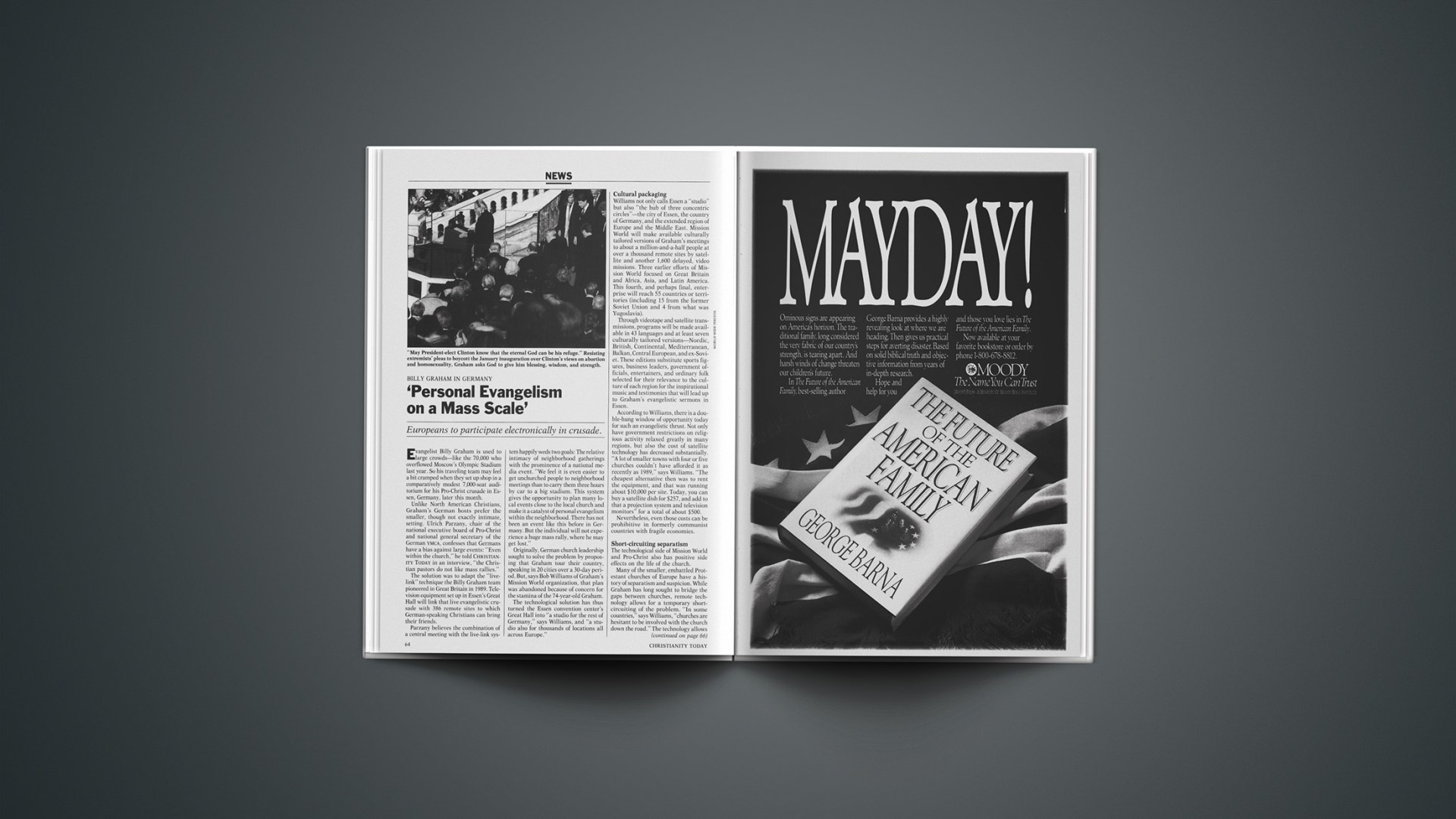
Evangelist Billy Graham is used to large crowds—like the 70,000 who overflowed Moscow’s Olympic Stadium last year. So his traveling team may feel a bit cramped when they set up shop in a comparatively modest 7,000-seat auditorium for his Pro-Christ crusade in Essen, Germany, later this month.
Unlike North American Christians, Graham’s German hosts prefer the smaller, though not exactly intimate, setting. Ulrich Parzany, chair of the national executive board of Pro-Christ and national general secretary of the German YMCA, confesses that Germans have a bias against large events: “Even within the church,” he told CHRISTIANITY TODAY in an interview, “the Christian pastors do not like mass rallies.”
The solution was to adapt the “live-link” technique the Billy Graham team pioneered in Great Britain in 1989. Television equipment set up in Essen’s Great Hall will link that live evangelistic crusade with 386 remote sites to which German-speaking Christians can bring their friends.
Parzany believes the combination of a central meeting with the live-link system happily weds two goals: The relative intimacy of neighborhood gatherings with the prominence of a national media event. “We feel it is even easier to get unchurched people to neighborhood meetings than to carry them three hours by car to a big stadium. This system gives the opportunity to plan many local events close to the local church and make it a catalyst of personal evangelism within the neighborhood. There has not been an event like this before in Germany. But the individual will not experience a huge mass rally, where he may get lost.”
Originally, German church leadership sought to solve the problem by proposing that Graham tour their country, speaking in 20 cities over a 30-day period. But, says Bob Williams of Graham’s Mission World organization, that plan was abandoned because of concern for the stamina of the 74-year-old Graham.
The technological solution has thus turned the Essen convention center’s Great Hall into “a studio for the rest of Germany,” says Williams, and “a studio also for thousands of locations all across Europe.”
Cultural packaging
Williams not only calls Essen a “studio” but also “the hub of three concentric circles”—the city of Essen, the country of Germany, and the extended region of Europe and the Middle East. Mission World will make available culturally tailored versions of Graham’s meetings to about a million-and-a-half people at over a thousand remote sites by satellite and another 1,600 delayed, video missions. Three earlier efforts of Mission World focused on Great Britain and Africa, Asia, and Latin America. This fourth, and perhaps final, enterprise will reach 55 countries or territories (including 15 from the former Soviet Union and 4 from what was Yugoslavia).
Through videotape and satellite transmissions, programs will be made available in 43 languages and at least seven culturally tailored versions—Nordic, British, Continental, Mediterranean, Balkan, Central European, and ex-Soviet. These editions substitute sports figures, business leaders, government officials, entertainers, and ordinary folk selected for their relevance to the culture of each region for the inspirational music and testimonies that will lead up to Graham’s evangelistic sermons in Essen.
According to Williams, there is a double-hung window of opportunity today for such an evangelistic thrust. Not only have government restrictions on religious activity relaxed greatly in many regions, but also the cost of satellite technology has decreased substantially. “A lot of smaller towns with four or five churches couldn’t have afforded it as recently as 1989,” says Williams. “The cheapest alternative then was to rent the equipment, and that was running about $10,000 per site. Today, you can buy a satellite dish for $257, and add to that a projection system and television monitors” for a total of about $500.
Nevertheless, even those costs can be prohibitive in formerly communist countries with fragile economies.
Short-circuiting separatism
The technological side of Mission World and Pro-Christ also has positive side effects on the life of the church.
Many of the smaller, embattled Protestant churches of Europe have a history of separatism and suspicion. While Graham has long sought to bridge the gaps between churches, remote technology allows for a temporary short-circuiting of the problem. “In some countries,” says Williams, “churches are hesitant to be involved with the church down the road.” The technology allows these churches to have their own evangelistic outreach without having to overcome overnight historically stubborn barriers.
In addition, personal evangelism training becomes available to churches that have not had access to it in the past. “We work hard to make it personal evangelism on a mass scale,” says Williams, “not mass evangelism.”
Listening to European Christian leadership, the Mission World team discovered that most previous personal evangelism training had been “simply how to read through a booklet with someone.”
Parzany adds that Pro-Christ is renewing interest in evangelism on the part of mainline church leaders. After Graham addressed the synod of the Protestant Churches last November, church leadership acknowledged that the balance he sought between preaching the Word and social responsibility encouraged them, in the words of the synod president, to “gladly accept [his] call … to discover new roads to preach the gospel and also to utilize modern media in doing so.”
By David Neff.