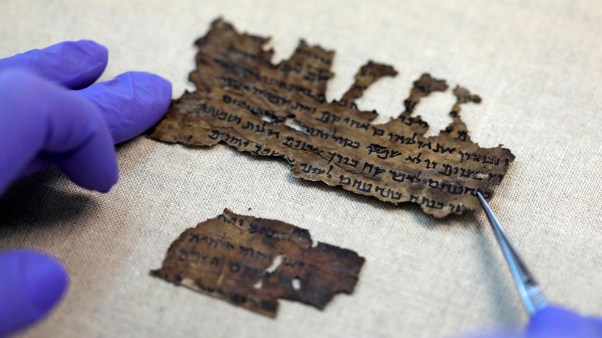

King David’s realm stretched from Dan in the north to Beersheba in the south, according to orders given to his general Joab in 2 Samuel 24. Now an inscription, found at Dan, has provided Bible scholars with the first extrabiblical mention of David from the period of the kingdom of Judah.
The inscription was discovered by accident on a fragment of a monument in the ruins of a wall as workers prepared the site for visitors. “When the rays of sun were hitting that stone at the proper angle, we noticed that there was writing,” archaeologist Avraham Biran reported from Jerusalem.
The 84-year-old Biran is a former director of the Israel Department of Antiquities and now works at Hebrew Union College and the Jewish Institute of Religion.
The 13-line text is still being deciphered, but the words that jumped out at Biran were “Bet David,” which means the house of David, or the dynasty of David. The found fragment contains the beginning of the lines from the edge of a stele, an inscribed stone monument.
Biran has concluded the one-foot-square stone is part of a larger victory stele of King Ben-Hadad of Damascus, erected following a campaign against Dan and other cities of Israel in the early ninth century B.C., about 100 years after David. The war between Asa, king of Judah, and Baasha, king of Israel, is detailed in 1 Kings 15:16–22. The account says Asa used silver and gold from the temple in Jerusalem to encourage Ben-Hadad to intervene on his side against Baasha.
After King Ahab retook the city of Dan, the stele probably was broken into rubble. One or more pieces were used in the wall. Says Biran, “We’ve been looking for [the rest of] it ever since then, turning every stone, but so far we haven’t found it.”
Until this discovery, the Israelite kings Omri, Ahab, and Jehu were the earliest biblical figures known from extrabiblical sources. They are mentioned in inscriptions of the Assyrian King Shalmaneser III, found in the last century. “We don’t need archaeological research to confirm what is written in the Bible,” Biran says. “I don’t like the word confirmation because I never doubted the story in the Bible.”
However, a number of biblical scholars do take a cautious view of the archaeological record. University of North Carolina-Chapel Hill religion professor Jack Sasson stressed that this find is not proof of David’s existence. But others disagree. Says University of Wisconsin-Madison professor Keith Schoville, “If we discovered in Syria a stone mentioning the house of Ben-Hadad, there wouldn’t be any question about the reality of that person.”
Schoville worked with Biran at Dan for five sessions in the late seventies and is president of the Near East Archaeological Society, an organization of evangelical scholars. He believes Biran has put his finger on the historical context of the inscription. This is an important find, he says. “It substantiates historical data about Israel and Judah.”
By Gordon Govier.