
Charismatic Methodists lead an awakening.
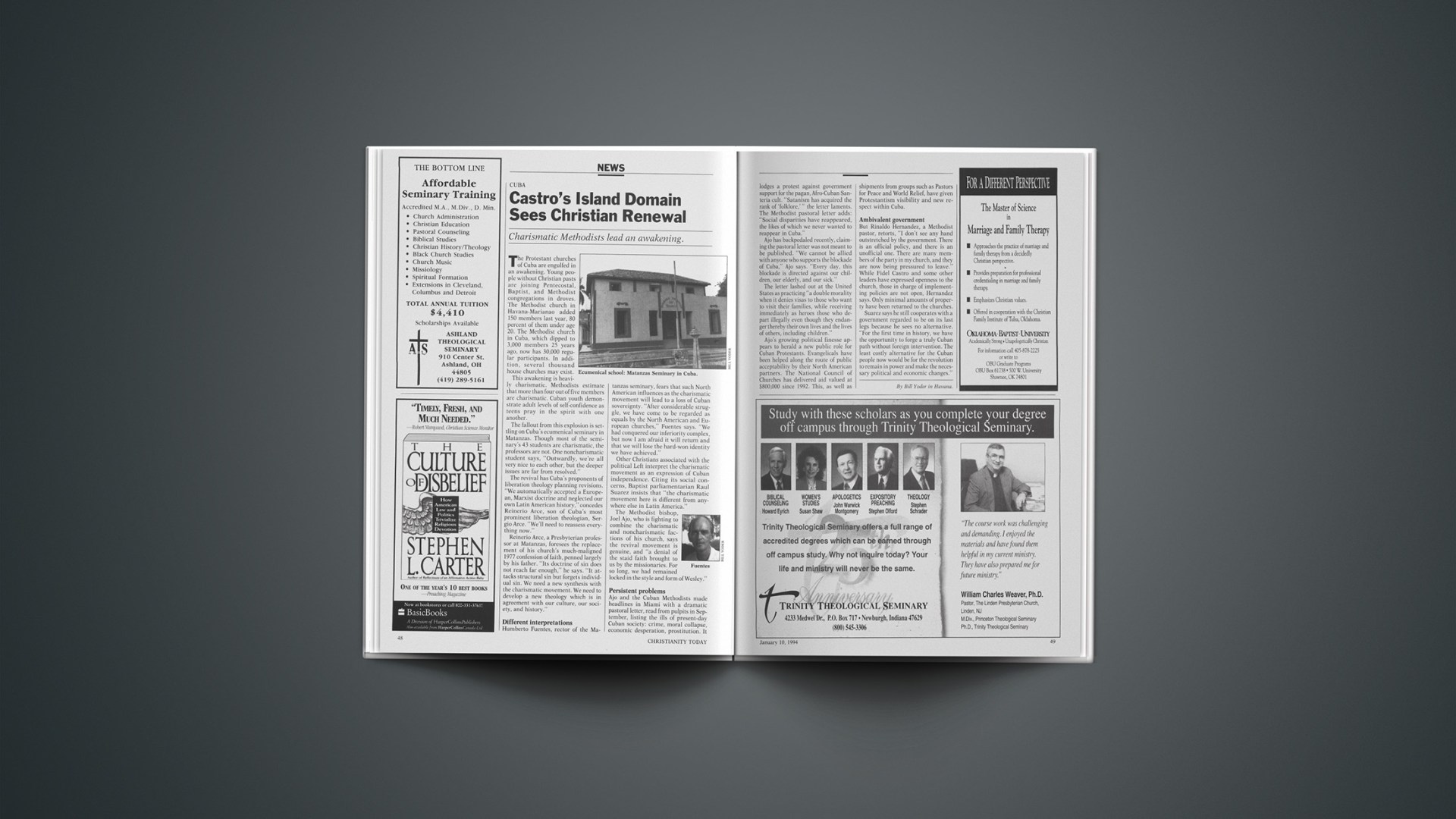
The Protestant churches of Cuba are engulfed in an awakening. Young people without Christian pasts are joining Pentecostal, Baptist, and Methodist congregations in droves. The Methodist church in Havana-Marianao added 150 members last year, 80 percent of them under age 20. The Methodist church in Cuba, which dipped to 3,000 members 25 years ago, now has 30,000 regular participants. In addition, several thousand house churches may exist.
This awakening is heavily charismatic. Methodists estimate that more than four out of five members are charismatic. Cuban youth demonstrate adult levels of self-confidence as teens pray in the spirit with one another.
The fallout from this explosion is settling on Cuba’s ecumenical seminary in Matanzas. Though most of the seminary’s 43 students are charismatic, the professors are not. One noncharismatic student says, “Outwardly, we’re all very nice to each other, but the deeper issues are far from resolved.”
The revival has Cuba’s proponents of liberation theology planning revisions. “We automatically accepted a European, Marxist doctrine and neglected our own Latin American history,” concedes Reinerio Arce, son of Cuba’s most prominent liberation theologian, Sergio Arce. “We’ll need to reassess everything now.”
Reinerio Arce, a Presbyterian professor at Matanzas, foresees the replacement of his church’s much-maligned 1977 confession of faith, penned largely by his father. “Its doctrine of sin does not reach far enough,” he says. “It attacks structural sin but forgets individual sin. We need a new synthesis with the charismatic movement. We need to develop a new theology which is in agreement with our culture, our society, and history.”
Different interpretations
Humberto Fuentes, rector of the Matanzas seminary, fears that such North American influences as the charismatic movement will lead to a loss of Cuban sovereignty. “After considerable struggle, we have come to be regarded as equals by the North American and European churches,” Fuentes says. “We had conquered our inferiority complex, but now I am afraid it will return and that we will lose the hard-won identity we have achieved.”
Other Christians associated with the political Left interpret the charismatic movement as an expression of Cuban independence. Citing its social concerns, Baptist parliamentarian Raul Suarez insists that “the charismatic movement here is different from anywhere else in Latin America.”
The Methodist bishop, Joel Ajo, who is fighting to combine the charismatic and noncharismatic factions of his church, says the revival movement is genuine, and “a denial of the staid faith brought to us by the missionaries. For so long, we had remained locked in the style and form of Wesley.”
Persistent problems
Ajo and the Cuban Methodists made headlines in Miami with a dramatic pastoral letter, read from pulpits in September, listing the ills of present-day Cuban society: crime, moral collapse, economic desperation, prostitution. It lodges a protest against government support for the pagan, Afro-Cuban Santería cult. “Satanism has acquired the rank of ‘folklore,’ ” the letter laments. The Methodist pastoral letter adds: “Social disparities have reappeared, the likes of which we never wanted to reappear in Cuba.”
Ajo has backpedaled recently, claiming the pastoral letter was not meant to be published. “We cannot be allied with anyone who supports the blockade of Cuba,” Ajo says. “Every day, this blockade is directed against our children, our elderly, and our sick.”
The letter lashed out at the United States as practicing “a double morality when it denies visas to those who want to visit their families, while receiving immediately as heroes those who depart illegally even though they endanger thereby their own lives and the lives of others, including children.”
Ajo’s growing political finesse appears to herald a new public role for Cuban Protestants. Evangelicals have been helped along the route of public acceptability by their North American partners. The National Council of Churches has delivered aid valued at $800,000 since 1992. This, as well as shipments from groups such as Pastors for Peace and World Relief, have given Protestantism visibility and new respect within Cuba.
Ambivalent government
But Rinaldo Hernandez, a Methodist pastor, retorts, “I don’t see any hand outstretched by the government. There is an official policy, and there is an unofficial one. There are many members of the party in my church, and they are now being pressured to leave.” While Fidel Castro and some other leaders have expressed openness to the church, those in charge of implementing policies are not open, Hernandez says. Only minimal amounts of property have been returned to the churches.
Suarez says he still cooperates with a government regarded to be on its last legs because he sees no alternative. “For the first time in history, we have the opportunity to forge a truly Cuban path without foreign intervention. The least costly alternative for the Cuban people now would be for the revolution to remain in power and make the necessary political and economic changes.”
By Bill Yoder in Havana.