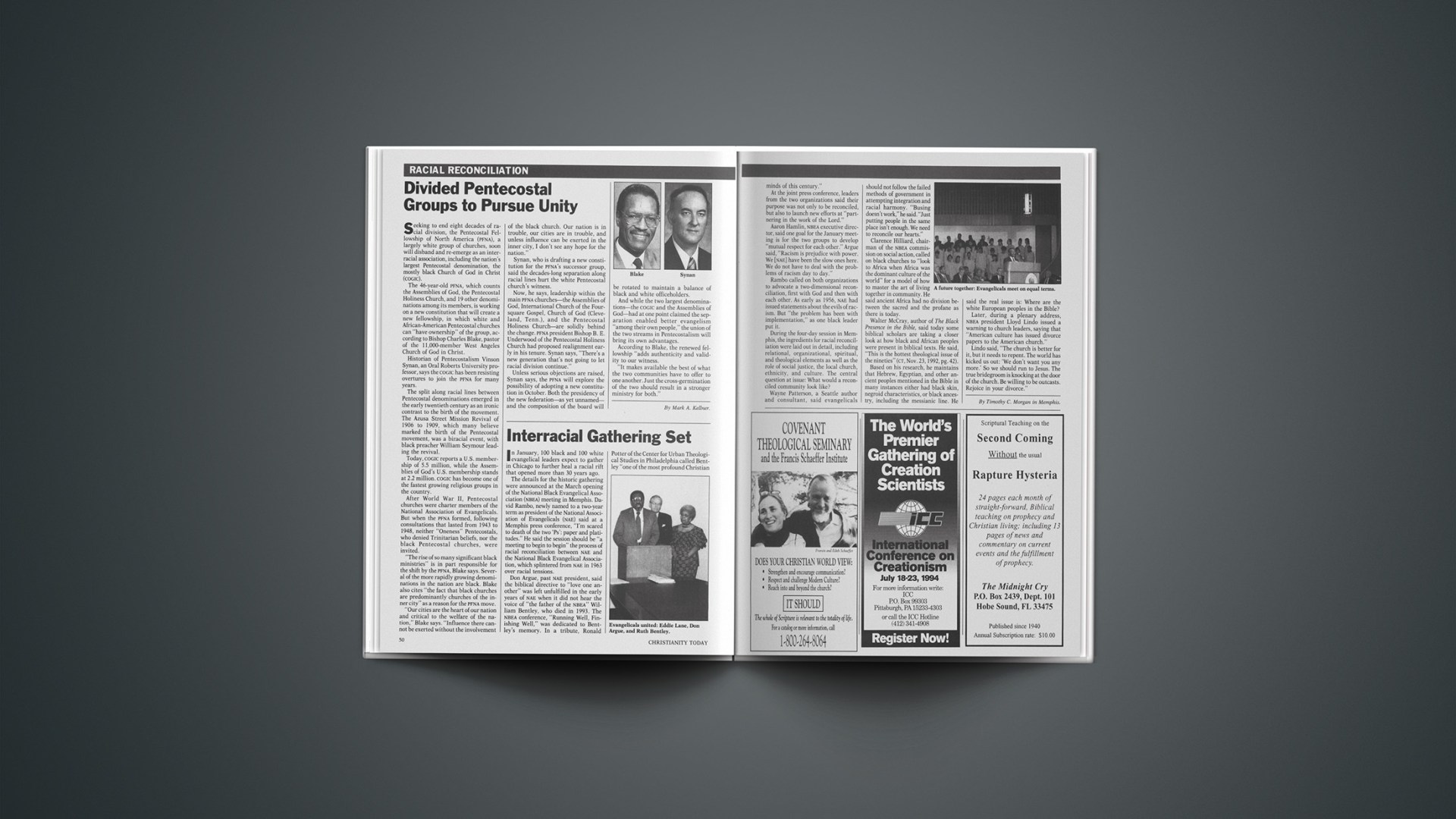

Seeking to end eight decades of racial division, the Pentecostal Fellowship of North America (PFNA), a largely white group of churches, soon will disband and re-emerge as an interracial association, including the nation’s largest Pentecostal denomination, the mostly black Church of God in Christ (COGIC).
The 46-year-old PFNA, which counts the Assemblies of God, the Pentecostal Holiness Church, and 19 other denominations among its members, is working on a new constitution that will create a new fellowship, in which white and African-American Pentecostal churches can “have ownership” of the group, according to Bishop Charles Blake, pastor of the 11,000-member West Angeles Church of God in Christ.
Historian of Pentecostalism Vinson Synan, an Oral Roberts University professor, says the COGIC has been resisting overtures to join the PFNA for many years.
The split along racial lines between Pentecostal denominations emerged in the early twentieth century as an ironic contrast to the birth of the movement. The Azusa Street Mission Revival of 1906 to 1909, which many believe marked the birth of the Pentecostal movement, was a biracial event, with black preacher William Seymour leading the revival.
Today, COGIC reports a U.S. membership of 5.5 million, while the Assemblies of God’s U.S. membership stands at 2.2 million. COGIC has become one of the fastest growing religious groups in the country.
After World War II, Pentecostal churches were charter members of the National Association of Evangelicals. But when the PFNA formed, following consultations that lasted from 1943 to 1948, neither “Oneness” Pentecostals, who denied Trinitarian beliefs, nor the black Pentecostal churches, were invited.
“The rise of so many significant black ministries” is in part responsible for the shift by the PFNA, Blake says. Several of the more rapidly growing denominations in the nation are black. Blake also cites “the fact that black churches are predominantly churches of the inner city” as a reason for the PFNA move.
“Our cities are the heart of our nation and critical to the welfare of the nation,” Blake says. “Influence there cannot be exerted without the involvement of the black church. Our nation is in trouble, our cities are in trouble, and unless influence can be exerted in the inner city, I don’t see any hope for the nation.”
Synan, who is drafting a new constitution for the PFNA’s successor group, said the decades-long separation along racial lines hurt the white Pentecostal church’s witness.
Now, he says, leadership within the main PFNA churches—the Assemblies of God, International Church of the Foursquare Gospel, Church of God (Cleveland, Tenn.), and the Pentecostal Holiness Church—are solidly behind the change. PFNA president Bishop B. E. Underwood of the Pentecostal Holiness Church had proposed realignment early in his tenure. Synan says, “There’s a new generation that’s not going to let racial division continue.”
Unless serious objections are raised, Synan says, the PFNA will explore the possibility of adopting a new constitution in October. Both the presidency of the new federation—as yet unnamed—and the composition of the board will be rotated to maintain a balance of black and white officeholders.
And while the two largest denominations—the COGIC and the Assemblies of God—had at one point claimed the separation enabled better evangelism “among their own people,” the union of the two streams in Pentecostalism will bring its own advantages.
According to Blake, the renewed fellowship “adds authenticity and validity to our witness.
“It makes available the best of what the two communities have to offer to one another. Just the cross-germination of the two should result in a stronger ministry for both.”