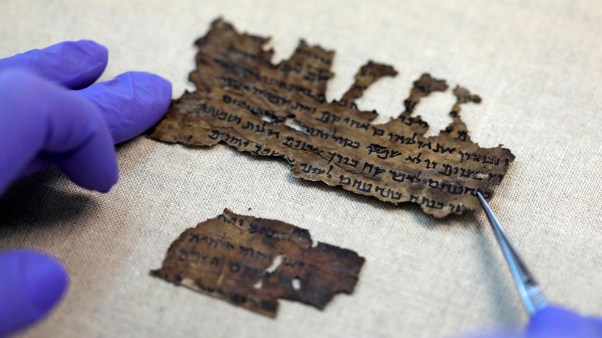
In the late 100s, Bishop Melito of Sardis (in modern Turkey) was pressed by a friend to obtain “an accurate statement of the ancient books as regards their number and their order.” Melito did, and as a result, gave a now-famous list of the Old Testament books. Except for its lack of Esther, this list matches today’s Jewish and Protestant Old Testament.
But how was this Old Testament canon—the recognized, authoritative writings—formed?
Four Stages
According to the legend of 2 Esdras 14:37–47 (written about a.d. 100), God commanded Ezra to drink a potent cup. “Thereupon, my heart poured forth understanding. And the Most High gave understanding to the five men [with me], and by turns they wrote what was dictated, in characters they did not know. … ” After forty days were up, God told Ezra to make these now sacred books public.
On firmer history, however, professors LaSor, Hubbard, and Bush (of Fuller Theological Seminary) distinguish four stages in the development of the Old Testament canon, slightly modified here:
1. Speeches and sayings. God wrote the Ten Commandments in stone (Deut. 5:22). Moses put the Book of the Covenant, including the Ten Commandments (Ex. 20:1 through 23:33), into writing, and the people agreed to obey it (24:3–8). Other books began as speeches or sayings that were recognized by people as authoritative. For example, the oracle preserved in Micah 3:9–12 originally had caused King Hezekiah to repent (Jer. 26:17–19). Most of the books of the Old Testament are anthologies of authoritative utterances.
2. Individual books. The Book of the Covenant became part of the Book of Exodus and immediately was accepted as the Word of God through Moses. Regarding Deuteronomy, Moses commanded, “Take this Book of the Law and place it beside the ark of the covenant. … There it will remain as a witness against you” (Deut. 31:24–26).
This book was later transferred to Solomon’s temple and endured decades of neglect. In 625 b.c., those repairing the temple rediscovered it; after hearing it read, King Josiah and all the people repented (2 Kings 22–23).
Sometimes books were later expanded by new utterances or writing—the obituary of Moses was certainly added to Deuteronomy, for instance.
Because of these additions, some books have come down to us in two forms. There is, for instance, both a short form of Jeremiah, preserved in the Greek translation, the Septuagint, and a long form, preserved in the received Hebrew text. There are also two editions of Ezekiel, Proverbs, and portions of other Old Testament books. (English Bibles, though, follow the Hebrew text.)
3. Collection of books. The five books of Moses—the “Book of the Law”—were probably edited right through the time of Ezra–Nehemiah (ca. 400 b.c.). During the exile (587–539 b.c.), Deuteronomy through 2 Kings (less Ruth) were added.
Daniel 9:2 cites Jeremiah as “in the books,” meaning the collection of sacred writings later called “The Prophets,” not those writings contained in the Law (Genesis through Deuteronomy).
Psalms consists of five books of collected psalms. Books I (Psalms 1–41) and II (42–72) represent an early collection and conclude, “The prayers of David son of Jesse are ended.” During the Exile, Book III (73–89) was added. After the Exile, the last section of the Psalter was added and divided into two books, IV (90–106) and V (107–150)—almost certainly to resemble the five books of Moses.
4. A fixed canon. After the Antiochene persecution (about 164 b.c.), probably Judas Maccabeus and his associates fixed the canonical books into three divisions: the Law, the Prophets, and the Writings. Jesus refers to this division in Luke 24:44.
After the canon was fixed, some rabbis wondered about the canonicity of certain books: Ezekiel, because his temple contradicted the one described in the Pentateuch; Proverbs, because 26:4 and 5 contradict one another; Ecclesiastes, because it seems unorthodox; Song of Solomon and Esther, because they omit the name of God (unless it is concealed in Song 8:6). Still, each found a defender.
This, then, is the canon the Christian church was born with. Jesus and his apostles assumed it.
Today’s Old Testaments
Early church fathers, however, began quoting other Jewish books as canonical. Polycarp, for instance, in about a.d. 135, quotes Tobit as Scripture. This happened because many of the fathers relied on the Greek Septuagint translation of the Old Testament which contained a number of extra books. These extra books continued to be debated through the Middle Ages.
Since the Reformation, Protestants have considered these books “apocrypha,” as having no sacred authority. Roman Catholics call them “deutero-canonical,” meaning they were added to the canon after the other books—officially at the Council of Trent (1546).
In today’s English Bibles, the Old Testament is arranged in four sections: law, history, lyrical books and wisdom books, and the prophets. This standard Christian arrangement goes back, via the Latin Bible, to the Greek Septuagint and was the arrangement used by Melito.
Dr. Bruce Waltke is professor of Old Testament at Regent College in Vancouver, British Colombia. His most recent book is a commentary on Micah (Baker, 1993).
Copyright © 1994 by the author or Christianity Today/Christian History magazine.Click here for reprint information on Christian History.