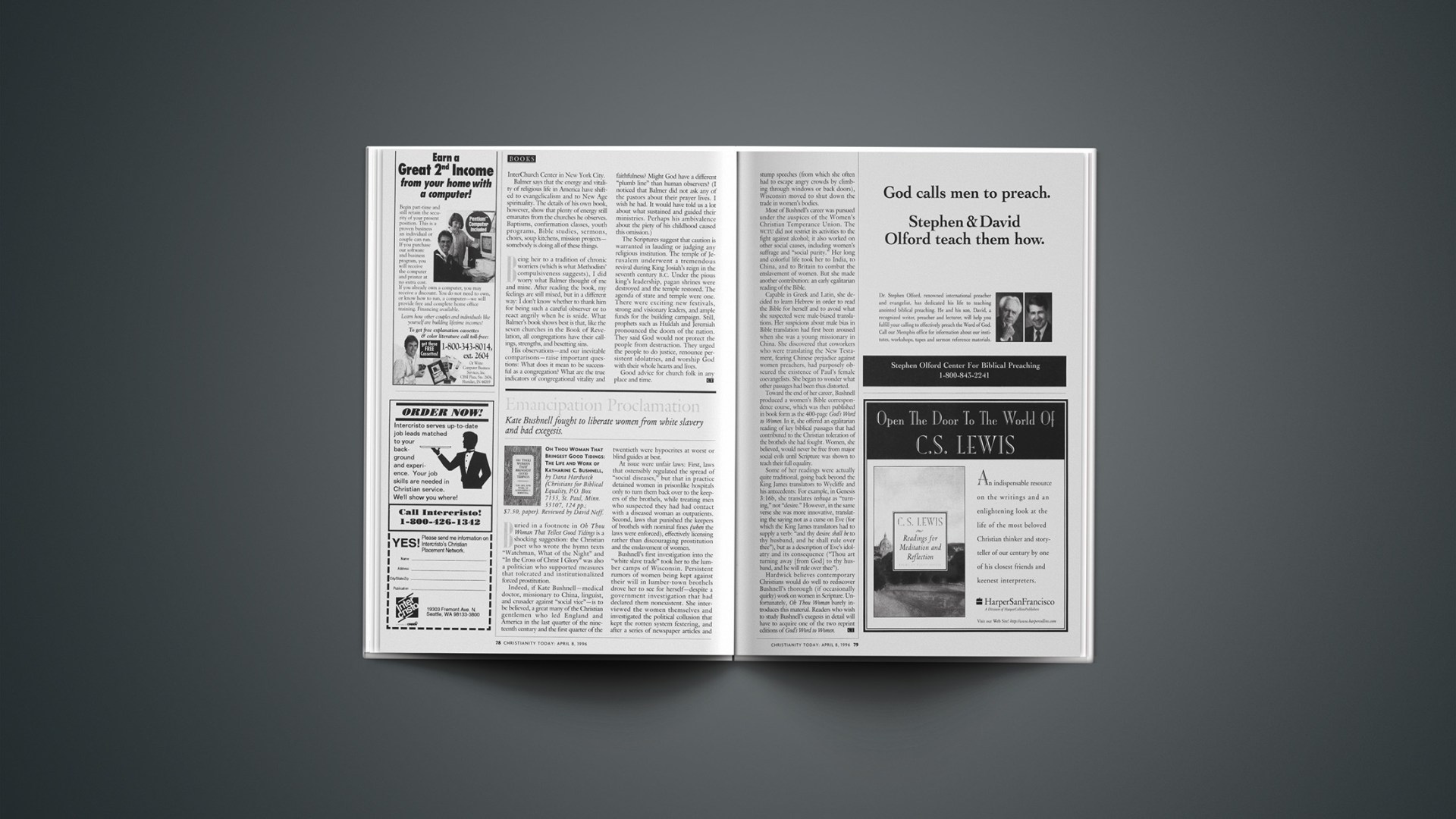

“Oh Thou Woman That Bringest Good Tidings: The Life and Work of Katharine C. Bushnell,” by Dana Hardwick (Christians for Biblical Equality, P.O. Box 7155, St. Paul, Minn. 55107, 124 pp.; $7.50, paper). Reviewed by David Neff.
Buried in a footnote in “Oh Thou Woman That Tellest Good Tidings” is a shocking suggestion: the Christian poet who wrote the hymn texts “Watchman, What of the Night” and “In the Cross of Christ I Glory” was also a politician who supported measures that tolerated and institutionalized forced prostitution.
Indeed, if Kate Bushnell—medical doctor, missionary to China, linguist, and crusader against “social vice”—is to be believed, a great many of the Christian gentlemen who led England and America in the last quarter of the nineteenth century and the first quarter of the twentieth were hypocrites at worst or blind guides at best.
At issue were unfair laws: First, laws that ostensibly regulated the spread of “social diseases,” but that in practice detained women in prisonlike hospitals only to turn them back over to the keepers of the brothels, while treating men who suspected they had had contact with a diseased woman as outpatients. Second, laws that punished the keepers of brothels with nominal fines (when the laws were enforced), effectively licensing rather than discouraging prostitution and the enslavement of women.
Bushnell’s first investigation into the “white slave trade” took her to the lumber camps of Wisconsin. Persistent rumors of women being kept against their will in lumber-town brothels drove her to see for herself—despite a government investigation that had declared them nonexistent. She interviewed the women themselves and investigated the political collusion that kept the rotten system festering, and after a series of newspaper articles and stump speeches (from which she often had to escape angry crowds by climbing through windows or back doors), Wisconsin moved to shut down the trade in women’s bodies.
Most of Bushnell’s career was pursued under the auspices of the Women’s Christian Temperance Union. The WCTU did not restrict its activities to the fight against alcohol; it also worked on other social causes, including women’s suffrage and “social purity.” Her long and colorful life took her to India, to China, and to Britain to combat the enslavement of women. But she made another contribution: an early egalitarian reading of the Bible.
Capable in Greek and Latin, she decided to learn Hebrew in order to read the Bible for herself and to avoid what she suspected were male-biased translations. Her suspicions about male bias in Bible translation had first been aroused when she was a young missionary in China. She discovered that coworkers who were translating the New Testament, fearing Chinese prejudice against women preachers, had purposely obscured the existence of Paul’s female coevangelists. She began to wonder what other passages had been thus distorted.
Toward the end of her career, Bushnell produced a women’s Bible correspondence course, which was then published in book form as the 400-page “God’s Word to Women.” In it, she offered an egalitarian reading of key biblical passages that had contributed to the Christian toleration of the brothels she had fought. Women, she believed, would never be free from major social evils until Scripture was shown to teach their full equality.
Some of her readings were actually quite traditional, going back beyond the King James translators to Wycliffe and his antecedents: For example, in Genesis 3:16b, she translates teshuqa as “turning,” not “desire.” However, in the same verse she was more innovative, translating the saying not as a curse on Eve (for which the King James translators had to supply a verb: “and thy desire shall be to thy husband, and he shall rule over thee”), but as a description of Eve’s idolatry and its consequence (“Thou art turning away [from God] to thy husband, and he will rule over thee”).
Hardwick believes contemporary Christians would do well to rediscover Bushnell’s thorough (if occasionally quirky) work on women in Scripture. Unfortunately, “Oh Thou Woman” barely introduces this material. Readers who wish to study Bushnell’s exegesis in detail will have to acquire one of the two reprint editions of “God’s Word to Women.”
Copyright © 1996 Christianity Today. Click for reprint information.