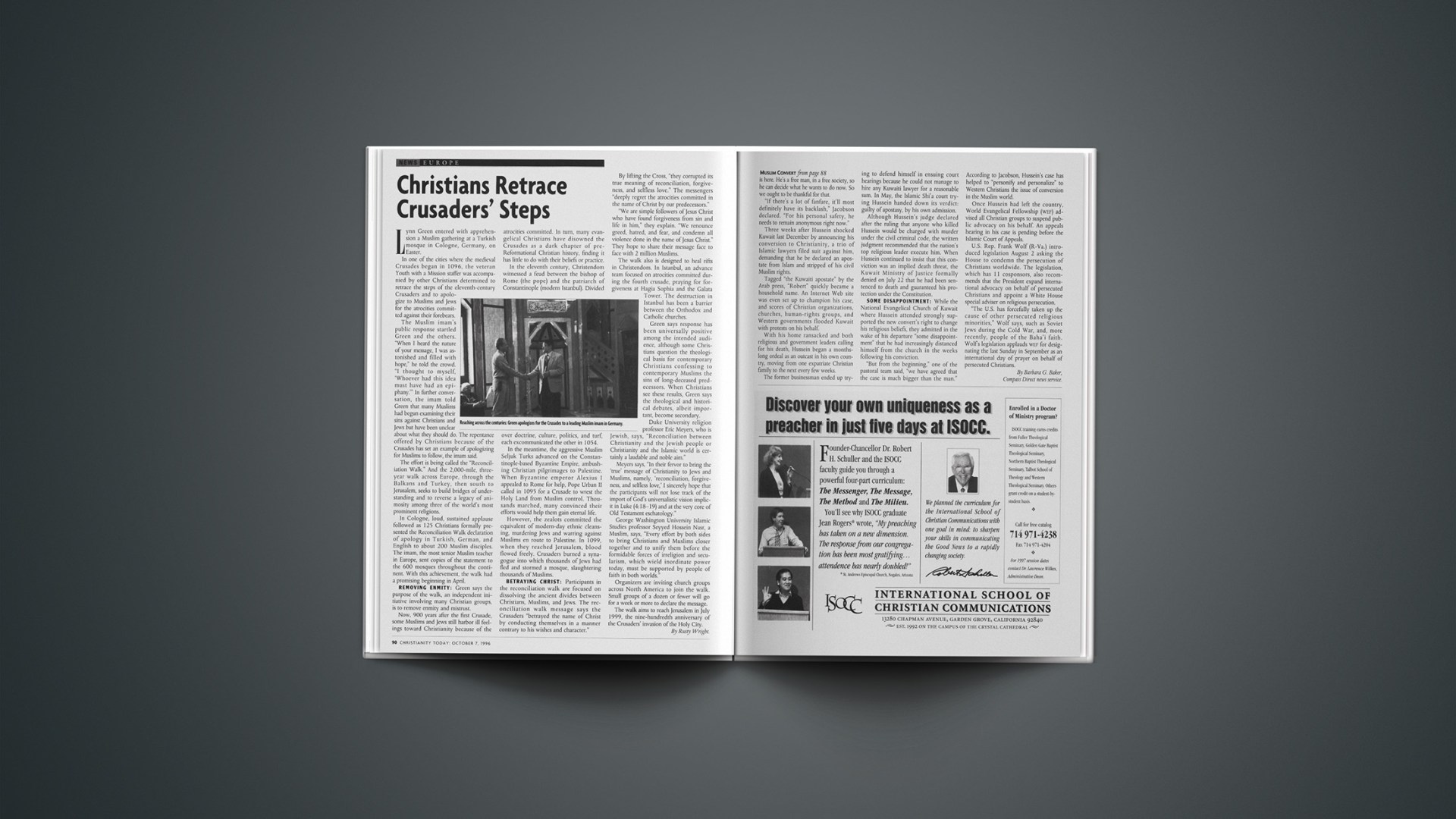

Lynn Green entered with apprehension a Muslim gathering at a Turkish mosque in Cologne, Germany, on Easter.
In one of the cities where the medieval Crusades began in 1096, the veteran Youth with a Mission staffer was accompanied by other Christians determined to retrace the steps of the eleventh-century Crusaders and to apologize to Muslims and Jews for the atrocities committed against their forebears.
The Muslim imam’s public response startled Green and the others. “When I heard the nature of your message, I was astonished and filled with hope,” he told the crowd. “I thought to myself, ‘Whoever had this idea must have had an epiphany.'” In further conversation, the imam told Green that many Muslims had begun examining their sins against Christians and Jews but have been unclear about what they should do. The repentance offered by Christians because of the Crusades has set an example of apologizing for Muslims to follow, the imam said.
The effort is being called the “Reconciliation Walk.” And the 2,000-mile, three-year walk across Europe, through the Balkans and Turkey, then south to Jerusalem, seeks to build bridges of understanding and to reverse a legacy of animosity among three of the world’s most prominent religions.
In Cologne, loud, sustained applause followed as 125 Christians formally presented the Reconciliation Walk declaration of apology in Turkish, German, and English to about 200 Muslim disciples. The imam, the most senior Muslim teacher in Europe, sent copies of the statement to the 600 mosques throughout the continent. With this achievement, the walk had a promising beginning in April.
REMOVING ENMITY: Green says the purpose of the walk, an independent initiative involving many Christian groups, is to remove enmity and mistrust.
Now, 900 years after the first Crusade, some Muslims and Jews still harbor ill feelings toward Christianity because of the atrocities committed. In turn, many evangelical Christians have disowned the Crusades as a dark chapter of pre-Reformational Christian history, finding it has little to do with their beliefs or practice.
In the eleventh century, Christendom witnessed a feud between the bishop of Rome (the pope) and the patriarch of Constantinople (modern Istanbul). Divided over doctrine, culture, politics, and turf, each excommunicated the other in 1054.
In the meantime, the aggressive Muslim Seljuk Turks advanced on the Constantinople-based Byzantine Empire, ambushing Christian pilgrimages to Palestine. When Byzantine emperor Alexius I appealed to Rome for help, Pope Urban II called in 1095 for a Crusade to wrest the Holy Land from Muslim control. Thousands marched, many convinced their efforts would help them gain eternal life.
However, the zealots committed the equivalent of modern-day ethnic cleansing, murdering Jews and warring against Muslims en route to Palestine. In 1099, when they reached Jerusalem, blood flowed freely. Crusaders burned a synagogue into which thousands of Jews had fled and stormed a mosque, slaughtering thousands of Muslims.
BETRAYING CHRIST: Participants in the reconciliation walk are focused on dissolving the ancient divides between Christians, Muslims, and Jews. The reconciliation walk message says the Crusaders “betrayed the name of Christ by conducting themselves in a manner contrary to his wishes and character.”
By lifting the Cross, “they corrupted its true meaning of reconciliation, forgiveness, and selfless love.” The messengers “deeply regret the atrocities committed in the name of Christ by our predecessors.”
“We are simple followers of Jesus Christ who have found forgiveness from sin and life in him,” they explain. “We renounce greed, hatred, and fear, and condemn all violence done in the name of Jesus Christ.” They hope to share their message face to face with 2 million Muslims.
The walk also is designed to heal rifts in Christendom. In Istanbul, an advance team focused on atrocities committed during the fourth crusade, praying for forgiveness at Hagia Sophia and the Galata Tower. The destruction in Istanbul has been a barrier between the Orthodox and Catholic churches.
Green says response has been universally positive among the intended audience, although some Christians question the theological basis for contemporary Christians confessing to contemporary Muslims the sins of long-deceased predecessors. When Christians see these results, Green says the theological and historical debates, albeit important, become secondary.
Duke University religion professor Eric Meyers, who is Jewish, says, “Reconciliation between Christianity and the Jewish people or Christianity and the Islamic world is certainly a laudable and noble aim.”
Meyers says, “In their fervor to bring the ‘true’ message of Christianity to Jews and Muslims, namely, ‘reconciliation, forgiveness, and selfless love,’ I sincerely hope that the participants will not lose track of the import of God’s universalistic vision implicit in Luke (4:18-19) and at the very core of Old Testament eschatology.”
George Washington University Islamic Studies professor Seyyed Hossein Nasr, a Muslim, says, “Every effort by both sides to bring Christians and Muslims closer together and to unify them before the formidable forces of irreligion and secularism, which wield inordinate power today, must be supported by people of faith in both worlds.”
Organizers are inviting church groups across North America to join the walk. Small groups of a dozen or fewer will go for a week or more to declare the message.
The walk aims to reach Jerusalem in July 1999, the nine-hundredth anniversary of the Crusaders’ invasion of the Holy City.
Copyright © 1996 Christianity Today. Click for reprint information.
Last Updated: October 2, 1996